



الصفحة 6
الصفحة 6
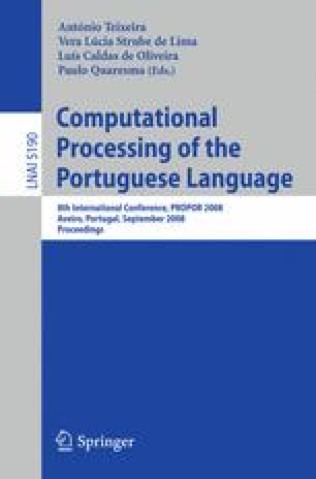
Computational Processing of the Portuguese Language ; 8th International Conference, PROPOR 2008 Aveiro, Portugal, September 8-10, 2008 Proceedings
This book constitutes the thoroughly refereed proceedings of the 8th International Workshop on Computational Processing of the Portuguese Language, PROPOR 2008, held in Aveiro, Portugal, in September 2008.

Computational Processing of the Portuguese Language ; 7th International Workshop, PROPOR 2006, Itatiaia, Brazil, May 13-17, 2006, Proceedings
Since 1993, PROPOR Workshops have become an important forum for - searchers involved in the Computational Processing of Portuguese,both written and spoken. The workshop and this book were structured around the following main t- ics, seven for full papers: (i) automatic summarization; (ii) resources; (iii) au- matic translation; (iv) named entity recognition; (v) tools and frameworks; (vi) systems and models; and another ?ve topics for short papers; (vii) information extraction; (viii) speech processing; (ix) lexicon; (x) morpho-syntactic studies; (xi) web, corpus and evaluation.

Computational methods in systems biology ; Vol. 3082 ; International Conference CMSB 2004, Paris, France, May 26-28, 2004, Revised Selected Papers
present CMBSlib, a library of Computational Models of Biological Systems. It is aimed at providing a list of test problems for formalisms, modeling issues and implementation issues in systems biology. The main motivation for CMBSlib is to stimulate research on the formal modeling of biological systems, by facilitating the exchange of formal models between researchers, and by providing a forum of comparison and validation of not only models, but also modeling formalisms and implementations. Unlike a standardization effort, CMBSlib welcomes the most exotic formalisms and models provided they attack the modeling of well documented biological systems. Models of biological systems written in any referenced formalism can be submitted to CMBSlib. No special format or standard is required. We discuss the advantages of and problems encountered in building such a library, give an example of typical entry in the library, and most of all we invite the community to become active contributors to CMBSlib.

Computational linguistics and intelligent text processing ; Vol. 3878 ; 7th International Conference, CICLing 2006, Mexico City, Mexico, February 19-25, 2006, Proceedings
CICLing 2006 (www.CICLing.org) was the 7th Annual Conference on Intelligent Text Processing and Computational Linguistics. The CICLing conferences are intended to provide a wide-scope forum for discussion of the internal art and craft of natural language processing research and the best practices in its applications.
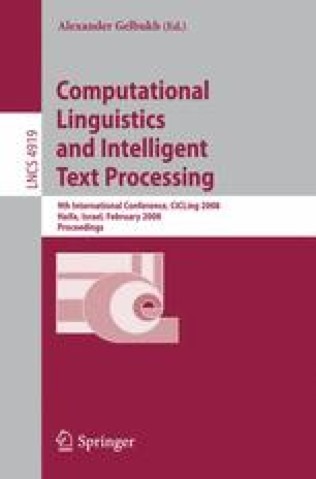
Computational linguistics and intelligent text processing ; 9th International Conference, CICLing 2008, Haifa, Israel, February 17-23, 2008. Proceedings
The CICLing conferences are intended to provide a wide-scope forum for the discussion of both the art and craft of natural language processing research and the best practices in its applications. This volume contains the papers accepted for oral presentation at the c- ference, as well as several of the best papers accepted for poster presentation.
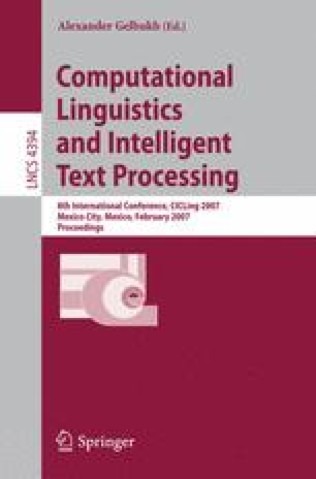
Computational linguistics and intelligent text processing ; 8th International Conference, CICLing 2007, Mexico City, Mexico, February 18-24, 2007, Proceedings
This book cover all current issues in computational linguistics research and present intelligent text processing applications. The papers are organized in topical sections on: lexical resources, corpus-based knowledge acquisition, morphology and part-of-speech tagging, named entity recognition, temporal expression treatment, word segmentation, sentence splitting, chunking, grammar formalisms and syntax, word sense disambiguation and discrimination and semantics.

Computational linguistics and intelligent text processing ; Vol. 3406 ; 6th International Conference, CICLing 2005, Mexico City, Mexico, February 13-19, 2005, Proceedings
This book constitutes the refereed proceedings of the 6th International Conference on Computational Linguistics and Intelligent Text Processing, CICLing 2005, held in Mexico City, Mexico in February 2005. An approach that involves natural language analysis techniques for the treatment of software system functional requirements is described in this book. This approach is used as the basis for a process developed to generate sequence diagrams automatically from the textual specification of use cases. This facility has been integrated in the Requirements Engineering Phase of OO-Method, an automatic production environment of software. For this purpose, a translator that is based on natural language parser is used. The translator provides grammatical information to each use case sentence and it identifies the corresponding interaction. The automatic transformation is conceived and specified following an orientation that is based on models and patterns. The results of the validation of the transformation patterns are presented.

Computational Forensic ; 2nd International Workshop, IWCF 2008, Washington, DC, USA, August 7-8, 2008. Proceedings
This book constitutes the refereed proceedings of the Second International Workshop, IWCF 2008, held in Washington, DC, USA, August 2008. The papers are organized in topical sections on trends and challenges; scanner, printer, and prints; human identification; shoeprints; linguistics;decision making and search; speech analysis; signatures and handwriting.

Computational Collective Intelligence ; 12th International Conference, ICCCI 2020, Da Nang, Vietnam, November 30 – December 3, 2020, Proceedings
This volume constitutes the refereed proceedings of the 12th International Conference on Computational Collective Intelligence, ICCCI 2020, held in Da Nang, Vietnam, in November 2020.* The 70 full papers presented were carefully reviewed and selected from 314 submissions. The papers are grouped in topical sections on: knowledge engineering and semantic web; social networks and recommender systems; collective decision-making; applications of collective intelligence; data mining methods and applications; machine learning methods; deep learning and applications for industry 4.0; computer vision techniques; biosensors and biometric techniques; innovations in intelligent systems; natural language processing; low resource languages processing; computational collective intelligence and natural language processing; computational intelligence for multimedia understanding; and intelligent processing of multimedia in web systems.

Combinatorial pattern matching ; Vol. 3537 ; 16th Annual Symposium, CPM 2005, Jeju Island, Korea, June 19-22, 2005, Proceedings
This volume presents the proceedings of The 16th Annual Symposium on Combinatorial Pattern Matching was heldon Jeju Island, Korea on June 19–22, 2005. the Program Committee accepted 37 of the submissionsto be presented at the conference. This collection of papers offers original research contributionsin combinatorial pattern matching and its applications.In addition to the selected papers
Combinatorial pattern matching ; 19th Annual Symposium, CPM 2008, Pisa, Italy, June 18-20, 2008 Proceedings
This book constitutes the refereed proceedings of the 19th Annual Symposium on Combinatorial Pattern Matching, CPM 2008, held in Pisa, Italy, in June 2008.

Collaboration Technologies and Social Computing ; 26th International Conference, CollabTech 2020, Tartu, Estonia, September 8–11, 2020, Proceedings
This book constitutes the proceedings of the 26th International Conference on Collaboration Technologies and Social Computing, CollabTech 2020. The conference was scheduled to take place in Tartu, Estonia, in September 2020. It was held virtually due to the COVID-19 pandemic. The 10 full and 5 work-in-progress papers presented in this volume were carefully reviewed and selected from 25 submissions.
Cognitive Systems ; Joint Chinese-German Workshop, Shanghai, China, March 7-11, 2005, Revised Selected Papers
This book organized in topical sections on multimodal human-computer interfaces, neuropsychology and neurocomputing, Chinese-German natural language processing and psycholinguistics, as well as information processing and retrieval from the semantic Web for intelligent applications.

Clinical text mining : Secondary use of electronic patient records
Describes the results of natural language processing and machine learning methods applied to clinical text from electronic patient records. It is divided into twelve chapters. Chapters 1-4 discuss the history and background of the original paper-based patient records, their purpose, and how they are written and structured. These initial chapters do not require any technical or medical background knowledge. The remaining eight chapters are more technical in nature and describe various medical classifications and terminologies such as ICD diagnosis codes, SNOMED CT, MeSH, UMLS, and ATC. Chapters 5-10 cover basic tools for natural language processing and information retrieval, and how to apply them to clinical text. The book’s closing chapters present a number of applications in clinical text mining and summarise the lessons learned from the previous chapters.
Mathematical Linguistics
Mathematical Linguistics introduces the mathematical foundations of linguistics to computer scientists, engineers, and mathematicians interested in natural language processing. The book presents linguistics as a cumulative body of knowledge from the ground up, with no prior knowledge of linguistics being assumed, covering more than the average two-semester introductory course in linguistics.This comprehensive, reader-friendly volume offers readers a high-level orientation, discussing the foundations of the field and presenting both the classical work and the most recent results. It covers an extremely rich array of topics including not only syntax and semantics but also phonology and morphology, probabilistic approaches, complexity, learnability, and the analysis of speech and handwriting.
Markov Models for Pattern Recognition : From Theory to Applications
Describes the underlying theoretical concepts - covering Hidden Markov models and Markov chain models - and presents the techniques and algorithmic solutions essential to creating real world applications. The actual use of Markov models in their three main application areas - namely speech recognition, handwriting recognition, and biological sequence analysis - is presented with examples of successful systems.

Machines, Computations, and Universality ; 4th International Conference, MCU 2004, Saint Petersburg, Russia, September 21-24, 2004, Revised Selected Papers
Constitutes the post-proceedings of the 4th International Conference on Machines, Computations, and Universality, MCU 2004, held in St Petersburg, Russia in September 2004. This book covers a variety of foundational aspects in theoretical computer science such as cellular automata, molecular computing, quantum computing, and formal languages

Machine Learning Techniques for Multimedia : Case Studies on Organization and Retrieval
This book provides a comprehensive coverage of the most important machine learning techniques used and their application in this domain. Arising from the EU MUSCLE network, a program that drew together multidisciplinary teams with expertise in machine learning, pattern recognition, artificial intelligence, and image, video, text and crossmedia processing, the book first introduces the machine learning principles and techniques that are applied in multimedia data processing and analysis. The second part focuses on multimedia data processing applications, with chapters examining specific machine learning issues in domains .
Machine Learning Refined : Foundations, Algorithms, and Applications
Provides students with the fundamental knowledge and practical tools needed to conduct research and build data-driven products. The authors prioritize geometric intuition and algorithmic thinking, and include detail on all the essential mathematical prerequisites, to offer a fresh and accessible way to learn. Practical applications are emphasized, with examples from disciplines including computer vision, natural language processing, economics, neuroscience, recommender systems, physics, and biology.

Machine learning refined : Foundations, algorithms, and applications
Providing a unique approach to machine learning, this text contains fresh and intuitive, yet rigorous, descriptions of all fundamental concepts necessary to conduct research, build products, tinker, and play. By prioritizing geometric intuition, algorithmic thinking, and practical real world applications in disciplines including computer vision, natural language processing, economics, neuroscience, recommender systems, physics, and biology, this text provides readers with both a lucid understanding of foundational material as well as the practical tools needed to solve real-world problems. With in-depth Python and MATLAB/OCTAVE-based computational exercises and a complete treatment of cutting edge numerical optimization techniques, this is an essential resource for students and an ideal reference for researchers and practitioners working in machine learning, computer science, electrical engineering, signal processing, and numerical optimization
