



الصفحة 6
الصفحة 6
Machine learning methods for reverse engineering of defective structured surfaces
Pascal Laube presents machine learning approaches for three key problems of reverse engineering of defective structured surfaces: parametrization of curves and surfaces, geometric primitive classification and inpainting of high-resolution textures. The proposed methods aim to improve the reconstruction quality while further automating the process. The contributions demonstrate that machine learning can be a viable part of the CAD reverse engineering pipeline.

Logical approaches to computational barriers ; 2nd Conference on Computability in Europe, CiE 2006, Swansea, UK, June 30-July 5, 2006, Proceedings
The sources of new ideas and methods include practical developments in areas such as neural networks, quantum computation, natural computation, molecular computation, and computational learning. Applications are everywhere, especially, in algebra, analysis and geometry, or data types and programming. This volume, Logical Approaches to Computational Barriers, is the proce- ings of the second in a series of conferences of CiE that was held at the Depa- ment of Computer Science, Swansea University, 30 June - 5 July, 2006.

LATIN 2006 : Theoretical Informatics ; 7th Latin American Symposium, Valdivia, Chile, March 20-24, 2006, Proceedings
This book constitutes the refereed proceedings of the 7th International Symposium, Latin American Theoretical Informatics, LATIN 2006, held in March 2006. The 66 revised full papers presented together with seven invited papers were carefully reviewed and selected from 224 submissions. The papers presented are devoted to a broad range of topics in theoretical computer science with a focus on algorithmics and computations related to discrete mathematics as well as on cryptography, data compression and Web applications.

Laser additive manufacturing: design, materials, processes and applications
Laser-based additive manufacturing (LAM) is a revolutionary advanced digital manufacturing technology developed in recent decades, which is also a key strategic technology for technological innovation and industrial sustainability. This technology unlocks the design and constraints of traditional manufacturing and meets the needs of complex geometry fabrication and high-performance part fabrication. A deeper understanding of the design, materials, processes, structures, properties and applications is desired to produce novel functional devices, as well as defect-free structurally sound and reliable LAM parts.The topics in this Special Issue reprint include macro- and micro-scale additive manufacturing with lasers, such as structure/material design, fabrication, modeling and simulation, in situ characterization of additive manufacturing processes and ex situ materials characterization and performance, with an overview that covers various applications in aerospace, biomedicine, optics and energy.
Iterated Function Systems for Real-Time Image Synthesis
Natural phenomena can be visually described with fractal-geometry methods, where iterative procedures rather than equations are used to model objects. With the development of better modelling algorithms, the efficiency of rendering, the realism of computer-generated scenes and the interactivity of visual stimuli are reaching astonishing levels. Iterated Function Systems for Real-Time Image Synthesis gives an explanation of iterated function systems and how to use them in generation of complex objects.
Comprehensive mathematics for computer scientists 2 : Calculus and ODEs, splines, probability, fourier and wavelet theory, fractals and neural networks, categories and lambda calculus
This second volume of a comprehensive tour through mathematical core subjects for computer scientists completes the first volume in two - gards: Part III first adds topology, di?erential, and integral calculus to the t- ics of sets, graphs, algebra, formal logic, machines, and linear geometry, of volume 1. With this spectrum of fundamentals in mathematical e- cation, young professionals should be able to successfully attack more involved subjects, which may be relevant to the computational sciences. In a second regard, the end of part III and part IV add a selection of more advanced topics. In view of the overwhelming variety of mathematical approaches in the computational sciences, any selection, even the most empirical, requires a methodological justi?cation. Our primary criterion has been the search for harmonization and optimization of thematic - versity and logical coherence. This is why we have, for instance, bundled such seemingly distant subjects as recursive constructions, ordinary d- ferential equations, and fractals under the unifying perspective of c- traction theory.

Comprehensive mathematics for computer scientists 1 : Sets and numbers, graphs and algebra, logic and machines, linear geometry
This two-volume textbook Comprehensive Mathematics for Computer Scientists is a self-contained comprehensive presentation of mathematics including sets, numbers, graphs, algebra, logic, grammars, machines, linear geometry, calculus, ODEs, and special themes such as neural networks, Fourier theory, wavelets, numerical issues, statistics, categories, and manifolds. The concept framework is streamlined but defining and proving virtually everything.
Complex Analysis with Applications to Number Theory
The book discusses major topics in complex analysis with applications to number theory.It 's including the theory of several finitely and infinitely complex variables, hyperbolic geometry, two- and three-manifolds, and number theory. In addition to solved examples and problems, the book covers most topics of current interest, such as Cauchy theorems, Picard’s theorems, Riemann–Zeta function, Dirichlet theorem, Gamma function, and harmonic functions.
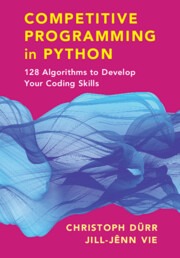
Competitive Programming in Python : 128 Algorithms to Develop your Coding Skills
Learn all the algorithmic techniques and programming skills you need from two experienced coaches, problem setters, and jurors for coding competitions. The authors highlight the versatility of each algorithm by considering a variety of problems and show how to implement algorithms in simple and efficient code. What to expect: * Master 128 algorithms in Python. * Discover the right way to tackle a problem and quickly implement a solution of low complexity.
Bilinear integrable systems : From classical to quantum, continuous to discrete ; Proceedings of the NATO Advanced Research Workshop on Bilinear Integrable Systems: From Classical to Quantum, Continuous to Discrete St. Petersburg, Russia, 15-19 September 2002
Trained as a physicistin his home university Kyushu University, Professor Hirota earned his PhD in’61 at Northwestern University with Professor Siegert in the field of “QuantumStatistical mechanics”. He wrote a widely appreciated Doctoral dissertation on“Functional Integral representation of the grand partition function”. As a youngresearcher, he entered the RCA Company in Tokyo to do research on semi-conductor plasmas. Professor Hirota was led to model the Toda lattice as a non-linear networkof ladder-type LC circuits. The self-dual case led to equations very reminiscentof the Sine-Gordon equation, with much the same features (existence of onesoliton, soliton-soliton interaction, etc)
Basic Notions of Algebra
Aims to present a general survey of algebra, of its basic notions and main branches.Those parts of the book devoted to the systematic treatment of notions and results of algebra make very limited demands on the reader: we presuppose only that the reader knows calculus, analytic geometry and linear algebra in the form taught in many high schools and colleges. The extent of the prerequisites required in our treatment of examples is harder to state; an acquaintance with projective space, topological spaces, differentiable and complex analytic manifolds and the basic theory of functions of a complex variable is desirable, but the reader should bear in mind that difficulties arising in the treatment of some specific example are likely to be purely local in nature, and not to affect the understanding of the rest of the book.
Basic Algebra
Basic Algebra and Advanced Algebra systematically develop concepts and tools in algebra that are vital to every mathematician, whether pure or applied, aspiring or established. Together, the two books give the reader a global view of algebra and its role in mathematics as a whole.Basic Algebra presents the subject matter in a forward-looking way that takes into account its historical development. It is suitable as a text in a two-semester advanced undergraduate or first-year graduate sequence in algebra, possibly supplemented by some material from Advanced Algebra at the graduate level. It requires of the reader only familiarity with matrix algebra, an understanding of the geometry and reduction of linear equations, and an acquaintance with proofs.

Autonomic and Trusted Computing ; 5th International Conference, ATC 2008, Oslo, Norway, June 23-25, 2008 Proceedings
This book constitutes the refereed procedings of the 5th International Conference on Autonomic and Trusted Computing, ATC 2008, held in Oslo, Norway, in June 2008, co-located with UIC 2008, the 5th International Conference on Ubiquitous Intelligence and Computing.

Automated deduction in Geometry ; 6th International Workshop, ADG 2006, Pontevedra, Spain, August 31-September 2, 2006, Revised Papers
The book show the lively variety of topics and methods and the current applicability of automated deduction in geometry to different branches of mathematics and to other sciences and technologies.
Automated deduction in Geometry ; 5th International Workshop, ADG 2004, Gainesville, FL, USA, September 16-18, 2004, Revised Papers
This book constitutes the thoroughly refereed post-proceedings of the 6th International Workshop on Automated Deduction in Geometry, ADG 2006, held at Pontevedra, Spain, in August/September 2006 as a satellite event of the International Congress of Mathematicians, ICM 2006. The 13 revised full papers presented were carefully selected from the submissions made due to a call for papers - within the scope of ADG - shortly after the meeting. The papers show the lively variety of topics and methods and the current applicability of automated deduction in geometry to different branches of mathematics and to other sciences and technologies.

Articulated Motion and Doformable Objects ; 4th International Conference, AMDO 2006, Port d'Andratx, Mallorca, Spain, July 11-14, 2006, Proceedings
The subject of the conference was ongoing research in articulated motionon a sequence of images and sophisticated models for deformable objects. Thegoals of these areas are to understand and interpret the motion of complexobjects that can be found in sequences of images in the real world. The maintopics considered as priority were: geometric and physical deformable models,motion analysis, articulated models and animation, modelling and visualizationof deformable models, deformable models applications, motion analysis applica-tions, single or multiple human motion analysis and synthesis, face modelling,tracking, recovering and recognition models, virtual and augmentedreality, haptics devices, biometrics techniques.

Arithmetic of finite fields ; 1st International Workshop, WAIFI 2007, Madrid, Spain, June 21-22, 2007, Proceedings
This book presented structures in finite fields, efficient implementation and architectures, efficient finite field arithmetic, classification and construction of mappings over finite fields, curve algebra, cryptography, codes, and discrete structures.

Arakelov Geometry and Diophantine Applications
Bridging the gap between novice and expert, the aim of this book is to present in a self-contained way a number of striking examples of current diophantine problems to which Arakelov geometry has been or may be applied. Arakelov geometry can be seen as a link between algebraic geometry and diophantine geometry.The first chapters provide some background and introduction to the subject. These are followed by a presentation of different applications to arithmetic geometry. The final part describes the recent application of Arakelov geometry to Shimura varieties and the proof of an averaged version of Colmez's conjecture. This book thus blends initiation to fundamental tools of Arakelov geometry with original material corresponding to current research.

Approximation, randomization and combinatorial optimization. algorithms and techniques ; 11th International Workshop, APPROX 2008, and 12th International Workshop, RANDOM 2008, Boston, MA, USA, August 25-27, 2008. Proceedings
This book constitutes the joint refereed proceedings of the 11th International Workshop on Approximation Algorithms for Combinatorial Optimization Problems, APPROX 2008.

Approximation and Online Algorithms ; Vol.3879 : 3rd International Workshop, WAOA 2005, Palma de Mallorca, Spain, October 6-7, 2005, Revised Selected Papers
The third Workshop on Approximation and Online Algorithms (WAOA 2005) focused on the design and analysis of algorithms for online and computationally hard problems. Both kinds of problems have a large number of applications from a variety of ?elds. WAOA 2005 took place in Palma de Mallorca, Spain, on 6–7 October 2005. The workshop was part of the ALGO 2005 event that also hosted ESA, WABI, and ATMOS. The two previous WAOA workshops were held in Budapest (2003) and Rome (2004).
