



الصفحة 59
الصفحة 59

Deep Learning and its Applications
Presents an introduction to deep learning and various applications of deep learning such as recommendation systems, text recognition, diabetic retinopathy prediction of breast cancer, prediction of epilepsy, sentiment, fake news detection, software defect prediction and protein function prediction.

Deep learning and computer vision in remote sensing-II
Computer vision (CV) have seen a massive rise in popularity in the remote sensing field over the last few years. This success is mostly due to the effectiveness of deep learning (DL) algorithms. However, remote sensing data acquisition and annotation, as well as information extraction from massive remote sensing data, are still challenging. This reprint collected novel developments in the field of deep learning and computer vision methods for remote sensing. Papers dealing with fundamental theoretical analyses, as well as those demonstrating their application to real-world problems, have been published. With practical examples and real-world case studies, this reprint provides a valuable resource for researchers, professionals, and students seeking to harness the power of deep learning in the field of remote sensing.

Deep learning and computer vision in remote sensing-I
In the last few years, huge amounts of progress have been made regarding remote sensing in the field of computer vision. This success and progress is mostly due to the effectiveness of deep learning (DL) algorithms. In addition, the remote sensing community has shifted its attention to DL, and DL algorithms have been used to achieve significant success in many image analysis tasks. However, with regard to remote sensing, a number of challenges caused by difficulties in data acquisition and annotation have not been fully solved yet. This reprint is a collection of novel developments in the field of remote sensing using computer vision, deep learning, and artificial intelligence. The articles published involve fundamental theoretical analyses as well as those demonstrating their application to real-world problems.

Deep fake detection
Deep learning has been successfully applied to solve various complex problems ranging from big data analytics to computer vision and human-level control. Deep learning advances however have also been employed to create software that can cause threats to privacy, democracy and national security. One of those deep learning-powered applications recently emerged is “deepfake”. Deepfake algorithms can create fake images and videos that humans cannot distinguish them from authentic ones. The proposal of technologies that can automatically detect and assess the integrity of digital visual media is therefore indispensable.

Decrypted Secrets : Methods and Maxims of Cryptology
Cryptology, for millennia a "secret science", is rapidly gaining in practical importance for the protection of communication channels, databases, and software. Beside its role in computerized information systems (public key systems), more and more applications within computer systems and networks are appearing, which also extend to access rights and source file protection. The first part of this book treats secret codes and their uses - cryptography. The second part deals with the process of covertly decrypting a secret code - cryptanaly-sis - where in particular advice on assessing methods is given. The book presupposes only elementary mathematical knowledge.

Decoding the city urbanism in the Age of Big Data
Shows how Big Data change reality and, hence, the way we deal with the city. They demonstrate how the Lab interprets digital data as material that can be used for the formulation of a different urban future. The publication also looks at the negative aspects of the city-related data acquisition and control.

Declarative programming for knowledge management ; 16th International conference on applications of declarative programming and knowledge management, INAP 2005, Fukuoka, Japan, October 22-24, 2005. Revised Selected Papers
Presents a selection of papers presented at the 16th Inter- tional Conference on Applications of Declarative Programming and Knowledge Management, INAP 2005,held in October 2005 at Waseda University, Fukuoka, Japan. These papers re?ect a snapshot of ongoing research and current app- cations in knowledge management and declarative programming.

Declarative agent languages and technologiesV ; 5th International Workshop, DALT 2007, Honolulu, HI, USA, May 14, 2007, Revised Selected and Invited Papers
This book constitutes the thoroughly refereed post-workshop proceedings of the 5th International Workshop on Declarative Agent Languages and Technologies, DALT 2007, held in Honolulu, USA, in 2007.

Declarative agent languages and technologies IV ; 4th International Workshop, DALT 2006, Hakodate, Japan, May 8, 2006, Selected, Revised and Invited Papers
Constitutes the thoroughly refereed post-proceedings of the 4th International Workshop on Declarative Agent Languages and Technologies, DALT 2006, held in Japan in May 2006. This was an associated event of AAMAS 2006, the main international conference on autonomous agents and multi-agent systems. The 12 revised full papers presented together with one invited talk and three invited papers were carefully selected for inclusion in the book.

Declarative agent languages and technologies III ; 3rd International Workshop, DALT 2005, Utrecht, The Netherlands, July 25, 2005, Selected and Revised Papers
The workshop on Declarative Agent Languages and Technologies is a we- established venue for researchers interested in sharing their experiences in the areas of declarative and formal aspects of agents and multi-agent systems, and in engineering and technology. Today it is still a challenge to develop techno- gies that can satisfy the requirements of complex agent systems. The design and development of multi-agent systems still calls for models and technologies that ensure predictability, enable feature discovery, allow for the veri?cation of properties, and guarantee ?exibility. Declarative approaches are potentially a valuable means for satisfying the needs of multi-agent system developers and for specifying multi-agent systems.

Declarative agent languages and technologies II ; 2nd international workshop, DALT 2004, New York, NY, USA, July 19, 2004, revised selected papers
Nearly 40 research groups worldwide were motivated to contribute to this event by submitting their most recent research achievements, covering a wide variety of the topics listed in the call for papers. More than 30 top researchers agreed to join the Program Committee, which then collectively faced the hard task of selecting the one-day event program. The fact that research in multi-agent systems is no longer only a novel and promising research horizon at dawn is, in our opinion, the main reason behind DALT’s (still short) success story. On the one hand, agent theories and app- cations are mature enough to model complex domains and scenarios, and to successfully address a wide range of multifaceted problems, thus creating the urge to make the best use of this expressive and versatile paradigm, and also pro?t from all the important results achieved so far. On the other hand, bui- ing multi-agent systems still calls for models and technologies that could ensure system predictability, accommodate ?exibility, heterogeneity and openness, and enable system veri?cation.

Decision Support for Global Enterprises
Decision Support for Global Enterprises consists of peer-reviewed and invited papers with two primary goals: (1) Stimulate creative discussion between academic researchers and the practitioner IS community to improve the research and practice in the area. (2) Increase awareness of the problems and challenges faced by global enterprises that can be met with innovative decision support systems. Limitations are also explored, covering the following topics: the emerging enterprise decision making processes and technologies; decision making in uncertain, changing conditions; the changing infrastructure in organizations and society; the expanding role of web technologies; and emerging theories and practices for managing knowledge and making decisions.

Decision Procedures : An Algorithmic Point of View
Concentrates on decision procedures for first-order theories that are commonly used in automated verification and reasoning, theorem-proving, compiler optimization and operations research.

Datatype-Generic Programming ; International Spring School, SSDGP 2006, Nottingham, UK, April 24-27, 2006, Revised Lectures
A leitmotif in the evolution of programming paradigms has been the level and extent of parametrisation that is facilitated — the so-called genericity of the paradigm. The sorts of parameters that can be envisaged in a programming language range from simple values, like integers and fioating-point numbers, through structured values, types and classes, to kinds (the type of types and/or classes).Datatype-generic programming is about parametrising programsby the structure of the data that they manipulate. To appreciate the importance of data type genericity,one need look no further than the internet. The internet is a massive repository of structured data, but the structure is rarely exploited. For example, compression of data can be much more efiective if its structure is known, but most compression algorithms regard the input data as simply a string of bits, and take no account of its internal organisation. Datatype-generic programming is about exploiting the structure of data when it is relevant and ignoring it when it is not. Programming languages most c- monly used at the present time do not provide efiective mechanisms for do- menting and implementing datatype genericity.

Dataset Studio
Data is the new oil, which means that AI engineers can face difficulties in locating suitable datasets. Dataset Studio is a comprehensive platform designed to support AI engineers in the creation and optimization of datasets. This project offers a diverse range of services that encompass data collection, data augmentation, and data classification. As a result, this software empowers engineers by automatically generating structured data through the utilization of advanced tools and AI techniques. By automating the laborious tasks of manual data collection and extraction, Dataset Studio effectively streamlines the workflow for AI engineers, enabling them to save valuable time and focus on the more intricate aspects of dataset development and refinement.

Data-Driven Fault Detection and Reasoning for Industrial Monitoring
Assesses the potential of data-driven methods in industrial process monitoring engineering. The process modeling, fault detection, classification, isolation, and reasoning are studied in detail. These methods can be used to improve the safety and reliability of industrial processes. Fault diagnosis, including fault detection and reasoning, has attracted engineers and scientists from various fields such as control, machinery, mathematics, and automation engineering. Combining the diagnosis algorithms and application cases, this book establishes a basic framework for this topic and implements various statistical analysis methods for process monitoring.

Databases in networked information systems; 4th international workshop, DNIS 2005, Aizu-Wakamatsu, Japan, March 28-30, 2005, Proceedings
This book constitutes the refereed proceedings of the 4th International Workshop on Databases in Networked Information Systems, DNIS 2005, held in Aizu-Wakamatsu, Japan in March 2005. The 17 revised full papers presented together with 8 invited papers were carefully reviewed and selected for inclusion in the book. The papers are organized in topical sections on information interchange and management systems, Web data management systems, networked information systems applications, and networked information systems implementations.

Databases in Networked Information Systems ; 5th International Workshop, DNIS 2007, Aizu-Wakamatsu, Japan, October 17-19, 2007, Proceedings
This book Is focusing on data semantics and infrastructure for information management and interchange, the papers are organized in topical sections on geospatial decision-making, Web data management systems, infrastructure of networked information systems, and Web query and web mining systems.

Database theory - ICDT 2005 ; 10th international conference, Edinburgh, UK, January 5-7, 2005, Proceedings
This volume collects the papers presented at the 10th International Conference on Database Theory, ICDT 2005, held during January 5–7, 2005, in Edinburgh, UK. ICDT (http://alpha.luc.ac.be/~lucp1080/icdt/) has now a long tra- tion of international conferences, providing a biennial scienti?c forum for the communication of high-quality and innovative research results on theoretical - pects of all forms of database systems and database technology. The conference usually takes place in Europe, and has been held in Rome (1986), Bruges (1988), Paris (1990), Berlin (1992), Prague (1995), Delphi (1997), Jerusalem (1999), London (2001), and Siena (2003) so far. ICDT has merged with the Sym- sium on Mathematical Fundamentals of Database Systems (MFDBS), initiated in Dresden in 1987, and continued in Visegrad in 1989 and Rostock in 1991. ICDT had a two-stage submission process. First, 103 abstracts were subm- ted, which were followed a week later by 84 paper submissions. From these 84 submissions, the ICDT Program Committee selected 24 papers for presentation at the conference. Most of these papers were “extended abstracts” and preli- nary reports on work in progress. It is anticipated that most of these papers will appear in a more polished form in scienti?c journals.
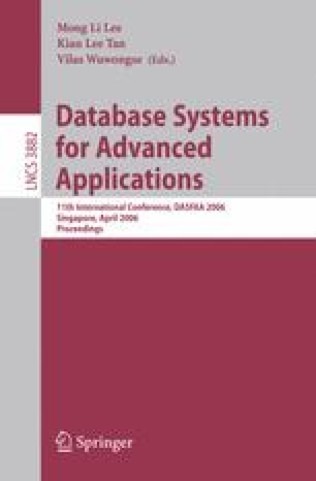
Database Systems for Advanced Applications ; Vol. 3882 ; 11th International Conference, DASFAA 2006, Singapore, April 12-15, 2006, Proceedings
This book constitutes the refereed proceedings of the 11th International Conference on Database Systems for Advanced Applications, DASFAA 2006, held in Singapore in April 2006.
