



الصفحة 58
الصفحة 58

Dependable computing ; 3rd Latin-American Symposium, LADC 2007, Morelia, Mexico, September 26-28, 2007, Proceedings
This book presented fault-tolerant algorithms, software engineering of dependable systems, networking and mobile computing, experimental dependability evaluation, as well as intrusion tolerance and security.

Dependable computing ; 2nd Latin-American symposium, LADC 2005, Salvador, Brazil, October 25-28, 2005 : proceedings
Contains the proceedings of the 'Second Latin-American Symposium' on Dependable Computing, LADC 2005. This book comprises 16 papers presented together with 3 invited talks. The papers are organized in topical sections on evaluation, certification, modelling, embedded systems, time, and distributed systems algorithms.

Dependable computing - EDCC 2005 ; 5th European dependable computing Conference, Budapest, Hungary, April 20-22, 2005, Proceedings
It is always a special honor to chair the European Dependable Computing C- ference (EDCC). EDCC has become one of the well-established conferences in the ?eld of dependability in the European research area. Budapest was selected as the host of this conference due to its traditions in organizing international scienti?c events and its traditional role of serving as a meeting point between East and West. EDCC-5 was the ?fth in the series of these high-quality scienti?c conf- ences. In addition to the overall signi?cance of such a pan-European event, this year’s conference was a special one due to historic reasons. The roots of EDCC date back to the moment when the Iron Curtain fell. Originally, two groups of scientists from di?erent European countries in Western and Eastern Europe – who were active in research and education related to dependability created a – joint forum in order to merge their communities as early as in 1989. This trend has continued up to today. This year’s conference was the ?rst one where the overwhelming majority of the research groups belong to the family of European nations united in the European Union. During the past 16 years we observed that the same roots in all the professional, cultural and scienti?c senses led to a seamless integration of these research communities previously separated ar- ?cially for a long time. EDCC has become one of the main European platforms to exchange new - searchideasinthe?eldofdependability.

Dependable and adaptable networks and services ; 13th Open European Summer School and IFIP TC6.6 Workshop, EUNICE 2007, Enschede, The Netherlands, July 18-20, 2007, Proceedings
Innovative Internet Applications.’ Much has changed since then: wireless network technologies have become a constantly growing part of the Internet infrastructure, and increasingly smaller and more powerful computing devices with ?exible connectivity open the possibility of new services and applications.

Deontic Logic in Computer Science ; 9th International Conference, DEON 2008, Luxembourg, Luxembourg, July 15-18, 2008. Proceedings
This volume presents the refereed proceedings of the 9th International Conference on Deontic Logic in Computer Science, DEON 2008, held in Luxembourg in July 2008.

Deontic Logic and Artificial Normative Systems ; 8th International Workshop on Deontic Logic in Computer Science, DEON 2006, Utrecht, The Netherlands, July 12-14, 2006, Proceedings
This volume presents the papers contributed to DEON 2006, the 8th Inter- tional Workshop on Deontic Logic in Computer Science, held in Utrecht, The Netherlands, July 12–14, 2006. These biennial DEON (more properly, ?EON) workshops are designed to promote international cooperation among scholars across disciplines who are interested in deontic logic and its use in computer science.

Demystifying Internet of Things Security : Successful IoT Device/Edge and Platform Security Deployment
The IoT presents unique challenges in implementing security and Intel has both CPU and Isolated Security Engine capabilities to simplify it. This book explores the challenges to secure these devices to make them immune to different threats originating from within and outside the network. The requirements and robustness rules to protect the assets vary greatly and there is no single blanket solution approach to implement security.

Defence Industry Applications of Autonomous Agents and Multi-Agent Systems
In this book defense and security related applications are increasingly being tackled by researchers and practioners using technologies developed in the field of Intelligent Agent research.

Defence Applications of Multi-Agent Systems; International Workshop, DAMAS 2005, Utrecht, The Netherlands, July 25, 2005, Revised and Invited Papers
This book constitutes the thoroughly refereed post-proceedings of the International Workshop on Defence Applications of Multi-Agent Systems, DAMAS 2005, held in Utrecht, The Netherlands in July 2005 as an associated event of AAMAS 2005, the main international conference on autonomous agents and multi-agent systems. The 10 revised full papers presented together with 1 invited article are organized in topical sections on decision support and simulation, unmanned aerial vehicles, as well as on systems and security.

Deepfake detection = اكتشاف التزييف العميق
In the rapidly evolving era of artificial intelligence, addressing the escalating threats of deepfake technology becomes a necessity because of the increasing sophistication of AI algorithms in generating deceptive content, and since it threatens the integrity of information across diverse data. The main objective is to build a sophisticated AI-driven system to detect different types of deepfake in text, audio, and images. In English text deepfake detection, multiple pre-trained tokenizers have been used, but XLNET and BERT stand out with identifying objects outside the dataset with an accuracy of 0.9809 and both have been generalized & trained using LSTM. In Arabic text deepfake detection, Arabert has been trained using LSTM which led with an accuracy of 99.53% by generalizing the model. Both English and Arabic datasets have been generated to enhance the accuracy and effectiveness of the models. Audio deepfake detection has been generalized too, using Random Forest with an accuracy of 98.259%.

Deepfake detection
Recently, various techniques of manipulating the video content have become available to everyone – online, one can find free applications e.g., for face swapping in videos. Such universal accessibility carries a notable risk of flooding online content with false information, affecting not only the greats of this world, but also the whole societies, also the rapid progress in synthetic image generation and manipulation has now come to a point where it raises significant concerns for the implications towards society. It is therefore necessary to develop a verification tool that will help assess the authenticity of the videos posted on the internet. This project describes the approach of using artificial intelligence solutions to detect doctored videos.

Deepfake detection
The rise of large language models (LLMs) and the increasing sophistication of deepfake images have made detecting synthetic content a pressing challenge. Several approaches have been proposed to tackle this problem, including statistical analysis, and machine learning algorithms. In this project, A novel zero-shot approach is proposed that utilizes the power of LLMs to detect fake text. The pre-trained LLM is fine-tuned to enhance its ability to differentiate real and fake text. The approach uses the LLM to detect text by analyzing the log probabilities of the text. For detecting fake images, computer vision algorithms and neural networks are used to analyze facial features. The facial region is cropped and preprocessed and the neural network identifies patterns indicative of synthetic content.

Deepfake
The technology used to create such digital content has quickly become accessible to the masses, such as “DEEPFAKE.” Deep fakes refer to manipulated videos, or other digital representations produced by sophisticated artificial intelligence, that yields to synthesize a sequence of face images and voices of characters corresponding to their identities, such as voice tone, facial expression, with a good lip synchronization. Therefore, this study is about developing real-time video generation software, which generates a target video from a single input image. Several methods and algorithms have been applied to detect, analyze personalize facial expression, voice and natural head poses to present a life-like image instead of a low quality one.
Deep neural networks and data for automated driving : robustness, uncertainty quantification, and insights towards safety
Environment perception for highly automated driving heavily employs deep neural networks, facing many challenges. How much data do we need for training and testing? How to use synthetic data to save labeling costs for training? How do we increase robustness and decrease memory usage? For inevitably poor conditions: How do we know that the network is uncertain about its decisions? Can we understand a bit more about what actually happens inside neural networks? This leads to a very practical problem particularly for DNNs employed in automated driving: What are useful validation techniques and how about safety? This book unites the views from both academia and industry, where computer vision and machine learning meet environment perception for highly automated driving. Naturally, aspects of data, robustness, uncertainty quantification, and, last but not least, safety are at the core of it. This book is unique: In its first part, an extended survey of all the relevant aspects is provided. The second part contains the detailed technical elaboration of the various questions mentioned above.

Deep Learning, Machine Learning and IoT in Biomedical and Health Informatics : Techniques and Applications
Examines and demonstrates state-of-the-art approaches for IoT and Machine Learning based biomedical and health related applications. This book aims to provide computational methods for accumulating, updating and changing knowledge in intelligent systems and particularly learning mechanisms that help us to induce knowledge from the data. It is helpful in cases where direct algorithmic solutions are unavailable, there is lack of formal models, or the knowledge about the application domain is inadequately defined. In the future IoT has the impending capability to change the way we work and live. These computing methods also play a significant role in design and optimization in diverse engineering disciplines. With the influence and the development of the IoT concept, the need for AI (artificial intelligence) techniques has become more significant than ever.
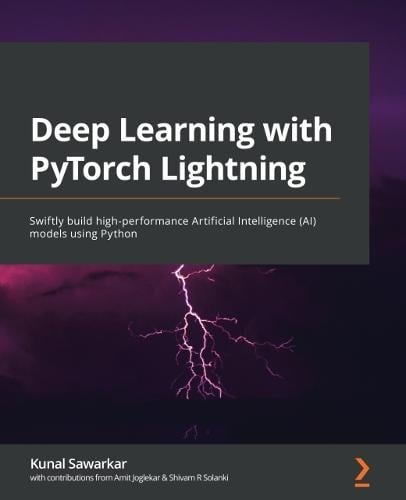
Deep Learning with PyTorch Lightning : Build and train high-performance artificial intelligence and self-supervised models using Python
You’ll learn how to configure PyTorch Lightning on a cloud platform, understand the architectural components, and explore how they are configured to build various industry solutions. You’ll build a neural network architecture, deploy an application from scratch, and see how you can expand it based on your specific needs, beyond what the framework can provide. In the later chapters, you’ll also learn how to implement capabilities to build and train various models like Convolutional Neural Nets (CNN), Natural Language Processing (NLP), Time Series, Self-Supervised Learning, Semi-Supervised Learning, Generative Adversarial Network (GAN) using PyTorch Lightning.

Deep learning pipeline : Building a deep learning model with TensorFlow
Build your own pipeline based on modern TensorFlow approaches rather than outdated engineering concepts. This book shows you how to build a deep learning pipeline for real-life TensorFlow projects. You'll learn what a pipeline is and how it works so you can build a full application easily and rapidly. Then troubleshoot and overcome basic Tensorflow obstacles to easily create functional apps and deploy well-trained models. Step-by-step and example-oriented instructions help you understand each step of the deep learning pipeline while you apply the most straightforward and effective tools to demonstrative problems and datasets.

Deep learning for computational problems in hardware security : Modeling attacks on strong physically unclonable function circuits
Discusses a broad overview of traditional machine learning methods and state-of-the-art deep learning practices for hardware security applications, in particular the techniques of launching potent "modeling attacks" on Physically Unclonable Function (PUF) circuits, which are promising hardware security primitives. The volume is self-contained and includes a comprehensive background on PUF circuits, and the necessary mathematical foundation of traditional and advanced machine learning techniques such as support vector machines, logistic regression, neural networks, and deep learning. This book can be used as a self-learning resource for researchers and practitioners of hardware security, and will also be suitable for graduate-level courses on hardware security and application of machine learning in hardware security.

Deep learning architecture and application
As one of the fastest-growing topics in machine learning, deep learning algorithms have achieved unprecedented success in recent years. Novel paradigms (such as contrastive learning and few-shot learning) in deep learning and rising neural network architectures (e.g., transformer and masked autoencoder) are dramatically changing the field of data-driven algorithms. More importantly, deep learning models are redefining the next generation of industrial applications spanning image recognition, speech processing, language translation, healthcare, and other sciences. For example, recent advances in deep representation learning are allowing us to learn about protein 3D structures, which sheds new light on fundamental medicine and biology along with potentially bringing in billions of dollars (e.g., in the pharmaceutical market).

Deep learning approaches to cloud security
Covering one of the most important subjects to our society today, cloud security, this editorial team delves into solutions taken from evolving deep learning approaches, solutions allowing computers to learn from experience and understand the world in terms of a hierarchy of concepts, with each concept defined through its relation to simpler concepts.
