



الصفحة 52
الصفحة 52

FM 2005: Formal Methods ; International Symposium of Formal Methods Europe, Newcastle, UK, July 18-22, 2005, Proceedings
This volume contains the proceedings of Formal Methods 2005, the 13th InternationalSymposiumonFormalMethodsheldinNewcastleuponTyne,UK, during July 18–22, 2005. Formal Methods Europe (FME, www.fmeurope.org) is an independent association which aims to stimulate the use of, and research on, formal methods for system development. FME conferences began with a VDM Europe symposium in 1987. Since then, the meetings have grown and have been held about once every 18 months. Throughout the years the symposia have been notablysuccessfulinbringingtogetherresearchers,tooldevelopers,vendors,and users, both from academia and from industry. Formal Methods 2005 con?rms this success. We received 130 submissions to the main conference, from all over the world. Each submission was carefully refereed by at least three reviewers. Then, after an intensive, in-depth discussion, the Program Committee selected 31 papers for presentation at the conference. They form the bulk of this volume.
Flexitranstore ; Special session in the 21st International symposium on high voltage engineering (ISH 2019)
This book comprises 10 high-level papers on research and innovation within the Flexitranstore Project that were presented at the FLEXITRANSTORE special session organized as part of the 21st International Symposium on High Voltage Engineering.

Flexible Query Answering Systems ; 7th International Conference, FQAS 2006, Milan, Italy, June 7-10, 2006
This book constitutes the refereed proceeding of the 7th International Conference on Flexible Query Answering Systems, FQAS 2006, held in Milan, Italy in June 2006. The 60 revised full papers presented were carefully reviewed and selected from numerous submissions. The papers are organized in topical sections on flexibility in database management and quering, vagueness and uncertainty in XML quering and retrieval, information retrieval and filtering, multimedia information access, user modeling and personalization, knowledge and data extraction, intelligent information extraction from text, and knowledge representation and reasoning.

Flexible and Efficient Information Handling ; 23rd British National Conference on Databases, BNCOD 23, Belfast, Northern Ireland, UK, July 18-20, 2006, Proceedings
This book constitutes the refereed proceedings of the 23rd British National Conference on Databases, BNCOD 23, held in Belfast, Northern Ireland, July 2006. The volume presents 12 revised full papers and 6 revised short papers, together with 2 invited lectures and 13 poster papers. Topical sections include data modelling and architectures and transaction management, data integration and interoperability and information retrieval, query processing and optimisation, data mining, data warehousing and more.

Flex solutions : Essential techniques for Flex 2 and 3 developers
Flex Solutions: Essential Techniques for Flex 2 and Flex 3 Developers faces problems and provides solutions that can be applied to any project, from the most simple to the most complex. Solutions are also provided for enhancing the security of Flex applications, and techniques are offered for optimizing the actual work environment by increasing the performance of Flex Builder, adding video content, and creating an AIR project to bring your web application onto the desktop.

Flash Application Design Solutions : The Flash Usability Handbook
In this book, you’ll find a number of concrete Flash usability solutions that use elements such as navigation menus, data filtering, forms, content loaders, Flash liquid layouts, help tips, and many other features. You’ll learn how each of these solutions actually improves on what is possible with HTML and JavaScript. In each case, you’ll see how users interact with the website feature, and how it gives users the most intuitive, enjoyable experience possible while using your application. You’ll get a step-by-step analysis of how to program and build each solution, and how to make it scalable, maintainable, and reusable.

Flash 8 Essentials
As a creative professional or interactive developer, you’ll be amazed at the exciting possibilities presented to you by the features available in Flash 8; but as a busy designer, we know you won't have as much time as you’d like to explore these new additions. Never fear; this book wastes no time looking at timeline basics, tweens, or movie-publishing options—it focuses exclusively on the new Flash 8 features, getting you quickly up to speed with a combination of illustrative tutorials, handy references, and inspirational examples. By the end of the book, you’ll know that there’s no shortage of new tools to enhance and inspire your Flash development; and since this book is written by some of the community's leading Flash experts, you’ll know you’re in good hands.

First Steps : Developing BizTalk Applications
First Steps: Developing BizTalk Applications is a primer to most other introductory BizTalk books. If you feel like traditional beginning books are too abstract, and that you are mired in detail and missing the “big picture,” check out this book. It's a jumpstart to learning BizTalk. You'll learn about the product in a phased approach.

First course on fuzzy theory and applications
This basic textbook gives an easily accessible introduction to Fuzzy theory and its applications. It provides basic and concrete concepts of the field in a self-contained, condensed and understandable style. This "First Course on Fuzzy Theory and Applications" includes numerous examples, descriptive illustrations and figures of the basic concepts, as well as exercises at the end of each chapter. The author has long time experience in teaching on fuzzy theory and its applications and continuously developed and summarized his didactic lecture notes into this book. This book can be used in introductory graduate and undergraduate courses in Fuzziness and Soft Computing and is recommendable to students, scientists, engineers, or professionals in the field for self-study.
Finite-state methods and natural language processing ; 5th International Workshop, FSMNLP 2005, Helsinki, Finland, September 1-2, 2005, Revised Papers
This book constitutes the thoroughly refereed post-proceedings of the 5th International Workshop on Finite-State Methods in Natural Language Processing, FSMNLP 2005, held in Helsinki, Finland, September 2005. The book presents 24 revised full papers and seven revised poster papers together with two invited contributions and abstracts of six software demos. Topics include morphology, optimality theory, some special FSM families, weighted FSM algorithms, FSM representations, exploration, ordered structures, and surface parsing.
Finite model theory and its applications
This book gives a broad overview of core topics of finite model theory: expressive power, descriptive complexity, and zero-one laws, together with selected applications to database theory and artificial intelligence, especially, constraint databases and constraint satisfaction problems. The final chapter provides a concise modern introduction to modal logic, which emphasizes the continuity in spirit and technique with finite model theory. This underlying spirit involves the use of various fragments of, and hierarchies within, first order, second order, fixed point, and infinitary logics to gain insight into phenomena in complexity theory and combinatorics.

Finite Elements III : First-Order and Time-Dependent PDEs
Volume III is divided into 28 chapters. The first eight chapters focus on the symmetric positive systems of first-order PDEs called Friedrichs' systems. This part of the book presents a comprehensive and unified treatment of various stabilization techniques from the existing literature. It discusses applications to advection and advection-diffusion equations and various PDEs written in mixed form such as Darcy and Stokes flows and Maxwell's equations. The remainder of Volume III addresses time-dependent problems: parabolic equations (such as the heat equation), evolution equations without coercivity (Stokes flows, Friedrichs' systems), and nonlinear hyperbolic equations (scalar conservation equations, hyperbolic systems). It offers a fresh perspective on the analysis of well-known time-stepping methods. The last five chapters discuss the approximation of hyperbolic equations with finite elements. Here again a new perspective is proposed.

Finite Difference Computing with PDEs : A Modern Software Approach
This easy-to-read book introduces the basics of solving partial differential equations by means of finite difference methods. Unlike many of the traditional academic works on the topic, this book was written for practitioners. Accordingly, it especially addresses: the construction of finite difference schemes, formulation and implementation of algorithms, verification of implementations, analyses of physical behavior as implied by the numerical solutions, and how to apply the methods and software to solve problems in the fields of physics and biology.

Finite Difference Computing with Exponential Decay Models
This text provides a very simple, initial introduction to the complete scientific computing pipeline: models, discretization, algorithms, programming, verification, and visualization. The pedagogical strategy is to use one case study – an ordinary differential equation describing exponential decay processes – to illustrate fundamental concepts in mathematics and computer science. The book is easy to read and only requires a command of one-variable calculus and some very basic knowledge about computer programming. Contrary to similar texts on numerical methods and programming, this text has a much stronger focus on implementation and teaches testing and software engineering in particular.

Financial cryptography and data security Vol. 4107 ; 10th International Conference, FC 2006 Anguilla, British West Indies, February 27 - March 2, 2006, Revised Selected Papers
This book constitutes the thoroughly refereed post-proceedings of the 10th International Conference on Financial Cryptography and Data Security, FC 2006, held in Anguilla, British West Indies in February/March 2006. The 19 revised full papers and six revised short papers presented were carefully reviewed and selected from 64 submissions.

Financial cryptography and data security Vol. 3570 ; 9th International Conference, FC 2005, Roseau, The Commonwealth Of Dominica, February 28 - March 3, 2005, Revised Papers
The 9th International Conference on Financial Cryptography and Data Security (FC 2005) was held in the Commonwealth of Dominica from February 28 to March 3, 2005. This conference, organized by the International Financial Cryptography Association (IFCA), continues to be the premier international forum for research, exploration, and debate regarding security in the context of finance and commerce. The conference title and scope was expanded this year to cover all aspects of securing transactions and systems. The goal is to build an interdisciplinary meeting, bringing together cryptographers, data-security specialists, business and economy researchers, as well as economists, IT professionals, implementers, and policy makers. We think that this goal was met this year. The conference received 90 submissions and 24 papers were accepted, 22 in the Research track and 2 in the Systems and Applications track. In addition, the conference featured two distinguished invited speakers, Bezalel Gavish and Lynne Coventry, and two interesting panel sessions, one on phishing and the other on economics and information security. Also, for the first time, some of the papers that were judged to be very strong but did not make the final program were selected for special invitation to our Works in Progress (Rump) Session that took place on Wednesday evening.

Financial cryptography and data security ; FC 2020 International Workshops, AsiaUSEC, CoDeFi, VOTING, and WTSC, Kota Kinabalu, Malaysia, February 14, 2020, Revised Selected Papers
This book constitutes the refereed proceedings of two workshops held at the 24th International Conference on Financial Cryptography and Data Security, FC 2020, in Kota Kinabalu, Malaysia, in February 2020. The 39 full papers and 3 short papers presented in this book were carefully reviewed and selected from 73 submissions. The papers feature four Workshops: The 1st Asian Workshop on Usable Security, AsiaUSEC 2020, the 1st Workshop on Coordination of Decentralized Finance, CoDeFi 2020, the 5th Workshop on Advances in Secure Electronic Voting, VOTING 2020, and the 4th Workshop on Trusted Smart Contracts, WTSC 2020.
Financial cryptography and data security ; 12th International Conference, FC 2008, Cozumel, Mexico, January 28-31, 2008. Revised Selected Papers
This book constitutes the thoroughly refereed post-conference proceedings of the 12th International Conference on Financial Cryptography and Data Security, FC 2008, held in Cozumel, Mexico, in January 2008.The 16 revised full papers and 9 revised short papers presented together with 5 poster papers, 2 panel reports, and 1 invited lecture were carefully reviewed and selected from 86 submissions. The papers are organized in topical sections on attacks and counter measures, protocols, theory, hardware, chips and tags, signatures and encryption, as well as anonymity and e-cash.
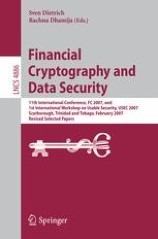
Financial cryptography and data security ; 11th International Conference, FC 2007, and First International workshop on usable security, USEC 2007, Scarborough, Trinidad/Tobago, February 12-16, 2007. Revised Selected Papers
This book cover all aspects of securing transactions and systems, which this year included a range of technical areas such as cryptography, payment systems, anonymity, privacy, - thentication, and commercial and ?nancial transactions.

Financial Cryptography ; 5th International Conference, FC 2001, Grand Cayman, British West Indies, February 19-22, 2001. Proceedings
Constitutes the post-proceedings of the 5th International Conference on Financial Cryptography held in the British West Indies in 2002. Papers cover managing payment transaction costs, trust and risk management, groups and anonymity, certificates and authentication, credit card security and more.
