



الصفحة 50
الصفحة 50

Artificial intelligence and security ; 6th International Conference, ICAIS 2020, Hohhot, China, July 17–20, 2020, Proceedings, Part II
This two-volume set LNCS 12239-12240 constitutes the refereed proceedings of the 6th International Conference on Artificial Intelligence and Security, ICAIS 2020, which was held in Hohhot, China, in July 2020. The conference was formerly called “International Conference on Cloud Computing and Security” with the acronym ICCCS. The total of 142 full papers presented in this two-volume proceedings was carefully reviewed and selected from 1064 submissions. The papers were organized in topical sections as follows: Part I: Artificial intelligence and internet of things. Part II: Internet of things, information security, big data and cloud computing, and information processing.

Artificial Intelligence and Security ; 6th International Conference, ICAIS 2020, Hohhot, China, July 17–20, 2020, Proceedings, Part II
The 3-volume set CCIS 1252 until CCIS 1254 constitutes the refereed proceedings of the 6th International Conference on Artificial Intelligence and Security, ICAIS 2020, which was held in Hohhot, China, in July 2020. The conference was formerly called “International Conference on Cloud Computing and Security” with the acronym ICCCS.

Artificial intelligence and security ; 6th International Conference, ICAIS 2020, Hohhot, China, July 17–20, 2020, Proceedings, Part I
This two-volume set LNCS 12239-12240 constitutes the refereed proceedings of the 6th International Conference on Artificial Intelligence and Security, ICAIS 2020, which was held in Hohhot, China, in July 2020. The conference was formerly called “International Conference on Cloud Computing and Security” with the acronym ICCCS. The total of 142 full papers presented in this two-volume proceedings was carefully reviewed and selected from 1064 submissions. The papers were organized in topical sections as follows: Part I: Artificial intelligence and internet of things. Part II: Internet of things, information security, big data and cloud computing, and information processing.

Artificial intelligence and security ; 6th International Conference, ICAIS 2020, Hohhot, China, July 17–20, 2020, Proceedings, Part I
The 3-volume set CCIS 1252 until CCIS 1254 constitutes the refereed proceedings of the 6th International Conference on Artificial Intelligence and Security, ICAIS 2020, which was held in Hohhot, China, in July 2020. The conference was formerly called “International Conference on Cloud Computing and Security” with the acronym ICCCS.

Artificial intelligence and neural networks ; 14th Turkish Symposium, TAINN 2005, Izmir, Turkey, June 16-17, 2005, Revised Selected Papers
The Turkish Artificial Intelligence and Neural Network Symposium (TAINN) is an annual meeting where scientists present their new ideas and algorithms on artificial intelligence and neural networks with either oral or poster presentation. The TAINN- Turkish Conference on AI and NN Series started in 1992 at Bilkent University in Ankara, envisioned by various researchers in AI and NN then at the Bilkent, Middle East Technical, Bo aziçi and Ege universities as a forum for local researchers to get together and communicate. Since then, TAINN has been held annually around early summer. This year the 14th TAINN conference was organized by the EE and CE departments of the zmir Institute of Technology with an emphasis on international contributions.

Artificial intelligence and national security
Analyses the implications of the technical, legal, ethical and privacy challenges as well as challenges for human rights and civil liberties regarding Artificial Intelligence (AI) and National Security. It also offers solutions that can be adopted to mitigate or eradicate these challenges wherever possible. As a general-purpose, dual-use technology, AI can be deployed for both good and evil. The use of AI is increasingly becoming of paramount importance to the governments mission to keep their nations safe. However, the design, development and use of AI for national security poses a wide range of legal, ethical, moral and privacy challenges. This book explores national security uses for Artificial Intelligence (AI) in Western Democracies and its malicious use. This book also investigates the legal, political, ethical, moral, privacy and human rights implications of the national security uses of AI in the aforementioned democracies. It illustrates how AI for national security purposes could threaten most individual fundamental rights, and how the use of AI in digital policing could undermine user human rights and privacy.

Artificial intelligence : Methodology, systems, and applications ; 12th International Conference, AIMSA 2006, Varna, Bulgaria, September 12-15, 2006, Proceedings
This book constitutes the refereed proceedings of the 12th International Conference on Artificial Intelligence: Methodology, Systems, and Applications, AIMSA 2006. The 28 revised full papers presented together with the abstracts of 2 invited lectures were carefully reviewed and selected from 81 submissions. The papers are organized in topical sections on agents, constraints and optimization, user concerns, decision support, models and ontologies, machine learning, ontology manipulation, natural language processing, and applications.

Artificial intelligence : Methodology, systems, and applications ; 10th International Conference, AIMSA 2002, Varna, Bulgaria, September 4-6, 2002. Proceedings
The AIMSA conference series was frst conceived in 1984 as a gathering of AI researchers and students from Eastern and Central Europe.Sincethenthecon- rence has followed a biennial schedule of meetings in Bulgaria, attracting parti- pantsfrom awidergeographicalarea.The AIMSA organizers are delighted to present you with another exciting program, coveringmostareasof Artifcial Intelligence.Inkeepingwithitsm- sion to inform the research community and excite the commercial sector, AIMSA presents this year two invited contributions from world-leading European rese- chersworkingoncutting-edgeAIresearch: Prof.CaroleGoble, ontheSemantic Web.
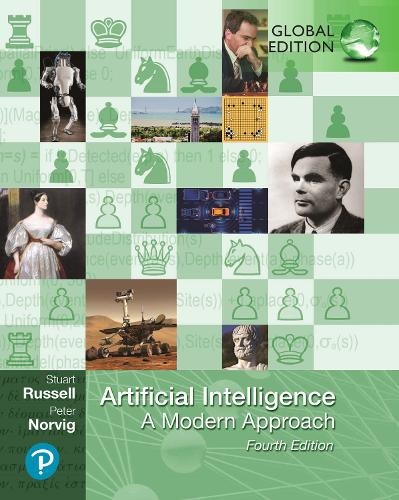
Artificial intelligence : A modern approach ; global ed.
Explores the full breadth and depth of the field of artificial intelligence (AI). The 4th edition brings readers up to date on the latest technologies, presents concepts in a more unified manner, and offers new or expanded coverage of machine learning, deep learning, transfer learning, multi agent systems, robotics, natural language processing, causality, probabilistic programming, privacy, fairness, and safe AI

Artificial immune systems ; Vol. 3627 ; 4th International conference, ICARIS 2005, Banff, Alberta, Canada, August 14-17, 2005, Proceedings
Your immune system is unique. It is in many ways as complex as your brain, butit is not centred in one location, like the brain. It is not a single organ—it consistsof many different cell types, diverse methods of intercellular communication, andmany different organs. Its functionality is blurred throughout you—we can’textract the immune system, or point to where it begins and ends. The immunesystem is not separable from the system it protects. It has integral links to everyorgan of our bodies.This has radical implications for the field of Artificial Immune Systems (AIS),that we are only now beginning to comprehend. One of the first insights is thatmodelling the immune system, or developing any kind of immune algorithm, isdifficult. The immune system is one aspect of biology that we find difficult toapply simple reductionist explanations to. We can very successfully extract sub-processes of the whole and create immune algorithms based on those processes.

Articulated motion and deformable objects ; 5th International Conference, AMDO 2008, Port d’Andratx, Mallorca, Spain, July 9-11, 2008. Proceedings
This book constitutes the refereed proceedings of the 5th International Conference on Articulated Motion and Deformable Objects, AMDO 2008, held in Port d'Andratx, Mallorca, Spain, in July 2008.

Arithmetic of finite fields ; 8th International Workshop, WAIFI 2020, Rennes, France, July 6–8, 2020, Revised Selected and Invited Papers
This book constitutes the thoroughly refereed post-workshop proceedings of the 8th International Workshop on the Arithmetic of Finite Field, WAIFI 2020, held in Rennes, France in July 2020.

Argumentation in multi-agent systems ; 4th International Workshop, ArgMAS 2007, Honolulu, HI, USA, May 15, 2007, revised selected and invited papers
This volume presents the latest developments in the growing area of research at the interface of argumentation theory and multiagent systems. Argumentation provides tools for designing, implementing and analyzing sophisticated forms of interaction among rational agents.

Architecture of computing systems ; 34th International Conference, ARCS 2021, Virtual Event, June 7–8, 2021, Proceedings
This book constitutes the proceedings of the 34th International Conference on Architecture of Computing Systems, ARCS 2021, held virtually in July 2021. The 12 full papers in this volume were carefully reviewed and selected from 24 submissions. 2 workshop papers (VEFRE) are also included. ARCS has always been a conference attracting leading-edge research outcomes in Computer Architecture and Operating Systems, including a wide spectrum of topics ranging from fully integrated, self-powered embedded systems up to high-performance computing systems. It also provides a platform covering newly emerging and cross-cutting topics, such as autonomous and ubiquitous systems, reconfigurable computing and acceleration, neural networks and artificial intelligence. The selected papers cover a variety of topics from the ARCS core domains, including heterogeneous computing, memory optimizations, and organic computing.

Architecting dependable systems V
As software systems become increasingly ubiquitous, the issues of dependability become more and more crucial. Given that solutions to these issues must be considered from the very beginning of the design process, it is reasonable that dependability is addressed at the architectural level. This book was born of an effort to bring together the research communities of software architectures and dependability.

Architecting dependable systems IV
As software systems become ubiquitous, the issues of dependability become more and more crucial. Given that solutions to these issues must be considered from the very beginning of the design process, it is reasonable that dependability is addressed at the architectural level. It also contains sections on architectural description languages, architectural components and patterns, architecting distributed systems, and architectural assurances for dependability.

Architecting dependable systems III
As software systems become ubiquitous, the issues of dependability become more and more crucial. Given that solutions to these issues must be considered from the very beginning of the design process, it is reasonable that dependability is addressed at the architectural level. This book comes as a result of an effort to bring together the research communities of software architectures and dependability. The papers are organised in topical sections on architectures for dependable services, monitoring and reconfiguration in software architectures, dependability support for software architectures, architectural evaluation, and architectural abstractions for dependability

Arabic and Chinese Handwriting Recognition ; SACH 2006 Summit College Park, MD, USA, September 27-28, 2006 Selected Papers
Cheriet provides an overview of the problems of Arabic recognition and how systems can use natural language processing techniques to correct errors in lexicon-based systems.

Arabic AI-generated adverts = إعلانات عربية مولدة بالذكاء الاصطناعي
In the ever-evolving landscape of digital marketing, our groundbreaking platform emerges, harnessing the power of artificial intelligence to revolutionize the creation of marketing campaigns. This innovative solution seamlessly combines neural networks, natural language generation, and multimedia processing capabilities to generate comprehensive and personalized marketing assets from a single product image. At its core, the platform leverages deep learning models that analyze the visual characteristics of the uploaded product image and identifies key features and attributes to define the product category, this enables the generation of compelling and persuasive marketing content tailored to the specific product. The platform's multi-faceted approach encompasses three distinct components: text generation, poster creation, and video advertisement production. Utilizing advanced natural language generation techniques, it crafts engaging marketing text that captures the essence and unique selling points of the product. Simultaneously, its image processing capabilities produce visually stunning promotional posters that blend the product image with eye-catching graphics and typography. along with creating captivating video advertisements optimized for social media and online advertising campaigns.

Applied Parallel Computing ; State of the Art in Scientific Computing ; 8th International Workshop, PARA 2006, Umea, Sweden, June 18-21, 2006, Revised Selected Papers
It covers partial differential equations, parallel scientific computing algorithms, linear algebra, simulation environments, algorithms and applications for blue gene/L, scientific computing tools and applications, parallel search algorithms, peer-to-peer computing, mobility and security, algorithms for single-chip multiprocessors.
