



الصفحة 5
الصفحة 5

Information hiding ; Vol. 3727 ; 7th International workshop, IH 2005, Barcelona, Spain, June 6-8, 2005, Revised selected papers
Constitutes the refereed post-proceedings of the 7th International Workshop on Information Hiding, IH 2005, held in Barcelona, Spain in June 2005. This book features the papers that are organized in topical sections on anonymity, watermarking, theory, watermark attacks, steganography, hiding in unusual content, steganalysis, and fingerprinting.

Information extraction : Algorithms and prospects in a retrieval context
The book focuses on content recognition in text. It elaborates on the past and current most successful algorithms and their application in a variety of domains (e.g., news filtering, mining of biomedical text, intelligence gathering, competitive intelligence, legal information searching, and processing of informal text). An important part discusses current statistical and machine learning algorithms for information detection and classification and integrates their results in probabilistic retrieval models. The book also reveals a number of ideas towards an advanced understanding and synthesis of textual content.

Informatics in Control, Automation and Robotics II
Informatics in Control, Automation and Robotics II is a collection of the best papers presented at the 2nd International Conference on Informatics in Control, Automation and Robotics (ICINCO). The purpose of ICINCO was to bring together researchers, engineers and practitioners interested in the application of informatics to Control, Automation and Robotics.
Implementing machine learning for finance : A systematic approach to predictive risk and performance analysis for investment portfolios
Introduces pattern recognition and future price forecasting that exerts effects on time series analysis models, such as the Autoregressive Integrated Moving Average (ARIMA) model, Seasonal ARIMA (SARIMA) model, and Additive model, and it covers the Least Squares model and the Long Short-Term Memory (LSTM) model. It presents hidden pattern recognition and market regime prediction applying the Gaussian Hidden Markov Model. The book covers the practical application of the K-Means model in stock clustering. It establishes the practical application of the Variance-Covariance method and Simulation method (using Monte Carlo Simulation) for value at risk estimation. It also includes market direction classification using both the Logistic classifier and the Multilayer Perceptron classifier. Finally, the book presents performance and risk analysis for investment portfolios. You will: Understand the fundamentals of the financial market and algorithmic trading, as well as supervised and unsupervised learning models that are appropriate for systematic investment portfolio management / Know the concepts of feature engineering, data visualization, and hyperparameter optimization / Design, build, and test supervised and unsupervised ML and DL models / Discover seasonality, trends, and market regimes, simulating a change in the market and investment strategy problems and predicting market direction and prices / Structure and optimize an investment portfolio with preeminent asset classes and measure the / underlying risk

Implementation and Application of Functional Languages ; 19th International Workshop, IFL 2007, Freiburg, Germany, September 27-29, 2007. Revised Selected Papers
This book constitutes the thoroughly refereed post-proceedings of the 19th International Workshop on Implementation and Applications of Functional Languages, IFL 2007, held in Freiburg, Germany in September 2007.The 15 revised full papers presented went through two rounds of reviewing and improvement and were selected from 33 submissions. The papers address all current theoretical and methodological issues on functional and function-based languages such as type checking, contract checking, compilation, parallelism, development and debugging, data structures, parsing as well as various performance related concepts.

Image-Based Rendering
Image-based rendering (IBR) refers to a collection of techniques and representations that allows 3D scenes and objects to be visualized in a realistic way without full 3D model reconstruction. The potential for photorealistic visualization has tremendous appeal, especially for applications such as video games, virtual travel, and E-commerce, which stand to greatly benefit from this technology.

Hyperparameter tuning for machine and deep learning with R : A practical guide
Equips readers with the ability to achieve better results with significantly less time, costs, effort and resources using the methods described here. The case studies presented in this book can be run on a regular desktop or notebook computer. The content focuses on the hyperparameter tuning of ML and DL algorithms, and is divided into two main parts: theory (Part I) and application (Part II). Essential topics covered include: a survey of important model parameters; four parameter tuning studies and one extensive global parameter tuning study; statistical analysis of the performance of ML and DL methods based on severity; and a new, consensus-ranking-based way to aggregate and analyze results from multiple algorithms.

Hybrid metaheuristics ; Vol. 4030 ; 3rd International Workshop, HM 2006, Gran Canaria, Spain, October 13-14, 2006, Proceedings
The selection of papers for HM 2006 consolidated some of the mainstream issues that have emerged from the past editions. Firstly, there are prominent examples of e?ective hybrid techniques whose design and implementation were motivated by challenging real-world applications. We believe this is particularly important for two reasons: on the one hand, researchers are conscious that the primary goal of developing algorithms is to solve relevant real-life problems; on the other hand, the path towarde?cient solving methods for practical problems is a source of new outstanding ideas and theories. A second important issue is that the research community on metaheur- tics has become increasingly interested in and open to techniques and methods known from arti?cial intelligence (AI) and operations research (OR). So far, the most representative examples of such integration have been the use of AI/OR techniques as subordinates of metaheuristic methods. As a historical and - ymological note, this is in perfect accordance with the original meaning of a metaheuristic as a “general strategy controlling a subordinate heuristic. ” The awareness of the need for a sound experimental methodology is a third keypoint.

Human-computer interaction – INTERACT 2005 ; IFIP TC 13 International Conference, Rome, Italy, September 12-16, 2005, Proceedings
We will be, sooner or later, not only handling personal computers but also mul- purpose cellular phones, complex personal digital assistants, devices that will be context-aware, and even wearable computers stitched to our clothes…we would like these personal systems to become transparent to the tasks they will be performing. In fact the best interface is an invisible one, one giving the user natural and fast access to the application he (or she) intends to be executed. The working group that organized this conference (the last of a long row!) tried to combine a powerful scientific program (with drastic refereeing) with an entertaining cultural program, so as to make your stay in Rome the most pleasant one all round: I do hope that this expectation becomes true. July 2005 Stefano Levialdi, IEEE Life Fellow INTERACT 2005 General Chairman [1] Peter J. Denning, ACM Communications, April 2005, vol. 48, N° 4, pp. 27-31. Editors’ Preface INTERACT is one of the most important conferences in the area of Human-Computer Interaction at the world-wide level. We believe that this edition, which for the first time takes place in a Southern European country, will strengthen this role, and that Rome, with its history and beautiful setting provides a very congenial atmosphere for this conference. The theme of INTERACT 2005 is Communicating Naturally with Computers.
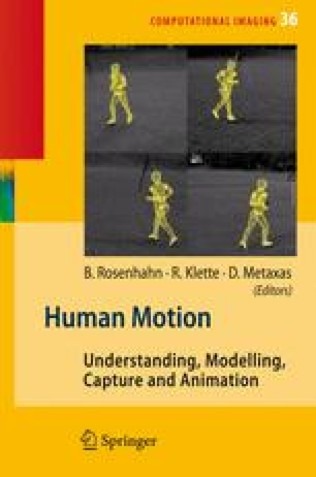
Human motion : Understanding, modeling, capture and animation
Edward Muybridge (1830–1904) is known as the pioneer in motion capt- ing with his famous experiments in 1887 called “Animal Locomotion”. Since then, the feld of animal or human motion analysis has grown in many dir- tions. However, research and results that involve human-like animation and the recovery of motion is still far from being satisfactory. Progress in human motion analysis depends on empirically anchored and grounded research in computer vision, computer graphics, and biomechanics. This book is based on a June 2006 workshop held in Dagstuhl, Germany. This workshop brought together for the frst time researchers from the afo- mentioned disciplines.

Human interactive proofs ; 2nd International workshop, HIP 2005, Bethlehem, PA, USA, May 19-20, 2005, Proceedings
Constitutes the refereed proceedings of the Second International Workshop on Human Interactive Proofs, HIP 2005, held in Bethlehem, PA, USA in May 2005. This book is devoted to the new class of security protocols called human interactive proofs. It includes sections such as: CAPTCHAs and performance analysis, and HIP architectures.

Human Ear Recognition by Computer
Human Ear Recognition by Computer is the first book on the automatic recognition of human ears. It presents an entire range of computational algorithms for recognition of humans by their ears. These algorithms have been tested and validated on the largest databases that are available today,This state-of-the-art research reference explores all aspects of 3D ear recognition, including representation, detection, recognition, indexing and performance prediction. It has been written for a professional audience of both researchers and practitioners within industry, and is also ideal as an informative text for graduate students in computer science and engineering.

Honeypots for Windows
Installing a honeypot inside your network as an early warning system can significantly improve your security. Currently, almost every book and resource about honeypots comes from a Unix background, which leaves Windows administrators still grasping for help. But Honeypots for Windows is a forensic journeyhelping you set up the physical layer, design your honeypot, and perform malware code analysis. You'll discover which Windows ports need to be open on your honeypot to fool those malicious hackers, and you'll learn about numerous open source tools imported from the Unix world. Install a honeypot on your DMZ or at home and watch the exploits roll in! Your honeypot will capture waves of automated exploits, and youll learn how to defend the computer assets under your control.
High-Performance Modelling and Simulation for Big Data Applications: Selected Results of the COST Action IC1406 cHiPSet
This book is the final compendium of case studies emanated from “High-Performance Modelling and Simulation for Big Data Applications” (cHiPSet).cHiPSet has created a sustainable reference network linking applied research in High Performance Computing (HPC) and Modelling & Simulation to tangibly address Big Data challenges.cHiPSet has also endeavoured to use and exploit results through Open Science practices, i.e., open access publication, open access to data repositories, and open-source software development. A testament to this philosophy, this compendium is set to become a required reference for the fast-changing fields of HPC, Big Data, and Modelling & Simulation.

High-Performance Computing ; 6th International Symposium, ISHPC 2005, Nara, Japan, September 7-9, 2005, First International Workshop on Advanced Low Power Systems, ALPS 2006, Revised Selected Papers
This is the joint post-proceedings of the 6th International Symposium on High Performance Computing (ISHPC-VI) and the First International Workshop on Advanced Low Power Systems 2006 (ALPS2006). The post-proceedings also contain the papers presented at the Second HPF International Workshop: - periences and Progress (HiWEP2005) and the Workshop on Applications for PetaFLOPS Computing (APC2005), which are workshops of ISHPC-VI. ISHPC-VI, HiWEP2005 and APC2005 were held in Nara, Japan during September 7–9, 2005. Fifty-eight papers from 11 countries were submitted to ISHPC-VI. After the reviews of the submitted papers, the ISHPC-VI Program Committee selected 15 regular (12-page) papers for oral presentation. In ad- tion, several other papers with favorable reviews were recommended for poster presentation, and 14 short (8-page) papers were also selected.
High Performance SQL Server " Consistent Response for Mission-Critical Applications
An excellent complement to query performance tuning books and provides the other half of what you need to know by focusing on configuring the instances on which mission-critical queries are executed. You will: Understand SQL Server's database engine and how it processes queries / Configure instances in support of high-throughput applications / Provide consistent response times to varying user numbers and query volumes / Design databases for high-throughput applications with focus on performance / Record performance baselines and monitor SQL Server instances against them / Troubleshot and fix performance problems

High performance embedded architectures and compilers ; 3rd International Conference, HiPEAC 2008, Göteborg, Sweden, January 27-29, 2008. Proceedings
This book constitutes the refereed proceedings of the Third International Conference on High Performance Embedded Architectures and Compilers, HiPEAC 2008, held in Göteborg, Sweden, January 27-29, 2008. The 25 revised full papers presented together with 1 invited keynote paper were carefully reviewed and selected from 77 submissions. The papers are organized in topical sections on Multithreaded and Multicore Processors, Reconfigurable - ASIP, Compiler Optimizations, Industrial Processors and Application Parallelization, Power-Aware Techniques, High-Performance Processors, Profiles: Collection and Analysis as well as Optimizing Memory Performance.

High performance embedded architectures and compilers ; 2nd International Conference, HiPEAC 2007, Ghent, Belgium, January 28-30, 2007. Proceedings
This book constitutes the refereed proceedings of the Second International Conference on High Performance Embedded Architectures and Compilers, HiPEAC 2007, held in Ghent, Belgium, in January 2007. The 19 revised full papers presented together with one invited keynote paper were carefully reviewed and selected from 65 submissions.

High performance embedded architectures and compilers ; 1st International Conference, HiPEAC 2005, Barcelona, Spain, November 17-18, 2005, Proceedings
The ProgramCommittee received a total of 84 submissions; only 17 were selected for presentation as full-length papers and another one as an invited paper. Each paper was rigorously reviewed by three ProgramCommittee members and at least one external referee. Many reviewers spent a great amount of e?ort to provide detailed feedback. In many cases, such feedback along with constructive shepherding resulted in dramatic improvement in the quality of accepted papers. The names of the Program Committee m- bers and the referees are listed in the proceedings. The net result of this team e?ort is that the symposium proceedings include outstanding contributions by authors from nine countries in three continents. In addition to paper presentations, this ?rst HiPEAC conference featured two keynotes delivered by prominent researchers from industry and academia.

High Performance Computing for Geospatial Applications
This volume fills a research gap between the rapid development of High Performance Computing (HPC) approaches and their geospatial applications. With a focus on geospatial applications, the book discusses in detail how researchers apply HPC to tackle their geospatial problems. Based on this focus, the book identifies the opportunities and challenges revolving around geospatial applications of HPC. Readers are introduced to the fundamentals of HPC, and will learn how HPC methods are applied in various specific areas of geospatial study.
