



الصفحة 5
الصفحة 5

Natural Language Processing and Chinese Computing ; 9th CCF International Conference, NLPCC 2020, Zhengzhou, China, October 14–18, 2020, Proceedings, Part II
This two-volume set of LNAI 12340 and LNAI 12341 constitutes the refereed proceedings of the 9th CCF Conference on Natural Language Processing and Chinese Computing, NLPCC 2020, held in Zhengzhou, China, in October 2020. The 70 full papers, 30 poster papers and 14 workshop papers presented were carefully reviewed and selected from 320 submissions. They are organized in the following areas: Conversational Bot/QA; Fundamentals of NLP; Knowledge Base, Graphs and Semantic Web; Machine Learning for NLP; Machine Translation and Multilinguality; NLP Applications; Social Media and Network; Text Mining; and Trending Topics.

Natural language processing and chinese computing ; 9th CCF International conference, NLPCC 2020, Zhengzhou, China, October 14–18, 2020, Proceedings, Part I
This two-volume set of LNAI 12340 and LNAI 12341 constitutes the refereed proceedings of the 9th CCF Conference on Natural Language Processing and Chinese Computing, NLPCC 2020, held in Zhengzhou, China, in October 2020. The 70 full papers, 30 poster papers and 14 workshop papers presented were carefully reviewed and selected from 320 submissions. They are organized in the following areas: Conversational Bot/QA; Fundamentals of NLP; Knowledge Base, Graphs and Semantic Web; Machine Learning for NLP; Machine Translation and Multilinguality; NLP Applications; Social Media and Network; Text Mining; and Trending Topics.
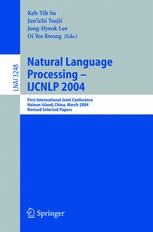
Natural Language Processing – IJCNLP 2004 ; 1st International Joint Conference, Hainan Island, China, March 22-24, 2004, Revised Selected Papers
This book constitutes the thoroughly refereed post-proceedings of the First International Joint Conference on Natural Language Processing, IJCNLP 2004, held in Hainan Island, China in March 2004. The 84 revised full papers presented in this volume were carefully selected during two rounds of reviewing and improvement from 211 papers submitted. The papers are organized in topical sections on dialogue and discourse; FSA and parsing algorithms; information extractions and question answering; information retrieval; lexical semantics, ontologies, and linguistic resources; machine translation and multilinguality; NLP software and applications, semantic disambiguities; statistical models and machine learning; taggers, chunkers, and shallow parsers; text and sentence generation; text mining; theories and formalisms for morphology, syntax, and semantics; word segmentation; NLP in mobile information retrieval and user interfaces; and text mining in bioinformatics.

Natural language and information systems ; 13th International Conference on Applications of Natural Language to Information Systems, NLDB 2008 London, UK, June 24-27, 2008 Proceedings
This volume contains the papers presented at NLDB 2008, the 13th Inter- tional Conference on Natural Language and Information Systems, held June 25-27,2008.It also containssome of the best researchproposalsas submitted to the NLDB2008 doctoral symposium heldonJune24,2008.Theprogrammealso includes three invited talks covering the main perspectives of the application of naturallanguageto informationsystems: the wayhumansprocess, communicate and understand natural language, what are the implications and challenges - wardssemanticsearchfor the new Webgeneration, how naturallanguageapplies to the well-established database way of querying as a means to unlock data and information for end users.

Nanoinformatics
Brings out the state of the art on how informatics-based tools are used and expected to be used in nanomaterials research. There has been great progress in the area in which “big-data” generated by experiments or computations are fully utilized to accelerate discovery of new materials, key factors, and design rules. Data-intensive approaches play indispensable roles in advanced materials characterization. "Materials informatics" is the central paradigm in the new trend. "Nanoinformatics" is its essential subset, which focuses on nanostructures of materials such as surfaces, interfaces, dopants, and point defects, playing a critical role in determining materials properties. There have been significant advances in experimental and computational techniques to characterize individual atoms in nanostructures and to gain quantitative information. The collaboration of researchers in materials science and information science is growing actively and is creating a new trend in materials science and engineering.

Multivariate Public Key Cryptosystems
Multivariate public key cryptosystems (MPKC) is a fast-developing new area in cryptography. In the past 10 years, MPKC schemes have increasingly been seen as a possible alternative to number theoretic-based cryptosystems such as RSA, as they are generally more efficient in terms of computational effort. As quantum computers are developed, MPKC will become a necessary alternative. Multivariate Public Key Cryptosystems systematically presents the subject matter for a broad audience. Information security experts in industry can use the book as a guide for understanding what is needed to implement these cryptosystems for practical applications, and researchers in both computer science and mathematics will find this book a good starting point for exploring this new field. It is also suitable as a textbook for advanced-level students.

Multiple-Aspect Analysis of Semantic Trajectories ; First International Workshop, MASTER 2019, Held in Conjunction with ECML-PKDD 2019, Würzburg, Germany, September 16, 2019, Proceedings
This book constitutes the refereed post-conference proceedings of the First International Workshop on Multiple-Aspect Analysis of Semantic Trajectories, MASTER 2019, held in conjunction with the 19th European Conference on Machine Learning and Knowledge Discovery in Databases, ECML PKDD 2019, in Würzburg, Germany, in September 2019.

Multiple Classifier Systems ; 7th International Workshop, MCS 2007, Prague, Czech Republic, May 23-25, 2007, Proceedings
These proceedings are a record of the Multiple Classifier Systems Workshop, MCS 2007, held at the Institute of Information Theory and Automation, Czech Academy of Sciences, Prague in May 2007. the workshop achieved its objective of bringing together researchers from diverse communities (neural networks, pattern rec- nition, machine learning and statistics) concerned with this research topic.

Multiobjective Optimization : Interactive and Evolutionary Approaches
Multiobjective optimization deals with solving problems having not only one, but multiple, often conflicting, criteria. Such problems can arise in practically every field of science, engineering and business, and the need for efficient and reliable solution methods is increasing. The task is challenging due to the fact that, instead of a single optimal solution, multiobjective optimization results in a number of solutions with different trade-offs among criteria, also known as Pareto optimal or efficient solutions. Hence, a decision maker is needed to provide additional preference information and to identify the most satisfactory solution. Depending on the paradigm used, such information may be introduced before, during, or after the optimization process. Clearly, research and application in multiobjective optimization involve expertise in optimization as well as in decision support.

Multimodal Technologies for Perception of Humans ; 1st International Evaluation Workshop on Classification of Events, Activities and Relationships, CLEAR 2006, Southampton, UK, April 6-7, 2006, Revised Selected Papers
This book constitutes the thoroughly refereed post-proceedings of the First International CLEAR 2006 Evaluation Campaign and Workshop on Classification of Events, Activities and Relationships for evaluation of multimodal technologies for the perception of humans, their activities and interactions. The workshop was held in the UK in April 2006.

Multimodal Processing and Interaction : Audio, Video, Text
Multimodal Processing and Interaction: Audio, Video and Text presents high quality, state-of-the-art research ideas and results from theoretic, algorithmic and application viewpoints. This edited volume contains both state-of-the-art reviews and original contributions by leading experts in the scientific and technological field of multimedia. It grew out of a four-year collaboration among research groups participating in the European network of Excellence on Multimedia Understanding, Semantics, Computation and Learning (MUSCLE).

Multimedia security : Algorithm development, analysis and applications (algorithms for intelligent systems)
Provides an insight about various techniques used in multimedia security and identifies its progress in both technological and algorithmic perspectives. In the contemporary world, digitization offers an effective mechanism to process, preserve and transfer all types of information. The incredible progresses in computing and communication technologies augmented by economic feasibility have revolutionized the world. The availability of efficient algorithms together with inexpensive digital recording and storage peripherals have created a multimedia era bringing conveniences to people in sharing the digital data that includes images, audio and video. The ever-increasing pace, at which the multimedia and communication technology is growing, has also made it possible to combine, replicate and distribute the content faster and easier, thereby empowering mankind by having a wealth of information at their disposal.

Multimedia Retrieval
The single chapters of this textbook explain the general architecture of multimedia information retrieval systems; various metadata languages like Dublin Core, RDF, or MPEG; pattern recognition through Markov models, unsupervised learning, and pattern clustering; various indexing approaches to audio and video streams; interaction and control; the protection of content and user privacy; and search effectiveness and efficiency.

Multimedia Forensics
Media forensics has never been more relevant to societal life. Not only media content represents an ever-increasing share of the data traveling on the net and the preferred communications means for most users, it has also become integral part of most innovative applications in the digital information ecosystem that serves various sectors of society, from the entertainment, to journalism, to politics. Undoubtedly, the advances in deep learning and computational imaging contributed significantly to this outcome. The underlying technologies that drive this trend, however, also pose a profound challenge in establishing trust in what we see, hear, and read, and make media content the preferred target of malicious attacks.

Multimedia Database Retrieval : A Human-Centered Approach
Multimedia Database Retrieval: A Human-Centered Approach presents the latest development in user-centered methods and the state-of-the-art in visual media retrieval. It includes discussion on perceptually inspired non-linear paradigm in user-controlled interactive retrieval (UCIR) systems. It also features a coherent approach which focuses on specific topics within content/concept-based retrievals via audio-visual information modeling of multimedia. Highlights include: * Exploring an adaptive machine that can learn from its environment * Optimizing the learning system by incorporating self-organizing adaptation into the retrieval process * Demonstrating state-of-the-art applications within small, medium, and large databases

Multilingual Information Access for Text, Speech and Images ; 5th Workshop of the Cross-Language Evaluation Forum, CLEF 2004, Bath, UK, September 15-17, 2004, Revised Selected Papers
The ?fth campaign of the Cross-Language Evaluation Forum (CLEF) for Eu- pean languages was held from January to September 2004. Participation in the CLEF campaigns has increased each year and CLEF 2004 was no exception: 55 groups submitted results for one or more of the di?erent tracks compared with 42 groups in the previous year. CLEF 2004 also marked a breaking point with respect to previous campaigns. The focus was no longer mainly concentrated on multilingual document retrieval as in previous years but was diversi?ed to include di?erent kinds of text retrieval across languages (e. g. , exact answers in the question-answering track) and retrieval on di?erent kinds of media (i. e. , not just plain text but collections containing image and speech as well). In ad- tion, increasing attention was given to issues that regard system usability and user satisfaction with tasks to measure the e?ectiveness of interactive systems or system components being included in both the cross-language question - swering and image retrieval tasks with the collaboration of the coordinators of the interactive track. The campaign culminated in a two-and-a-half-day workshop held in Bath, UK, 15–17 September, immediately following the 8th European Conference on Digital Libraries. The workshop was attended by nearly 100 researchers and s- tem developers.

Multi-Agent-Based Simulation VIII ; International Workshop, MABS 2007, Honolulu, HI, USA, May 15, 2007, Revised and Invited Papers
This book constitutes the thoroughly refereed post-proceedings of the 8th International Workshop on Multi-Agent-Based Simulation, MABS 2007, held in Honolulu, HI, USA in May 2007 as an associated event of AAMAS 2007, the main international conference on autonomous agents and multi-agent systems.The 10 revised full papers presented were carefully reviewed and selected from 20 submissions.The papers are organized in topical sections on architectures; teams, learning, education; economy, trust and reputation.

Multiagent System Technologies ; Vol. 3550 : 3rd German Conference, MATES 2005, Koblenz, Germany, September 11-13, 2005, Proceedings
After two successful MATES conferences in Erfurt 2003 and 2004, the 3rd G- man conference on Multi-agent System Technologies (MATES 2005) took place in Koblenz, Germany, in September 2005, and was co-located with the 28th German Conference on Arti?cial Intelligence (KI 2005). Building onotheragent-related events in Germany in the past, and organized by the GI German Special Interest Group on Distributed Arti?cial Intelligence, the MATES conference series aims at promoting the theory and applications of agents and multiagent systems. In corporating the 9th International Workshopon Cooperative Information Agents (CIA 2005), the topics of interest for MATES 2005 also covered the ?elds of intelligent information agents and systems for the Internet and the (Semantic) Web. As in recent years, MATES 2005 provided a distinguished, lively and int- disciplinary forum for researchers, users, and developers of agent technology, to present and discuss the latest advances of research and development in the area of autonomous agents and multiagent systems. Accordingly, the topics of MATES 2005 covered the whole range from the theory to applications of age- and multiagent technology. The technical program included a total of 24 sci- ti?c talks, and demonstrations of selected running agent systems, and both the MATES 2005 Best Paper and the CIA 2005 System Innovation awards.

Multiagent Engineering : Theory and Applications in Enterprises
1 Multiagent Engineering: A New Software Construction Paradigm Multiagent systems have a long academic tradition. They have their roots in distributed problem solving in Artificial Intelligence (AI) from where they emerged in the mid-eighties as a distinctive discipline. Research in multiagent systems owes much to the work of Rosenschein on rationality and autonomy of intelligent agents, the European MAAMAW workshop series

Multi-access Edge Computing : Software Development at the Network Edge
The book aims not only at providing a comprehensive technology and standard reference overview for students, but also useful research insights and practical exercises for edge software developers and investigators in the area (and for students looking to apply their skills). A particular emphasis is given Multi-access Edge Computing (MEC) as defined in European Telecommunications Standards Institute (ETSI), in relationship with other standard organizations like 3GPP, thus in alignment with the recent industry efforts to produce harmonized standards for edge computing leveraging both ETSI ISG MEC and 3GPP specifications.
