



الصفحة 5
الصفحة 5
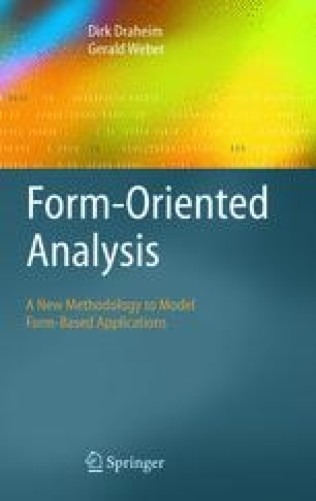
Form-oriented analysis : A new methodology to model form-based applications
Form-based applications range from simple web shops to complex enterprise resource planning systems. Draheim and Weber adapt well-established basic modeling techniques in a novel way to achieve a modeling framework optimized for this broad application domain. They introduce new modeling artifacts, such as page diagrams and form storyboards, and separate dialogue patterns to allow for reuse. In their implementation they have developed new constructs such as typed server pages, and tools for forward and reverse engineering of presentation layers. The methodology is explained using an online bookshop as a running example in which the user can experience the modeling concepts in action. The combination of theoretical achievements and hands-on practical advice and tools makes this book a reference work for both researchers in the areas of software architectures and submit-response style user interfaces, and professionals designing and developing such applications. More information and additional material is also available online.
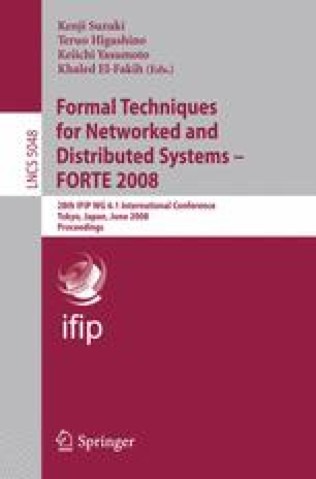
Formal Techniques for Networked and Distributed Systems - FORTE 2008 ; 28th IFIP WG 6.1 International Conference Tokyo, Japan, June 10-13, 2008 Proceedings
This book constitutes the refereed proceedings of the 28th IFIP WG 6.1 International Conference on Formal Techniques for Networked and Distributed Systems, FORTE 2008, held in Tokyo, Japan, in June 2008 co-located with TestCom/FATES 2008.The 19 revised full papers and 1 revised short paper presented together with 1 invited talk were carefully reviewed and selected from 44 submissions. The papers cover new approaches, concepts and experience in the application of formal methods for the specification and verification of distributed systems and applications.

Flexible and Efficient Information Handling ; 23rd British National Conference on Databases, BNCOD 23, Belfast, Northern Ireland, UK, July 18-20, 2006, Proceedings
This book constitutes the refereed proceedings of the 23rd British National Conference on Databases, BNCOD 23, held in Belfast, Northern Ireland, July 2006. The volume presents 12 revised full papers and 6 revised short papers, together with 2 invited lectures and 13 poster papers. Topical sections include data modelling and architectures and transaction management, data integration and interoperability and information retrieval, query processing and optimisation, data mining, data warehousing and more.

Flash Application Design Solutions : The Flash Usability Handbook
In this book, you’ll find a number of concrete Flash usability solutions that use elements such as navigation menus, data filtering, forms, content loaders, Flash liquid layouts, help tips, and many other features. You’ll learn how each of these solutions actually improves on what is possible with HTML and JavaScript. In each case, you’ll see how users interact with the website feature, and how it gives users the most intuitive, enjoyable experience possible while using your application. You’ll get a step-by-step analysis of how to program and build each solution, and how to make it scalable, maintainable, and reusable.

Flash 8 Essentials
As a creative professional or interactive developer, you’ll be amazed at the exciting possibilities presented to you by the features available in Flash 8; but as a busy designer, we know you won't have as much time as you’d like to explore these new additions. Never fear; this book wastes no time looking at timeline basics, tweens, or movie-publishing options—it focuses exclusively on the new Flash 8 features, getting you quickly up to speed with a combination of illustrative tutorials, handy references, and inspirational examples. By the end of the book, you’ll know that there’s no shortage of new tools to enhance and inspire your Flash development; and since this book is written by some of the community's leading Flash experts, you’ll know you’re in good hands.

Fast software encryption ; Vol. 3557 ; 12th International Workshop, FSE 2005, Paris, France, February 21-23, 2005, Revised Selected Papers
The Fast Software Encryption 2005 Workshop was the twelfth in a series of annual workshops on symmetric cryptography, sponsored for the fourth year by the International Association for Cryptologic Research (IACR). The workshop concentratedonallaspectsoffastprimitivesforsymmetriccryptology, including thedesign, cryptanalysisandimplementationofblockandstreamciphersaswell as hash functions and message authentication codes. The ?rst FSE workshop was held in Cambridge in 1993, followed by Leuven in 1994, Cambridge in 1996, Haifain1997, Parisin1998, Romein1999, NewYorkin2000, Yokohamain2001, Leuven in 2002, Lund in 2003, and New Delhi in 2004. This year, a total of 96 submissions were received. After an extensive review by the Program Committee, 30 submissions were accepted.

Explainable artificial intelligence in troke from the clinical, rehabilitation and nursing perspectives
As we know, strokes are one of the world's leading causes of death, and the cruel aspect of a stroke is that it leaves people with severe functional disability and/or cognitive impairment. Strokes have a significant impact on economies worldwide, as it is estimated that about 10% of the male population and 8% of the female population are affected by them. Such people need personal help in their everyday life and must be materially supported by social services. With the advancement of medicine, artificial intelligence, and new technologies have been developing rapidly and are gradually applied in diseases of the nervous system, increasingly helping diagnosis, treatment, rehabilitation, and prognosis of disease.

Expert Network Time Protocol : An Experience in Time with NTP
Have you ever tried to figure out why your computer clock is off, or why your emails somehow have the wrong timestamp? Most likely, it's due to an incorrect network time synchronization, which can be reset using the Network Time Protocol. Until now, most network administrators have been too paranoid to work with this, afraid that they would make the problem even worse. However, Expert Network Time Protocol: An Experience in Time with NTP takes the mystery out of time, and shows the network administrator how to regain the upper hand. This book is a fascinating look into NTP, and the stories behind the science. Written by Peter Rybaczyk, one of the foremost experts on NTP, this book will show the network administrator how to become more comfortable working with time.
Expert F#
Expert F# is about practical programming in a beautiful language that puts the power and elegance of functional programming into the hands of .NET developers. In combination with .NET, F# achieves unrivaled levels of programmer productivity and program clarity. This books serves as: The authoritative guide to F# by the designer of F#. A comprehensive reference of F# concepts, syntax, and features. A treasury of expert F# techniques for practical, real–world programming.

Evolutionary Computer Music
The evolutionary computation approach to music is an exciting new development for composers and musicologists alike. For composers, it provides an innovative and natural means for generating musical ideas from a specifiable set of primitive components and processes. For musicologists, these techniques are used to model the cultural transmission and change of a population's body of musical ideas over time. In both cases, musical evolution can be guided by a variety of constraints and tendencies built into the system, such as realistic psychological factors that influence the way music is expressed, experienced, learned, stored, modified, and passed on among individuals. This book discusses not only the applications of evolutionary computation to music, but also the tools needed to create and study such systems. These tools are drawn in part from research into the origins and evolution of biological organisms, ecologies, and cultural systems on the one hand, and from computer simulation methodologies on the other. They can be combined to create surrogate artificial worlds populated by interacting simulated organisms in which complex musical experiments can be performed that would otherwise be impossible.

Ergonomics and Health Aspects of Work with Computers ; International Conference, EHAWC 2007, Held as Part of HCI International 2007, Beijing, China, July 22-27, Proceedings
This book address the latest research and development efforts and highlight the human aspects of design and use of computing systems. It cover the entire field of Human-Computer Interaction, addressing major - vances in knowledge and effective use of computers in a variety of application areas. This volume contains thematic area of Ergonomics and Health Aspects of Work with Computers, addressing the following major topics:Health and Well Being in the Working Environment, Ergonomics and Design

Enterprise service oriented architectures : Concepts, challenges, recommendations
Enterprise Service Oriented Architectures helps readers solve this challenge in making different applications communicate in a loosely coupled manner. This classic handbook leverages the experiences of thought leaders functioning in multiple industry verticals and provides a wealth of knowledge for creating the agile enterprise.

Engineering self-organising systems ; Vol. 3464 : Methodologies and applications
Self-organisation, self-regulation, self-repair, and self-maintenance are promising conceptual approaches to deal with the ever increasing complexity of distributed interacting software and information handling systems. Self-organising applications are able to dynamically change their functionality and structure without direct user intervention to respond to changes in requirements and the environment. This book comprises revised and extended papers presented at the International Workshop on Engineering Self-Organising Applications, ESOA 2004, held in New York, NY, USA in July 2004 at AAMAS as well as invited papers from leading researchers. The papers are organized in topical sections on state of the art, synthesis and design methods, self-assembly and robots, stigmergy and related topics, and industrial applications.

Embedded Firmware Solutions : Development Best Practices for the Internet of Things
Embedded Firmware Solutions is the perfect introduction and daily-use field guide--for the thousands of firmware designers, hardware engineers, architects, managers, and developers--to Intel’s new firmware direction (including Quark coverage), showing how to integrate Intel® Architecture designs into their plans. Featuring hands-on examples and exercises using Open Source codebases, like Coreboot and EFI Development Kit (tianocore) and Chromebook, this is the first book that combines a timely and thorough overview of firmware solutions for the rapidly evolving embedded ecosystem with in-depth coverage of requirements and optimization.

Education and the knowledge society : Information technology supporting human development
Engineering the Knowledge Society (EKS) - Event of the World Summit on the Information Society (WSIS) This book is the result of a joint event of the World Federation of Engineering Organisations (WFEO) and the International Federation for Information Processing (IFIP) held during the World Summit on the Information Society (WSIS) in Geneva, Switzerland, December 11 - 12, 2003. The organisation was in the hands of Mr. Raymond Morel of the Swiss Academy of Engineering Sciences (SATW). Information Technology (or Information and Communication Technology) cannot be seen as a separate entity. Its application should support human development and this application has to be engineered. Education plays a central role in the engineering of Information and Communication Technology (ICT) for human support.

eDirectory Field Guide
eDirectory Field Guide is a handy reference for configuring, troubleshooting, and optimizing Novells eDirectory on NetWare, Linux, Unix, and Windows. Along with Sun ONE Directory Server and Microsoft Active Directory, Novells eDirectory is a leader in directory server software, the specialized database that enterprises employ to store user identities. This book offers tips for migrating from one operating system to another. iMonitor, troubleshooting, and administration tools (such as Novell's iManager and ConsoleOne) are discussed in detail.

E-CARGO and role-based collaboration : Modeling and solving problems in the complex
A model for collaboratively solving complex problems Explains the nature of collaboration, explores an easy-to-follow process of collaboration, and defines a model to solve complex problems in collaboration and complex systems. Written by a noted expert on the topic, the book initiates the study of an effective collaborative system from a novel perspective. The role-based collaboration (RBC) methodology investigates the most important aspects of a variety of collaborative systems including societal-technical systems. The models and algorithms can also be applied across system engineering, production, and management. Contains a set of concepts, models, and algorithms for the analysis, design, implementation, maintenance, and assessment of a complex system Presents computational methods that use roles as a primary underlying mechanism to facilitate collaborative activities including role assignment Explores the RBC methodology that concentrates on the aspects that can be handled by individuals to establish a well-formed team Offers an authoritative book written by a noted expert on the topic
Dynamics AX : A guide to microsoft axapta
The world’s leading Axapta 3.0 experts will take you from Axapta novice to pro in this book. This authoritative and comprehensive guide walks you gently through the bulk of what you need to know to productively apply the system in the real worldwith real data, sizing guidelines, deployment architectures, and code. By the book’s end, you will have acquired practical hands-on experience. You’ll be able to get Axapta 3.0 up and running, and identify gaps between the out-of-the-box product and your actual business needs. You’ll also know how to automate real-world business functions.

Domain-driven design with Java, a practitioner's guide : create simple, elegant, and valuable software solutions for complex business problems
Helps you as a developer and architect to put your knowledge to work in order to create elegant software designs that are enjoyable to work with and easy to reason about. You'll begin with an introduction to the concepts of domain-driven design and discover various ways to apply them in real-world scenarios. You'll also appreciate how DDD is extremely relevant when creating cloud native solutions that employ modern techniques such as event-driven microservices and fine-grained architectures. As you advance through the chapters, you'll get acquainted with core DDD's strategic design concepts such as the ubiquitous language, context maps, bounded contexts, and tactical design elements like aggregates and domain models and events. You'll understand how to apply modern, lightweight modeling techniques such as business value canvas, Wardley mapping, domain storytelling, and event storming, while also learning how to test-drive the system to create solutions that exhibit high degrees of internal quality.

Document Analysis Systems VII ; 7th International Workshop, DAS 2006, Nelson, New Zealand, February 13-15, 2006, Proceedings
This book constitutes the refereed proceedings of the 7th International Conference on Document Analysis Systems, DAS 2006, held in Nelson, New Zealand, in February 2006.
