



الصفحة 5
الصفحة 5

Distributed computing ; Vol. 4167 ; 20th International Symposium, DISC 2006, Stockholm, Sweden, September 18-20, 2006, Proceedings
DISC, the International Symposium on DIStributed Computing, is an annual forum for presentation of research on all facets of distributed computing, inc- ding the theory, design, analysis, implementation, and application of distributed systems and networks. The 20th anniversary edition of DISC was held on S- tember 18-20, 2006, in Stockholm, Sweden. There were 145 extended abstracts submitted to DISC this year, and this - lume contains the 35 contributions selected by the Program Committee and one invited paper among these 145 submissions.

Discovery Science ; 11th International Conference, DS 2008, Budapest, Hungary, October 13-16, 2008. Proceedings
This book constitutes the refereed proceedings of the 11th International Conference on Discovery Science, DS 2008, held in Budapest, Hungary, in October 2008, co-located with the 19th International Conference on Algorithmic Learning Theory, ALT 2008.

Digital libraries : Implementing strategies and sharing experiences ; 8th International Conference on Asian digital libraries, ICADL 2005, Bangkok, Thailand, December 12-15, 2005, Proceedings
Constitutes the proceedings of the 8th International Conference on Asian Digital Libraries, ICADL 2005. This book is organized in topical sections on concepts and models for digital library systems, case studies in digital libraries, digital archives and museums, multimedia digital libraries, digital libraries for community building, and more
Digital Human Modeling : Trends in Human Algorithms
The emerging information technologies have given rise to new human patterns in terms of both physiological and psychological interactions. Human Algorithms aim to model human forms, interactions, and dynamics in this new context.

Digital Holography : Digital Hologram Recording, Numerical Reconstruction, and Related Techniques
This book presents a self-contained treatment of the principles and major applications of digital hologram recording and numerical reconstruction (Digital Holography). The first part deals with optical foundations and the theory of holography. The next section describes how to record holograms directly with an electronic sensor (CCD) and describes the various reconstruction techniques. A special chapter is designated to digital holographic interferometry with applications in deformation and shape measurement and refractive index determination. Applications in imaging and microscopy are also described. The next part discusses special techniques such as digital light-in-flight holography, holographic endoscopy, information encrypting and comparative holography. In the last chapter related techniques of speckle metrology are treated briefly.
Diagrammatic representation and inference ; 4th International conference, Diagrams 2006, Stanford, CA, USA, June 28-30, 2006, Proceedings
Proceedings of the 4th International Conference on Theory and Application of Diagrams, Stanford, CA, USA in June 2006. 13 revised full papers, 9 revised short papers, and 12 extended abstracts are presented together with 2 keynote papers and 2 tutorial papers. The papers are organized in topical sections on diagram comprehension by humans and machines, notations: history, design and formalization, diagrams and education, reasoning with diagrams by humans and machines, and psychological issues in comprehension, production and communication.

Designing machine learning systems : An iterative process for production-ready applications
Machine learning systems are both complex and unique. Each design decision--such as how to process and create training data, which features to use, how often to retrain models, and what to monitor--in the context of how it can help your system as a whole achieve its objectives. The iterative framework in this book uses actual case studies backed by ample references. The book will help you tackle scenarios such as: Engineering data and choosing the right metrics to solve a business problem Automating the process for continually developing, evaluating, deploying, and updating models Developing a monitoring system to quickly detect and address issues your models might encounter in production Architecting an ML platform that serves across use cases Developing responsible ML systems
Designing big data platforms : How to use, deploy, and maintain big data systems
Provides expert guidance and valuable insights on getting the most out of Big Data systems. Helps readers understand how to process large amounts of data with well-known Linux tools and database solutions, use effective techniques to collect and manage data from multiple sources, transform data into meaningful business insights, and much more. Author Yusuf Aytas, a software engineer with a vast amount of big data experience, discusses the design of the ideal Big Data platform: one that meets the needs of data analysts, data engineers, data scientists, software engineers, and a spectrum of other stakeholders across an organization. Detailed yet accessible chapters cover key topics such as stream data processing, data analytics, data science, data discovery, and data security. This real-world manual for Big Data technologies: Provides up-to-date coverage of the tools currently used in Big Data processing and management / Offers step-by-step guidance on building a data pipeline, from basic scripting to distributed systems / Highlights and explains how data is processed at scale / Includes an introduction to the foundation of a modern data platform

Design process Improvement : A review of current practice
Intended for business leaders who want to understand the role of design management as a driver for commercial success; design managers who want to improve their company design procedures; designers who want to know how to design more efficiently and researchers who want to explore the field of design process improvement

Deontic Logic and Artificial Normative Systems ; 8th International Workshop on Deontic Logic in Computer Science, DEON 2006, Utrecht, The Netherlands, July 12-14, 2006, Proceedings
This volume presents the papers contributed to DEON 2006, the 8th Inter- tional Workshop on Deontic Logic in Computer Science, held in Utrecht, The Netherlands, July 12–14, 2006. These biennial DEON (more properly, ?EON) workshops are designed to promote international cooperation among scholars across disciplines who are interested in deontic logic and its use in computer science.

Defence Industry Applications of Autonomous Agents and Multi-Agent Systems
In this book defense and security related applications are increasingly being tackled by researchers and practioners using technologies developed in the field of Intelligent Agent research.

Deepfake detection
Recently, various techniques of manipulating the video content have become available to everyone – online, one can find free applications e.g., for face swapping in videos. Such universal accessibility carries a notable risk of flooding online content with false information, affecting not only the greats of this world, but also the whole societies, also the rapid progress in synthetic image generation and manipulation has now come to a point where it raises significant concerns for the implications towards society. It is therefore necessary to develop a verification tool that will help assess the authenticity of the videos posted on the internet. This project describes the approach of using artificial intelligence solutions to detect doctored videos.

Deep space probes : To the outer solar system and beyond
This second edition includes an entirely new chapter on holographic message plaques for future interstellar probes – a NASA-funded project.

Database systems for advanced applications ; Vol. 3453 ; 10th international conference, DASFAA 2005, Beijing, China, April 17-20, 2005, Proceedings
Data Stream Mining and Resource Adaptive Computation.- Purpose Based Access Control for Privacy Protection in Database Systems.- Complex Networks and Network Data Mining.- Bioinformatics.- Indexing DNA Sequences Using q-Grams.- PADS: Protein Structure Alignment Using Directional Shape Signatures.- LinkageTracker: A Discriminative Pattern Tracking Approach to Linkage Disequilibrium Mapping.- Watermarking and Encryption.- Query Optimization in Encrypted Database Systems.- Watermarking Spatial Trajectory Database.- Effective Approaches for Watermarking XML Data.- XML Query Processing.- A Unifying Framework for Merging and Evaluating XML Information.- Efficient Evaluation of Partial Match Queries for XML Documents Using Information Retrieval Techniques.- PathStack: A Holistic Path Join Algorithm for Path Query with Not-Predicates on XML Data.- XML Coding and Metadata Management.- An Improved Prefix Labeling Scheme: A Binary String Approach for Dynamic Ordered XML.- Efficiently Coding and Indexing XML Document.- XQuery-Based TV-Anytime Metadata Management.- Data Mining.- Effective Database Transformation and Efficient Support Computation for Mining Sequential Patterns.

Database and expert systems applications ; 16th international conference, DEXA 2005, Copenhagen, Denmark, August 22-26, 2005, Proceedings
DEXA 2005, the 16th International Conference on Database and Expert Systems Applications, was held at the Copenhagen Business School, Copenhagen, Denmark, from August 22 to 26, 2005. The success of the DEXA series has partly been due to the way in which it has kept abreast of recent developments by spawning specialized workshops and conferences each with its own proceedings. In 2005 the DEXA programme was co-located with the 7th International Conference on Data Warehousing and Knowledge Discovery [DaWaK 2005], the 6th International Conference on Electronic Commerce and Web Technologies [EC-Web 2005], the 4th International Conference on Electronic Government [EGOV 2005], the 2nd International Conference on Trust, Privacy, and Security in Digital Business [TrustBus 2005], the 2nd International Conference on Industrial Applications of Holonic and Multi-agent Systems [HoloMAS 2005], as well as 19 specialized workshops. These proceedings are the result of a considerable amount of hard work.

Data Quality and Record Linkage Techniques
This book helps practitioners gain a deeper understanding, at an applied level, of the issues involved in improving data quality through editing, imputation, and record linkage. The first part of the book deals with methods and models. Here, we focus on the Fellegi-Holt edit-imputation model, the Little-Rubin multiple-imputation scheme, and the Fellegi-Sunter record linkage model. Brief examples are included to show how these techniques work. In the second part of the book, the authors present real-world case studies in which one or more of these techniques are used. They cover a wide variety of application areas. These include mortgage guarantee insurance, medical, biomedical, highway safety, and social insurance as well as the construction of list frames and administrative lists.

Data Mining in Bioinformatics
8. 1. 1 Protein Subcellular Location The life sciences have entered the post-genome era where the focus of biological research has shifted from genome sequences to protein functionality. Withwhole-genomedraftsofmouseandhumaninhand,scientistsareputting more and more e?ort into obtaining information about the entire proteome in a given cell type. The properties of a protein include its amino acid sequences, its expression levels under various developmental stages and in di?erent tissues, its3Dstructure and activesites,its functionalandstructural binding partners, and its subcellular location. Protein subcellular location is important for understanding protein function inside the cell. For example, the observation that the product of a gene is localized in mitochondria will support the hypothesis that this protein or gene is involved in energy metabolism. Proteins localized in the cytoskeleton are probably involved in intracellular tra?cking and support.
CyberParks – The Interface Between People, Places and Technology: New Approaches and Perspectives
This book is about public open spaces, about people, and about the relationship between them and the role of technology in this relationship. It is about different approaches, methods, empirical studies, and concerns about a phenomenon that is increasingly being in the centre of sciences and strategies – the penetration of digital technologies in the urban space. As the main outcome of the CyberParks Project, this book aims at fostering the understanding about the current and future interactions of the nexus people, public spaces and technology. It addresses a wide range of challenges and multidisciplinary perspectives on emerging phenomena related to the penetration of technology in people’s lifestyles - affecting therefore the whole society, and with this, the production and use of public spaces. Cyberparks coined the term cyberpark to describe the mediated public space, that emerging type of urban spaces where nature and cybertechnologies blend together to generate hybrid experiences and enhance quality of life.

Creative applications of artificial intelligence in education
Explores the synergy between AI and education, highlighting its potential impact on pedagogical practices. It navigates the evolving landscape of AI-powered educational technologies and suggests practical ways to personalise instruction, nurture human-AI co-creativity, and transform the learning experience. Spanning from primary to higher education, this short and engaging volume proposes concrete examples of how educational stakeholders can be empowered in their AI literacy to foster creativity, inspire critical thinking, and promote problem-solving by embracing AI as a tool for expansive learning. Structured in three parts, the book starts developing the creative engagement perspective for learning and teaching to then present practical applications of AI in K-12 and higher education, covering different fields (teacher education, professional education, business education) as well as different types of AI supported tools (games, chatbots, and AI assisted assessment).
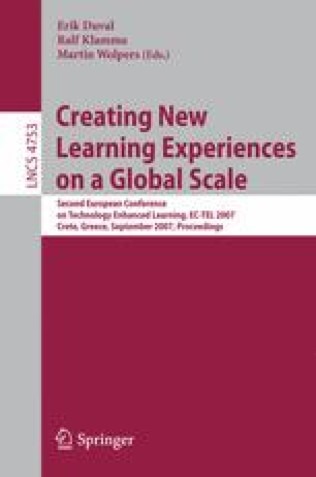
Creating New Learning Experiences on a Global Scale ; 2nd European Conference on Technology Enhanced Learning, EC-TEL 2007, Crete, Greece, September 17-20, 2007, Proceedings
It is holding more than 500 pages of combined wisdom on Technology Enhanced Learning (TEL) in your hands! With the advance of metadata, standards, learning objects, Web 2. 0 approaches to rip, mix and burn learning, wikis, blogs, syndication, user-generated content, W- based video, games and the ubiquitous availability of computing devices we can and have to offer more flexible learning services on a global scale.It provided a unique forum for all research related to technology enhanced learning, including its interactions with knowledge management, business processes and work environments.
