



الصفحة 47
الصفحة 47
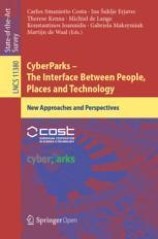
CyberParks – The Interface Between People, Places and Technology: New Approaches and Perspectives
This book is about public open spaces, about people, and about the relationship between them and the role of technology in this relationship. It is about different approaches, methods, empirical studies, and concerns about a phenomenon that is increasingly being in the centre of sciences and strategies – the penetration of digital technologies in the urban space. As the main outcome of the CyberParks Project, this book aims at fostering the understanding about the current and future interactions of the nexus people, public spaces and technology. It addresses a wide range of challenges and multidisciplinary perspectives on emerging phenomena related to the penetration of technology in people’s lifestyles - affecting therefore the whole society, and with this, the production and use of public spaces. Cyberparks coined the term cyberpark to describe the mediated public space, that emerging type of urban spaces where nature and cybertechnologies blend together to generate hybrid experiences and enhance quality of life.

Cyber Security ; 18th China Annual Conference, CNCERT 2021, Beijing, China, July 20–21, 2021, revised selected papers
This book constitutes the refereed proceedings of the 17th International Annual Conference on Cyber Security, CNCERT 2021, held in Beijing, China, in AJuly 2021. The 14 papers presented were carefully reviewed and selected from 51 submissions. The papers are organized according to the following topical sections: data security; privacy protection; anomaly detection; traffic analysis; social network security; vulnerability detection; text classification.

Cyber security ; 17th China Annual Conference, CNCERT 2020, Beijing, China, August 12, 2020, revised selected papers
This book constitutes the refereed proceedings of the 16th International Annual Conference on Cyber Security, CNCERT 2020, held in Beijing, China, in August 2020.

Cyber Security ; 15th International Annual Conference, CNCERT 2018, Beijing, China, August 14–16, 2018, Revised Selected Papers
This book cover the following topics: emergency response, mobile internet security, IoT security, cloud security, threat intelligence analysis, vulnerability, artificial intelligence security, IPv6 risk research, cybersecurity policy and regulation research, big data analysis and industrial security.

Cyber Security : Critical Infrastructure Protection
Focus on critical infrastructure protection. The chapters present detailed analysis of the issues and challenges in cyberspace and provide novel solutions in various aspects. The first part of the book focus on digital society, addressing critical infrastructure and different forms of the digitalization, strategic focus on cyber security, legal aspects on cyber security, citizen in digital society, and cyber security training. The second part focus on the critical infrastructure protection in different areas of the critical infrastructure. The chapters cover the cybersecurity situation awareness, aviation and air traffic control, cyber security in smart societies and cities, cyber security in smart buildings, maritime cyber security, cyber security in energy systems, and cyber security in healthcare. The third part presents the impact of new technologies upon cyber capability building as well as new challenges brought about by new technologies. These new technologies are among others are quantum technology, firmware and wireless technologies, malware analysis, virtualization.

Cryptology and network security ; Vol. 3810 ; 4th International Conference, CANS 2005, Xiamen, China, December 14-16, 2005, Proceedings
Constitutes the refereed proceedings of the Conference on Cryptology and Network Security, 2005. This book covers cryptanalysis, intrusion detection and viruses, authentication and signature, signcryption, e-mail security, cryptosystems, privacy and tracing, information hiding, firewalls, denial of service and DNS security, and trust management.

Cryptology and Network Security ; 7th International Conference, CANS 2008, Hong-Kong, China, December 2-4, 2008. Proceedings
This book constitutes the refereed proceedings of the 7th International Conference on Cryptology and Network Security, CANS 2008, held in Hong-Kong, China, in December 2008.

Cryptology and Network Security ; 19th International Conference, CANS 2020, Vienna, Austria, December 14–16, 2020, Proceedings
This book constitutes the refereed proceedings of the 19th International Conference on Cryptology and Network Security, CANS 2020, held in Vienna, Austria, in December 2020.* The 30 full papers were carefully reviewed and selected from 118 submissions. The papers focus on topics such as cybersecurity; credentials; elliptic curves; payment systems; privacy-enhancing tools; lightweight cryptography; and codes and lattices.
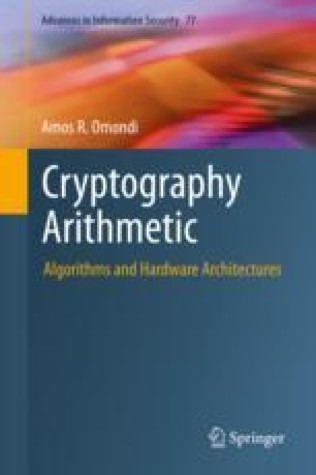
Cryptography Arithmetic : Algorithms and Hardware Architectures
Modern cryptosystems, used in numerous applications that require secrecy or privacy - electronic mail, financial transactions, medical-record keeping, government affairs, social media etc. - are based on sophisticated mathematics and algorithms that in implementation involve much computer arithmetic. And for speed it is necessary that the arithmetic be realized at the hardware (chip) level. This book is an introduction to the implementation of cryptosystems at that level.

Cryptographic hardware and embedded systems - CHES 2008 ; 10th International Workshop, Washington, D.C., USA, August 10-13, 2008. Proceedings
This book constitutes the refereed proceedings of the 10th Interntaional Workshop on Cryptographic Hardware and Embedded Systems, CHES 2008, held in Washington, D.C., USA, during August 10-13, 2008.

Cryptographic hardware and embedded systems - CHES 2007 ; 9th International Workshop, Vienna, Austria, September 10-13, 2007, Proceedings
The papers collected in this volume represent cutting-edge world wide research in the rapidly evolving fields of crypto-hardware, fault-based and side-channel cryptanalysis, and embedded cryptography, at the crossing of academic and - dustrial research. The wide diversity of subjects appearing in these proceedings covers virtually all related areas and shows our e?orts to extend the scope of CHES more than usual.

Cryptographic hardware and embedded systems - CHES 2006 ; 8th International Workshop, Yokohama, Japan, October 10-13, 2006, Proceedings
These are the proceedings of the Eighth Workshop on Cryptographic Hardware and Embedded Systems (CHES 2006) held in Yokohama, Japan, October 10-13, 2006. The CHES workshophas been sponsored by the International Association for Cryptographic Research (IACR) since 2004. The ?rst and the second CHES workshops were held in Worcester in 1999 and 2000, respectively, followed by Paris in 2001, San Francisco Bay Area in 2002, Cologne in 2003, Boston in 2004 and Edinburgh in 2005. This is the ?rst CHES workshop held in Asia.

Cryptographic hardware and embedded systems - CHES 2005 ; 7th International Workshop, Edinburgh, UK, August 29 - September 1, 2005, Proceedings
Constitutes the refereed proceedings of the 7th International Workshop on Cryptographic Hardware and Embedded Systems, CHES 2005, held in Edinburgh, UK in August/September 2005. The papers in this book are organized in topical sections on side channels, arithmetic for cryptanalysis, special purpose hardware, hardware attacks and more.

Critical Information Infrastructured Security ; 1st International Workshop, CRITIS 2006, Samos Island, Greece, August 31 - September 1, 2006
This volume contains the proceedings of the 1st International Workshop on Critical Information Infrastructure Security (CRITIS 2006), that was held between August 31 and September 1, 2006 on Samos, Greece, and was hosted by the University of the Aegean, Department of Information and Communication Systems Engineering, Laboratory of Information and Communication Systems Security (Info-Sec-Lab). In response to the CRITIS 2006 call for papers, 57 papers were submitted.

Crime detection camera
This paper presents a comprehensive crime detection system that uses a combination of hardware and software to monitor homes and communities in real time. The system consists of a Raspberry Pi 4B, a Raspberry Pi Camera V2, a flame sensor, an MQ-6 gas sensor, and a microphone, which are all connected to a database management system powered by MySQL. The data collected from these devices is analyzed by machine learning algorithms to detect crimes, such as theft or robbery, as well as fires and gas leaks. The system also includes a mobile app, ‘Safe Home’ which provides live video monitoring and real-time notifications to users, and an employee dashboard to monitor all statistics and manage all implemented systems.

Creative applications of artificial intelligence in education
Explores the synergy between AI and education, highlighting its potential impact on pedagogical practices. It navigates the evolving landscape of AI-powered educational technologies and suggests practical ways to personalise instruction, nurture human-AI co-creativity, and transform the learning experience. Spanning from primary to higher education, this short and engaging volume proposes concrete examples of how educational stakeholders can be empowered in their AI literacy to foster creativity, inspire critical thinking, and promote problem-solving by embracing AI as a tool for expansive learning. Structured in three parts, the book starts developing the creative engagement perspective for learning and teaching to then present practical applications of AI in K-12 and higher education, covering different fields (teacher education, professional education, business education) as well as different types of AI supported tools (games, chatbots, and AI assisted assessment).

Creating Web-based Laboratories
Remote web-based experimentation, enabling students and researchers to access the laboratory anytime via the Internet, is becoming an increasingly attractive way to complement or even replace traditional laboratory sessions. Placing a video camera & microphone before the equipment and apparatus to capture what is actually happening in the laboratory allows the images and audio data to be streamed to the client side. Researchers in different countries can share equipment and conduct research cooperatively and remotely. The authors summarise their research and discuss the development of the 5 web-based laboratories launched from the National University of Singapore. The principles, structure, and technologies required for the creation of Internet remote experimentation systems are discussed with particular emphasis on the integration of hardware and software systems. Also highlighted is the design and development of interfaces and components for use in typical web-based laboratories or similar web-control applications.

Creating New Learning Experiences on a Global Scale ; 2nd European Conference on Technology Enhanced Learning, EC-TEL 2007, Crete, Greece, September 17-20, 2007, Proceedings
It is holding more than 500 pages of combined wisdom on Technology Enhanced Learning (TEL) in your hands! With the advance of metadata, standards, learning objects, Web 2. 0 approaches to rip, mix and burn learning, wikis, blogs, syndication, user-generated content, W- based video, games and the ubiquitous availability of computing devices we can and have to offer more flexible learning services on a global scale.It provided a unique forum for all research related to technology enhanced learning, including its interactions with knowledge management, business processes and work environments.

Creating Flash Widgets with Flash CS4 and ActionScript 3.0
Creating Flash Widgets with Flash CS4 and ActionScript 3.0 is an introduction to developing widgets for the Internet using the features of Flash CS4 and ActionScript 3.0. Many social-networking sites, blogs, and personal home pages have adopted the use of widgets and Flash developers can create and distribute their own widgets for others to use. A step-by-step example demonstrates how to design and develop your own Flash widgets and integrate them with XML. In addition, publishing, promoting, and capitalizing on your Flash widgets is discussed.

Creating Cool MINDSTORMS® NXT Robots
Build and program MINDSTORM NXT robots with Daniele Benedettelli, one of the world's most respected NXT robot builders. He shows you how to build and program them from scratch, starting with the simplest robots and progressing in difficulty to a total of seven award–winning robots! You can download all the code, along with low–resolution videos that show how your robot works when it's finished. You don't need to be a programmer to develop these cool robots, because all the code is provided, but advanced developers will enjoy seeing the secrets of Benedettelli's code and techniques revealed.
