



الصفحة 46
الصفحة 46

Data mining and machine learning applications
Elaborates in detail on the current needs of data mining and machine learning and promotes mutual understanding among research in different disciplines, thus facilitating research development and collaboration. Data, the latest currency of today’s world, is the new gold. In this new form of gold, the most beautiful jewels are data analytics and machine learning. Data mining and machine learning are considered interdisciplinary fields. Data mining is a subset of data analytics and machine learning involves the use of algorithms that automatically improve through experience based on data.

Data mining and knowledge management ; Chinese academy of sciences symposium CASDMKD 2004, Beijing, China, July 12-14, 2004, Revised Paper
Knowledge management for enterprise: These papers address various issues related to the application of knowledge management in corporations using various techniques. A particular emphasis here is on coordination and cooperation. • Risk management: Better knowledge management also requires more advanced techniques for risk management, to identify, control, and minimize the impact of uncertain events, as shown in these papers, using fuzzy set theory and other approaches for better risk management. • Integration of data mining and knowledge management: As indicated earlier, the integration of these two research fields is still in the early stage. Nevertheless, as shown in the papers selected in this volume, researchers have endearored to integrate data mining methods such as neural networks with various aspects related to knowledge management,

Data Management. Data, Data Everywhere ; 24th British National Conference on Databases, BNCOD 24, Glasgow, UK, July 3-5, 2007, Proceedings
One of the most pressing challenges is to ?nd ways of evolving database technology to cope with its new role in underpinning the massively distributed and heterogeneous applications built on top of the Internet. This has afiected both the ways in which data has been accessed and the ways in which it is represented, with XML data management becoming an important issue and, as such, heavily represented at this conference. It has also brought back issues of performance that might have been considered largely solved by the improvements in hardware, since data now has to be managed on devices of low power and small memory as well as on standard client and powerful server machines. We therefore invited papers on all aspects of data management, particularly related to how dataisused in the ubiquitous environment of the modern Internet by complex distributed and scientific applications.

Data Management Technologies and Applications ; 8th International Conference, DATA 2019, Prague, Czech Republic, July 26–28, 2019, Revised Selected Papers
This book constitutes the thoroughly refereed proceedings of the 8th International Conference on Data Management Technologies and Applications, DATA 2019, held in Prague, Czech Republic, in July 2019. The 8 revised full papers were carefully reviewed and selected from 90 submissions. The papers deal with the following topics: decision support systems, data analytics, data and information quality, digital rights management, big data, knowledge management, ontology engineering, digital libraries, mobile databases, object-oriented database systems, and data integrity.

Data Management in Grid and Peer-to-Peer Systems ; 1st International Conference, Globe 2008, Turin, Italy, September 3, 2008. Proceedings
This book constitutes the refereed proceedings of the First International Conference on Data Management in Grid and Peer-to-Peer Systems, Globe 2008, held in Turin, Italy, in September 2008.

Data management in a connected world : Essays dedicated to Hartmut Wedekind on the occasion of his 70th birthday
Data management systems play the most crucial role in building large application s- tems. Since modern applications are no longer single monolithic software blocks but highly flexible and configurable collections of cooperative services, the data mana- ment layer also has to adapt to these new requirements. Therefore, within recent years, data management systems have faced a tremendous shift from the central management of individual records in a transactional way to a platform for data integration, fede- tion, search services, and data analysis. This book addresses these new issues in the area of data management from multiple perspectives, in the form of individual contributions, and it outlines future challenges in the context of data management.

Data Integration in the Life Sciences ; Vol. 4075 ; 3rd International Workshop, DILS 2006, Hinxton, UK, July 20-22, 2006, Proceedings
Data management and data integration are fundamental problems in the life sciences. Advances in molecular biology and molecular medicine are almost u- versallyunderpinned by enormouse?orts in data management,data integration, automatic data quality assurance, and computational data analysis. Many hot topics in the life sciences, such as systems biology, personalized medicine, and pharmacogenomics, critically depend on integrating data sets and applications producedby di?erent experimentalmethods, in di?erent researchgroups,andat di?erent levels of granularity.

Data Integration in the Life Sciences ; 5th International Workshop, DILS 2008, Evry, France, June 25-27, 2008. Proceedings
This book constitutes the refereed proceedings of the 5th International Workshop on Data Integration in the Life Sciences, DILS 2008, held in Evry, France in June 2008.

Data Integration in the Life Sciences ; 4th International Workshop, DILS 2007, Philadelphia, PA, USA, June 27-29, 2007, Proceedings
it cover a wide spectrum of theoretical and practical issues including scienti?c work?ows, - notation in data integration, mapping and matching techniques, and modeling of life science data. It presenting research on new models, methods, or algorithms and 6 papers presenting imp- mentation of systems or experience with systems in practice.

Data Communications and Networking with TCP
Teaches the principles of networking using TCP/IP protocol suite. It employs a bottom-up approach where each layer in the TCP/IP protocol suite is built on the services provided by the layer below.

Data Communications and networking
Helps students understand the basics of data communications and networking, and the protocols used in the Internet in particular by using the protocol layering of the Internet and TCP/IP protocol suite. Technologies related to data communication and networking may be the fastest growing in today's culture.

Data Center Handbook : Plan, Design, Build, and Operations of a Smart Data Center ; 2nd ed.
Explains the fundamentals, advanced technologies, and best practices used in planning, designing, building and operating a mission-critical, energy-efficient, sustainable data center. This handbook, in its second edition, covers anatomy, ecosystem and taxonomy of data centers that enable the Internet of Things and artificial intelligent ecosystems and encompass the following: Data center overview and strategic planning Data center technologies Data center design and construction Data center operations technologies

Data and Computer Communications
It is ideal for one/two-semester courses in Computer Networks, Data Communications, and Communications Networks in CS, CIS, and Electrical Engineering departments. This book is also suitable for Product Development personnel, Programmers, Systems Engineers, Network Designers and others involved in the design of data communications and networking products. With a focus on the most current technology and a convenient modular format, this best-selling text offers a clear and comprehensive survey of the entire data and computer communications field. Emphasizing both the fundamental principles as well as the critical role of performance in driving protocol and network design, it explores in detail all the critical technical areas in data communications, wide-area networking, local area networking, and protocol design.

Data and applications security XXII ; 22nd Annual IFIP WG 11.3 Working Conference on data and applications security London, UK, July 13-16, 2008 Proceedings
This volume contains the papers presented at the 22nd Annual IFIP WG 11.3 Working Conference on Data and Applications Security (DBSEC) held in L- don, UK, July 13–16, 2008.
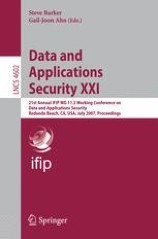
Data and applications security XXI ; 21st Annual IFIP WG 11.3 Working Conference on data and applications security, Redondo Beach, CA, USA, July 8-11, 2007, Proceedings
This book presented secure query evaluation, location-based security/mobile security, distributed security issues, cryptographic-based security, temporal access control and usage control, as well as system security issues.

Data and applications security and privacy XXXIV ; 34th Annual IFIP WG 11.3 Conference, DBSec 2020, Regensburg, Germany, June 25–26, 2020, Proceedings
This book constitutes the refereed proceedings of the 34th Annual IFIP WG 11.3 Conference on Data and Applications Security and Privacy, DBSec 2020, held in Regensburg, Germany, in June 2020.* The 14 full papers and 8 short papers presented were carefully reviewed and selected from 39 submissions. The papers present high-quality original research from academia, industry, and government on theoretical and practical aspects of information security. They are organized in topical sections named network and cyber-physical systems security; information flow and access control; privacy-preserving computation; visualization and analytics for security; spatial systems and crowdsourcing security; and secure outsourcing and privacy.

Cybersecurity of Digital Service Chains : Challenges, Methodologies, and Tools
This book presents the main scientific results from the H2020 GUARD project. The GUARD project aims at filling the current technological gap between software management paradigms and cybersecurity models, the latter still lacking orchestration and agility to effectively address the dynamicity of the former. This book provides a comprehensive review of the main concepts, architectures, algorithms, and non-technical aspects developed during three years of investigation; the description of the Smart Mobility use case developed at the end of the project gives a practical example of how the GUARD platform and related technologies can be deployed in practical scenarios.

Cyber-physical systems of systems : Foundations : A conceptual model and some derivations : The AMADEOS legacy
Technical Systems-of-Systems (SoS) – in the form of networked, independent constituent computing systems temporarily collaborating to achieve a well-defined objective – form the backbone of most of today’s infrastructure. The energy grid, most transportation systems, the global banking industry, the water-supply system, the military equipment, many embedded systems, and a great number more, strongly depend on systems-of-systems. The correct operation and continuous availability of these underlying systems-of-systems are fundamental for the functioning of our modern society.

Cyber-physical systems : Foundations and techniques
Covers the various aspects associated with Cyber-Physical Systems (CPS) such as algorithms, application areas, and the improvement of existing technology such as machine learning, big data and robotics. The scope of CPS is tremendous. In CPS, one sees the applications of various emerging technologies such as artificial intelligence (AI), Internet of Things (IoT), machine learning (ML), deep learning (DL), big data (BD), robotics, quantum technology, etc. In almost all sectors, whether it is education, health, human resource development, skill improvement, startup strategy, etc., one sees an enhancement in the quality of output because of the emergence of CPS into the field.

Cyber-physical systems : A model-based approach
In this concise yet comprehensive textbook, future inventors are introduced to the key concepts of Cyber-Physical Systems (CPS). Using modeling as a way to develop deeper understanding of the computational and physical components of these systems, one can express new designs in a way that facilitates their simulation, visualization, and analysis. Concepts are introduced in a cross-disciplinary way.
