



الصفحة 41
الصفحة 41

An introduction to ontology engineering
Provides the reader with a comprehensive introductory overview of ontology engineering. A secondary aim is to provide hands-on experience in ontology development that illustrate the theory. The book is divided into three blocks: Block I: logic foundations for ontologies both regarding the languages (mainly First Order predicate Logic, Description Logics, and OWL) and automated reasoning. Block II: developing good ontologies with methods and methodologies, the top-down approach with foundational ontologies, and the bottom-up approach to extract as much useful content as possible from legacy material. Block III: advanced topics with a selection of areas of specialisation, including Ontology-Based Data Access, the interaction between ontologies and natural languages (multilingual ontologies, controlled natural language), and advanced modelling with additional language features (fuzzy and temporal ontologies)
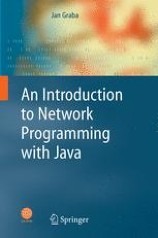
An Introduction to Network Programming with Java
This book provides an overview of Java … . Each chapter is supplemented with practical programming exercises.The combination of code templates with good supporting discussions allows a competent Java programmer to rapidly expand his or her skill base to include network programming.

An Introduction to Kolmogorov Complexity and Its Applications
Written by two experts in the field, this book is ideal for advanced undergraduate students, graduate students, and researchers in all fields of science. It is self-contained: it contains the basic requirements from mathematics, probability theory, statistics, information theory, and computer science. Included are history, theory, new developments, a wide range of applications, numerous (new) problem sets, comments, source references, and hints to solutions of problems. This is the only comprehensive treatment of the central ideas of Kolmogorov complexity and their applications.

An Introduction to Knowledge Engineering
Knowledge Engineering refers to the development of systems that use knowledge, rather than data, to solve many novel computing problems. This is achieved by the application of computing techniques, closely associated with human cognitive processes, for transforming data into knowledge. An Introduction to Knowledge Engineering presents a simple but detailed exploration of current and established work in the field.

An introduction to description logics
Designed so that domain knowledge can be described and so that computers can reason about this knowledge. DLs have recently gained increased importance since they form the logical basis of widely used ontology languages, in particular the web ontology language OWL. Written by four renowned experts, this is the first textbook on description logics. It is suitable for self-study by graduates and as the basis for a university course. Starting from a basic DL, the book introduces the reader to their syntax, semantics, reasoning problems and model theory and discusses the computational complexity of these reasoning problems and algorithms to solve them.

Ambisonics : A Practical 3D Audio Theory for Recording, Studio Production, Sound Reinforcement, and Virtual Reality
Provides a concise explanation of the fundamentals and background of the surround sound recording and playback technology Ambisonics. It equips readers with the psychoacoustical, signal processing, acoustical, and mathematical knowledge needed to understand the inner workings of modern processing utilities, special equipment for recording, manipulation, and reproduction in the higher-order Ambisonic format. The book comes with various practical examples based on free software tools and open scientific data for reproducible research. The book includes an extensive mathematical appendix. The book offers readers a deeper understanding of Ambisonic technologies, and will especially benefit scientists, audio-system and audio-recording engineers.

Alternative breast imaging : Four model-based approaches
Medical imaging has been transformed over the past 30 years by the advent of computerized tomography (CT), magnetic resonance imaging (MRI), and various advances in x-ray and ultrasonic techniques. An enabling force behind this progress has been the (so far) exponentially increasing power of computers, which has made it practical to explore fundamentally new approaches. In particular, what our group terms "model-based" modalities-which produce tissue property images from data using nonlinear, iterative numerical modeling techniques-have become increasingly feasible. Alternative Breast Imaging: Four Model-Based Approaches explores our research on four such modalities, particularly with regard to imaging of the breast: (1) MR elastography (MRE), (2) electrical impedance spectroscopy (EIS), (3) microwave imaging spectroscopy (MIS), and (4) near infrared spectroscopic imaging (NIS).
Algorithms on Trees and Graphs : With Python Code
Introduces graph algorithms on an intuitive basis followed by a detailed exposition using structured pseudocode, with correctness proofs as well as worst-case analyses. Centered around the fundamental issue of graph isomorphism, the content goes beyond classical graph problems of shortest paths, spanning trees, flows in networks, and matchings in bipartite graphs. Advanced algorithmic results and techniques of practical relevance are presented in a coherent and consolidated way. Numerous illustrations, examples, problems, exercises, and a comprehensive bibliography support students and professionals in using the book as a text and source of reference. Furthermore, Python code for all algorithms presented is given in an appendix. Topics and features: Algorithms are first presented on an intuitive basis, followed by a detailed exposition using structured pseudocode / Correctness proofs are given, together with a worst-case analysis of the algorithms / Full implementation of all the algorithms in Python / An extensive chapter is devoted to the algorithmic techniques used in the book / Solutions to all the problems
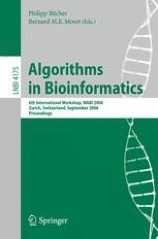
Algorithms in Bioinformatics ; Vol.4175 : 6th International Workshop, WABI 2006, Zurich, Switzerland, September 11-13, 2006, Proceedings
This book constitutes the refereed proceedings of the 6th International Workshop on Algorithms in Bioinformatics, WABI 2006, held in Zurich, Switzerland in September 2006 in the course of the ALGO 2006 conference meetings. The 36 revised full papers presented were carefully reviewed and selected from 100 submissions. All current issues of algorithms in bioinformatics are addressed, ranging from mathematical tools to experimental studies of approximation algorithms and reports on significant computational analyses. Numerous biological problems are dealt with, including genetic mapping, sequence alignment and sequence analysis, phylogeny, comparative genomics, and protein structure. For the first time also machine-learning approaches along with combinatorial optimization are covered.
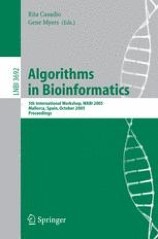
Algorithms in Bioinformatics ; Vol. 3692 ; 5th international workshop, WABI 2005, Mallorca, Spain, October 3-6, 2005, Proceedings
this book present the proceedings of the 5th Workshop on Algorithmsin Bioinformatics (WABI 2005) which took place in Spain, 2005. The Workshop on Algorithms in Bioinformatics highlights research workspecifically developed to address algorithmic problems in biosequence analysis. The emphasis is therefore on statistical and probabilistic algorithms that addressimportant problems in the field of molecular and structural biology. the workshop aims to present recent research results, includingsignificant work in progress, and to identify and explore directions of futureresearch.Original research papers (including significant work in progress) or state-of-the-art surveys were solicited on all aspects of algorithms in bioinformatics,including, but not limited to: exact and approximate algorithms for genomics,genetics, sequence analysis, gene and signal recognition, alignment, molecularevolution, phylogenetics, structure determination or prediction, gene expressionand gene networks, proteomics, functional genomics, and drug design.

Algorithms in Bioinformatics ; 7th International Workshop, WABI 2007, Philadelphia, PA, USA, September 8-9, 2007, Proceedings
All current issues of algorithms in bioinformatics are addressed, ranging from mathematical tools to experimental studies of approximation algorithms and reports on significant computational analyses. Numerous biological problems are dealt with, including genetic mapping, sequence alignment and sequence analysis, phylogeny, comparative genomics, and protein structure. Furthermore the papers feature high-performance computing approaches to computationally hard learning and optimization problems in bioinformatics and cover methods, software and dataset repositories for development and testing of such algorithms and their underlying models.
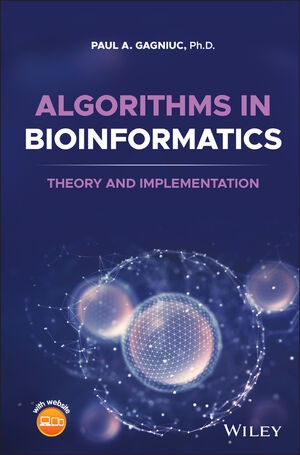
Algorithms in Bioinformatics : Theory and Implementation
Explores a comprehensive and insightful treatment of the practical application of bioinformatic algorithms in a variety of fields. Delivers a fulsome treatment of some of the main algorithms used to explain biological functions and relationships. It introduces readers to the art of algorithms in a practical manner which is linked with biological theory and interpretation. The book covers many key areas of bioinformatics, including global and local sequence alignment, forced alignment, detection of motifs, Sequence logos, Markov chains or information entropy. Other novel approaches are also described, such as Self-Sequence alignment, Objective Digital Stains (ODSs) or Spectral Forecast and the Discrete Probability Detector (DPD) algorithm. Readers will also benefit from the inclusion of: A detailed presentation of new methods, such as Self-sequence alignment, Objective Digital Stains and Spectral Forecast ; A treatment of sequence alignment, including local sequence alignment, global sequence alignment and forced sequence alignment with full implementations ; Discussions of position-specific weight matrices, including the count, weight, relative frequencies, and log-likelihoods matrices ; A detailed presentation of the methods related to Markov Chains as well as a description of their implementation in Bioinformatics and adjacent fields ; An examination of information and entropy, including sequence logos and explanations related to their meaning ; A chapter on philosophical transactions that allows the reader a broader view of the prediction process ; Extensive worked examples with detailed case studies that point out the meaning of different results
Algorithms and Programming : Problems and Solutions
This book containing classical and well-known problems supplemented by clear and in-depth explanations. The material covered includes such topics as combinatorics, sorting, searching, queues, grammar and parsing, selected well-known algorithms and much more.
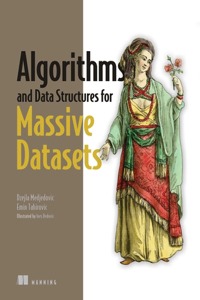
Algorithms and data structures for massive datasets
Learn: Probabilistic sketching data structures for practical problems Choosing the right database engine for your application Evaluating and designing efficient on-disk data structures and algorithms Understanding the algorithmic trade-offs involved in massive-scale systems Deriving basic statistics from streaming data Correctly sampling streaming data Computing percentiles with limited space resources Algorithms and Data Structures for Massive Datasets reveals a toolbox of new methods that are perfect for handling modern big data applications. You'll explore the novel data structures and algorithms that underpin Google, Facebook, and other enterprise applications that work with truly massive amounts of data. These effective techniques can be applied to any discipline, from finance to text analysis. Graphics, illustrations, and hands-on industry examples make complex ideas practical to implement in your projects--and there's no mathematical proofs to puzzle over. Work through this one-of-a-kind guide, and you'll find the sweet spot of saving space without sacrificing your data's accuracy. About the Technology Standard algorithms and data structures may become slow--or fail altogether--when applied to large distributed datasets. Choosing algorithms designed for big data saves time, increases accuracy, and reduces processing cost.
Algorithms and computation ; Vol. 3827 ; 16th International symposium, ISAAC 2005, Sanya, Hainan, China, December 19-21, 2005, Proceedings
This book constitutes the refereed proceedings of the 16th International Symposium on Algorithms and Computation, ISAAC 2005, held in China in 2005. The 112 revised full papers presented were carefully reviewed and selected from 549 submissions. The papers are organized in topical sections on computational geometry, computational optimization, graph drawing and graph algorithms, computational complexity, approximation algorithms, internet algorithms, quantum computing and cryptography, data structure, computational biology, experimental algorithm mehodologies and online algorithms, randomized algorithms, parallel and distributed algorithms, graph drawing and graph algorithms, computational complexity, combinatorial optimization, computational biology, computational complexity, computational optimization, computational geometry, approximation algorithms, graph drawing and graph algorithms, computational geometry, approximation algorithms, graph drawing and graph algorithms, and data structure.

Algorithms and architectures for parallel processing ; 7th International Conference, ICA3PP 2007, Hangzhou, China, June 11-14, 2007, Proceedings
The improvements in computation and communication capabilities have enabled the creation of demanding applications in critical domains such as the environment, health, aerospace, and other areas of science and technology. Similarly, new classes of applications are enabled by the availability of heterogeneous large-scale distributed systems which are becoming available nowadays (based on technologies such as grid and peer-to-peer systems).Parallel computing systems exploit a large diversity of computer architectures, from supercomputers, shared-memory or distributed-memory multi processors, to local networks and clusters of p- sonal computers. With the recent emergence of multi core architectures, parallel computing is now set to achieve “mainstream” status. Approaches that have been advocated by parallel computing researchers in the past are now being utilized in a number of software libraries and hardware systems that are available for everyday use. Parallel computing ideas have also come to dominate areas such as multi user gaming (especially in the development of gaming engines based on “cell” arc- tectures).

Algorithmic Learning in a Random World
This new monograph integrates mathematical theory and revealing experimental work. It demonstrates mathematically the validity of the reliability claimed by conformal predictors when they are applied to independent and identically distributed data, and it confirms experimentally that the accuracy is sufficient for many practical problems. Later chapters generalize these results to models called repetitive structures, which originate in the algorithmic theory of randomness and statistical physics. The approach is flexible enough to incorporate most existing methods of machine learning, including newer methods such as boosting and support vector machines and older methods such as nearest neighbors and the bootstrap.
Algorithmic Aspects of Bioinformatics
Advances in bioinformatics and systems biology require improved computational methods for analyzing data, while progress in molecular biology is in turn influencing the development of computer science methods. This book introduces some key problems in bioinformatics, discusses the models used to formally describe these problems, and analyzes the algorithmic approaches used to solve them. After introducing the basics of molecular biology and algorithmics, Part I explains string algorithms and alignments; Part II details the field of physical mapping and DNA sequencing; and Part III examines the application of algorithmics to the analysis of biological data. Exciting application examples include predicting the spatial structure of proteins, and computing haplotypes from genotype data. This book describes topics in detail and presents formal models in a mathematically precise, yet intuitive manner, with many figures and chapter summaries, detailed derivations, and examples. It is well suited as an introduction into the field of bioinformatics, and will benefit students and lecturers in bioinformatics and algorithmics, while also offering practitioners an update on current research topics.

Algebraic Biology ; 3rd International Conference, AB 2008, Castle of Hagenberg, Austria, July 31-August 2, 2008 Proceedings
This book constitutes the refereed proceedings of the Third International Conference on Algebraic Biology, AB 2008, held at the Castle of Hagenberg, Austria in July 2008 as part of the RISC Summer 2008, organized by the Research Institute for Symbolic Computation.

Ajax Patterns and Best Practices
Ajax is taking us into the next generation of web applications. Ajax has broken the client-server barrier by decoupling the client from the server, but an Ajax application still needs a server to extract content from. The most effective use of Ajax and the server requires an understanding of REST, an architectural style used to define Web services. Ajax Patterns and Best Practices explores dynamic web applications that combine Ajax and REST as a single solution. A major advantage of REST is that, like Ajax, it can be used with today's existing technologies.
