



الصفحة 4
الصفحة 4
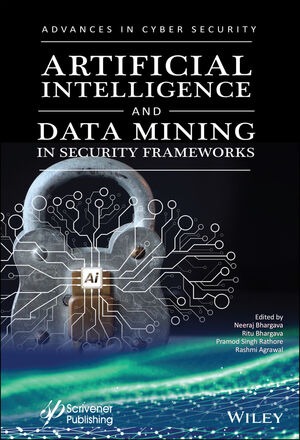
Artificial intelligence and data mining approaches in security frameworks
Offers solutions to the problems of security, outlining the concepts behind allowing computers to learn from experience and understand the world in terms of a hierarchy of concepts, with each concept defined through its relation to simpler concepts. provides state of the art approaches of artificial intelligence and data mining in these areas. It includes areas of detection, prediction, as well as future framework identification, development, building service systems and analytical aspects. In all these topics, applications of AI and data mining, such as artificial neural networks, fuzzy logic, genetic algorithm and hybrid mechanisms, are explained and explored. This book is aimed at the modeling and performance prediction of efficient security framework systems, bringing to light a new dimension in the theory and practice. This groundbreaking new volume presents these topics and trends, bridging the research gap on AI and data mining to enable wide-scale implementation. Whether for the veteran engineer or the student, this is a must-have for any library. This groundbreaking new volume: Clarifies the understanding of certain key mechanisms of technology helpful in the use of artificial intelligence and data mining in security frameworks ; Covers practical approaches to the problems engineers face in working in this field, focusing on the applications used every day ; Contains numerous examples, offering critical solutions to engineers and scientists ; Presents these new applications of AI and data mining that are of prime importance to human civilization as a whole
Anticipatory Behavior in Adaptive Learning Systems : From Brains to Individual and Social Behavior
Anticipatory behavior in adaptive learning systems is steadily gaining the - terest of scientists, although many researchers still do not explicitly consider the actual anticipatory capabilities of their systems.The introductory chapter of this volume therefore does not only provide an overview of the contributions included in this volume but also proposes a taxonomy of how anticipatory mechanisms can improve adaptive behavior and learning in cognitive systems. During the workshop it became clear that ant- ipations are involved in various cognitive processes that range from individual anticipatory mechanisms to social anticipatory behavior.

An Introduction to Language Processing with Perl and Prolog : An Outline of Theories, Implementation, and Application with Special Consideration of English, French, and German
This book teaches the principles of natural language processing, first covering linguistics issues such as encoding, entropy, and annotation schemes; defining words, tokens and parts of speech; and morphology. It then details the language-processing functions involved, including part-of-speech tagging using rules and stochastic techniques; using Prolog to write phase-structure grammars; parsing techniques and syntactic formalisms; semantics, predicate logic and lexical semantics; and analysis of discourse, and applications in dialog systems. The key feature of the book is the author's hands-on approach throughout, with extensive exercises, sample code in Prolog and Perl, and a detailed introduction to Prolog. The reader is supported with a companion website that contains teaching slides, programs, and additional material.

Agent-oriented software engineering V ; 5th International workshop, AOSE 2004, New York, NY, USA, July 2004, revised selected papers
The explosive growth of application areas such as electronic commerce, ent- prise resource planning and mobile computing has profoundly and irreversibly changed our views on software systems. Nowadays, software is to be based on open architectures that continuously change and evolve to accommodate new components and meet new requirements. Software must also operate on di?- ent platforms, without recompilation, and with minimal assumptions about its operating environment and its users. Furthermore, software must be robust and ¨ autonomous, capable of serving a naive user with a minimum of overhead and interference. Agent concepts hold great promise for responding to the new realities of software systems. They o?er higher-level abstractions and mechanisms which address issues such as knowledge representation and reasoning, communication, coordination, cooperation among heterogeneous and autonomous parties, p- ception, commitments, goals, beliefs, and intentions, all of which need conceptual modelling. On the one hand, the concrete implementation of these concepts can lead to advanced functionalities.

Agent-oriented information systems II ; 6th International bi-conference workshop, AOIS 2004, Riga, Latvia, June 8, 2004 and New York, NY, USA, July 20, 2004, revised selected papers
Information systems have become the backbone of all kinds of organizations - day. In almost every sector – manufacturing, education, health care, government and businesses large and small – information systems are relied upon for - eryday work, communication, information gathering and decision-making. Yet, the in?exibilities in current technologies and methods have also resulted in poor performance, incompatibilities and obstacles to change. As many organizations are reinventing themselves to meet the challenges of global competition and e-commerce, there is increasing pressure to develop and deploy new technologies that are ?exible, robust and responsive to rapid and unexpected change. Agent concepts hold great promise for responding to the new realities of - formation systems. They o?er higher-level abstractions and mechanisms which address issues such as knowledge representation and reasoning, communication, coordination, cooperation among heterogeneous and autonomous parties, p- ception, commitments, goals, beliefs, intentions, etc., all of which need conc- tual modelling. On the one hand, the concrete implementation of these concepts can lead to advanced functionalities.
Agent-mediated electronic commerce VI ; Theories for and engineering of distributed mechanisms and systems, AAMAS 2004 Workshop, Amec 2004, New York, NY, USA, July 19, 2004, revised selected papers
The design of intelligent trading agents, mechanisms, and systems has receivedgrowing atttention in the agents and multiagent systems communities in aneffort to address the increasing costs of search, transaction, and coordinationwhich follows from the increasing number of Internet-enabled distibuted elec-tronic markets. Furthermore, new technologies and supporting business modelsare resulting in a growing volume of open and horizontally integrated markets fortrading of an increasingly diverse set of goods and services. However, growth oftechnologies for such markets requires innovative solutions to a diverse set of ex-isting and novel technical problems which we are only beginning to understand.Specifically, distributed markets present not only traditional

Agent-mediated electronic commerce : Designing trading agents and mechanisms ; AAMAS 2005 Workshop, AMEC 2005, Utrecht, Netherlands, July 25, 2005, and IJCAI 2005 Workshop, TADA 2005, Edinburgh, UK, August 1, 2005, Selected and Revised Papers
This book constitutes the thoroughly refereed post-proceedings of the 7th International Workshop on Agent-Mediated Electronic Commerce, AMEC VII 2005, held in Utrecht, Netherlands in July 2005, as part of AAMAS 2005, and the third Workshop on Trading Agent Design and Analysis, TADA 2005, held in Edinburgh, UK in August 2005, in the course of the IJCAI 2005 conference meetings. The seven revised full AMEC 2005 papers presented were carefully selected.

Agent and multi-agent systems : Technologies and applications ; 1st KES International Symposium, KES-AMSTA 2007, Wroclaw, Poland, May 31-June 1, 2007, Proceedings
The aim of the symposium was to provide an international forum for scientific - search in the technologies and applications of agent and multi-agent systems. Agents and multi-agent systems are related to the modern software which has long been r- ognized as a promising technology for constructing autonomous, complex and intel- gent systems. A key development in the field of agent and multi-agent systems has been the specification of agent communication languages and formalization of - tologies. Agent communication languages are intended to provide standard decla- tive mechanisms for agents to communicate knowledge and make requests of each other, whereas ontologies are intended for conceptualization of the knowledge - main.
Access Control Systems : Security, Identity Management and Trust Models
Access Control Systems: Security, Identity Management and Trust Models provides a thorough introduction to the foundations of programming systems security, delving into identity management, trust models, and the theory behind access control models. The book details access control mechanisms that are emerging with the latest Internet programming technologies, and explores all models employed and how they work. The latest role-based access control (RBAC) standard is also highlighted.
Abstract Computing Machines : A Lambda Calculus Perspective
The book addresses ways and means of organizing computations, highlighting the relationship between algorithms and the basic mechanisms and runtime structures necessary to execute them using machines. It completely abstracts from concrete programming languages and machine architectures, taking instead the lambda calculus as the basic programming and program execution model to design various abstract machines for its correct implementation. The emphasis is on fully normalizing machines based on full-fledged beta-reductions as essential prerequisites for symbolic computations that treat functions and variables truly as first-class objects. Their weakly normalizing counterparts are shown to be functional abstract machines that sacrifice the flavors of full beta-reductions for decidedly simpler runtime structures and improved runtime efficiency. Further downgrading of the lambda calculus leads to classical imperative machines that permit side-effecting operations on the runtime environment.

A Computer Scientists Guide to Cell Biology
Provides a succinct treatment of the general concepts of cell biology, furnishing the computer scientist with the tools necessary to read and understand current literature in the field.After a brief introduction to cell biology, the text focuses on the principles behind the most-widely used experimental procedures and mechanisms, relating them to well-understood concepts in computer science. The presentation of the material has been prepared for the reader’s quick grasp of the topic: comments on nomenclature and background notes can be ascertained at a glance, and essential vocabulary is boldfaced throughout the text for easy identification.
