



الصفحة 4
الصفحة 4

Intelleger = انتليجر
The project management system is a web application designed to assist software managers in efficiently managing their projects, including websites, mobile apps, and other software initiatives. Utilizing artificial intelligence, the application streamlines project creation and management processes, offering significant benefits in terms of organization and accuracy. Managers can create projects by inputting essential details such as the name, scope, deadline, and tasks. The system generates AI-based functional and non-functional requirements tailored to the project scope using gpt2 model on Pure dataset. Managers can then review and edit these requirements as needed before finalizing the project. The application facilitates comprehensive task management by allowing managers to assign tasks to developers, edit task details, and ensure task deadlines align with project deadlines. Developers can log their start and end times automatically when they begin and complete tasks, providing accurate time tracking and performance analysis.also they can use code generation model to generate their task’s code using codebert model on concode and codesearchnet dataset Real-time notifications keep both managers and developers informed of task assignments, completions, and other critical updates.

Integration of AI and OR Techniques in Constraint Programming for Combinatorial Optimization Problems ; 5th International Conference, CPAIOR 2008 Paris, France, May 20-23, 2008 Proceedings
The 5th International Conference on Integration of AI and OR Techniques in Constraint Programming for Combinatorial Optimization Problems (CPAIOR 2008) was held in Paris, France May 20–23, 2008. The purpose of this conference series is to bring together researchers in the felds of constraint programming, artifcial intelligence, and operations research to explore ways of solving large-scale, practical optimization problems through integration and hybridization of the felds’ diferent techniques. Through the years, this research community is discovering that the felds have much in c- mon, and there has been tremendous richness in the resulting cross-fertilization of felds.

Integrated Circuit and System Design. Power and Timing Modeling, Optimization and Simulation ; Vol. 4148 ; 16th International Workshop, PATMOS 2006, Montpellier, France, September 13-15, 2006, Proceedings
Welcome to the proceedings of PATMOS 2006, the 16th in a series of international workshops. PATMOS 2006 was organized by LIRMM with CAS technical - sponsorship and CEDA sponsorship. Over the years, the PATMOS workshop has evolved into an important European event, where researchers from both industry and academia discuss and investigate the emerging challenges in future and contemporary applications, design methodologies, and tools required for the development of upcoming generations of integrated circuits and systems. The technical program of PATMOS 2006 contained state-of-the-art technical contributions, three invited talks, a special session on hearing-aid design, and an embedded tutorial. The technical program focused on timing, performance and power consumption, as well as architectural aspects with particular emphasis on modeling, design, characterization, analysis and optimization in the nanometer era. The Technical Program Committee, with the assistance of additional expert reviewers, selected the 64 papers presented at PATMOS. The papers were organized into 11 technical sessions and 3 poster sessions. As is always the case with the PATMOS workshops, full papers were required, and several reviews were received per manuscript.

Integrated Circuit and System Design. Power and Timing Modeling, Optimization and Simulation ; Vol. 3728 ; 15th International Workshop, PATMOS 2005, Leuven, Belgium, September 21-23, 2005, Proceedings
Welcome to the proceedings of PATMOS 2005, the 15th in a series of international workshops.PATMOS2005wasorganizedbyIMECwithtechnicalco-sponsorshipfrom the IEEE Circuits and Systems Society. Over the years, PATMOS has evolved into an important European event, where - searchers from both industry and academia discuss and investigate the emerging ch- lenges in future and contemporary applications, design methodologies, and tools - quired for the developmentof upcominggenerationsof integrated circuits and systems. The technical program of PATMOS 2005 contained state-of-the-art technical contri- tions, three invited talks, a special session on hearing-aid design, and an embedded - torial. The technical program focused on timing, performance and power consumption, as well as architectural aspects with particular emphasis on modeling, design, char- terization, analysis and optimization in the nanometer era. The Technical Program Committee, with the assistance of additional expert revi- ers, selected the 74 papers to be presented at PATMOS. The papers were divided into 11 technical sessions and 3 poster sessions. As is always the case with the PATMOS workshops, the review process was anonymous, full papers were required, and several reviews were carried out per paper. Beyond the presentations of the papers, the PATMOS technical program was - riched by a series of speeches offered by world class experts, on important emerging research issues of industrial relevance. Prof. Jan Rabaey, Berkeley, USA, gave a talk on “Traveling the Wild Frontier of Ulta Low-Power Design”, Dr. Sung Bae Park, S- sung, gave a presentation on “DVL (Deep Low Voltage): Circuits and Devices”, Prof.

Instrumaster
Experiments with different neural network structures and algorithms in order to achieve musical note recognition as well as musical instrument recognition, all bundled in a mobile application. It also aims to create the most effective music-learning application that works completely offline, which is hard to find in modern music applications. The paper also explores why the instrument identifying AI is solely based on Multi-Layer Perceptron (MLP) and why the note-identifying AI system was chosen to be a ML system over CNN or other deep-learning trained AI. The paper presents feature extraction methods for audio signals and files and dives deep into the process, such as FFT, MFCCs, Wavelengths, sampling rates, etc. It also touches on Logistic Regression Algorithms, their limitations, and their performance with the different use cases in the application. All these techniques are then compared side by side for maximally added value, making this research paper a good reference for any future developers looking to find optimal neural networks techniques when it comes to audio processing and analysis.

Inside deep learning : Math, algorithms, models
Journey through the theory and practice of modern deep learning, and apply innovative techniques to solve everyday data problems. In Inside Deep Learning, you will learn how to: Implement deep learning with PyTorch Select the right deep learning components Train and evaluate a deep learning model Fine tune deep learning models to maximize performance Understand deep learning terminology Adapt existing PyTorch code to solve new problems Inside Deep Learning is an accessible guide to implementing deep learning with the PyTorch framework. It demystifies complex deep learning concepts and teaches you to understand the vocabulary of deep learning so you can keep pace in a rapidly evolving field. No detail is skipped--you'll dive into math, theory, and practical applications. Everything is clearly explained in plain English.

Innovation in manufacturing networks ; 8th IFIP International Conference on information technology for balanced automation systems, Porto, Portugal, June 23–25, 2008
The IFIP series publishes state-of-the-art results in the sciences and technologies of information and communication. The scope of the series includes: foundations of computer science; software theory and practice; education; computer applications in technology; communication systems; systems modeling and optimization; information systems; computers and society; computer systems technology; security and protection in information processing systems; artificial intelligence; and human-computer interaction. Proceedings and post-proceedings of refereed international conferences in computer science and interdisciplinary fields are featured.

Infrastructure for Agents, Multi-Agent Systems, and Scalable Multi-Agent Systems ; International Workshop on Infrastructure for Scalable Multi-Agent Systems, Barcelona, Spain, June 3-7, 2000 Revised Papers
Building research grade multi-agent systems usually involves a broad variety of software infrastructure ingredients like planning, scheduling, coordination, communication, transport, simulation, and module integration technologies and as such constitutes a great challenge to the individual researcher active in the area. The book presents a collection of papers on approaches that will help make deployed and large scale multi-agent systems a reality. The first part focuses on available infrastructure and requirements for constructing research-grade agents and multi-agent systems. The second part deals with support in infrastructure and software development methods for multi-agent systems that can directly support coordination and management of large multi-agent communities; performance analysis and scalability techniques are needed to promote deployment of multi-agent systems to professionals in software engineering and information technology.

Information theory and machine learning
The recent successes of machine learning, especially regarding systems based on deep neural networks, have encouraged further research activities and raised a new set of challenges in understanding and designing complex machine learning algorithms. New applications require learning algorithms to be distributed, have transferable learning results, use computation resources efficiently, convergence quickly on online settings, have performance guarantees, satisfy fairness or privacy constraints, incorporate domain knowledge on model structures, etc. A new wave of developments in statistical learning theory and information theory has set out to address these challenges.

Information technology for balanced manufacturing systems ; IFIP TC 5, WG 5.5 7th International Conference on information technology for balanced automation systems in manufacturing and services, Niagra Falls, Ontario, Canada, September 4-6, 2006
International Federation for Information Processing The IFIP series publishes state-of-the-art results in the sciences and technologies of information and communication. The scope of the series includes: foundations of computer science; software theory and practice; education; computer applications in technology; communication systems; systems modeling and optimization; information systems; computers and society; computer systems technology; security and protection in information processing systems; artificial intelligence; and human-computer interaction. Proceedings and post-proceedings of referred international conferences in computer science and interdisciplinary fields are featured. These results often precede journal publication and represent the most current research. The principal aim of the IFIP series is to encourage education and the dissemination and exchange of information about all aspects of computing.

Information Systems Development : Advances in Theory, Practice, and Education
Comprised of the proceedings of the 13th International Conference on Information Systems Development held August 26th-28th, 2004, at Vilnius Gediminas Technical University, Vilnius, Lithuania. This volume aims to provide a forum for the research and practices addressing issues associated with Information Systems Development (ISD).

Information hiding ; Vol. 3727 ; 7th International workshop, IH 2005, Barcelona, Spain, June 6-8, 2005, Revised selected papers
Constitutes the refereed post-proceedings of the 7th International Workshop on Information Hiding, IH 2005, held in Barcelona, Spain in June 2005. This book features the papers that are organized in topical sections on anonymity, watermarking, theory, watermark attacks, steganography, hiding in unusual content, steganalysis, and fingerprinting.

Information extraction : Algorithms and prospects in a retrieval context
The book focuses on content recognition in text. It elaborates on the past and current most successful algorithms and their application in a variety of domains (e.g., news filtering, mining of biomedical text, intelligence gathering, competitive intelligence, legal information searching, and processing of informal text). An important part discusses current statistical and machine learning algorithms for information detection and classification and integrates their results in probabilistic retrieval models. The book also reveals a number of ideas towards an advanced understanding and synthesis of textual content.

Informatics in Control, Automation and Robotics II
Informatics in Control, Automation and Robotics II is a collection of the best papers presented at the 2nd International Conference on Informatics in Control, Automation and Robotics (ICINCO). The purpose of ICINCO was to bring together researchers, engineers and practitioners interested in the application of informatics to Control, Automation and Robotics.
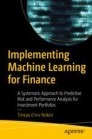
Implementing machine learning for finance : A systematic approach to predictive risk and performance analysis for investment portfolios
Introduces pattern recognition and future price forecasting that exerts effects on time series analysis models, such as the Autoregressive Integrated Moving Average (ARIMA) model, Seasonal ARIMA (SARIMA) model, and Additive model, and it covers the Least Squares model and the Long Short-Term Memory (LSTM) model. It presents hidden pattern recognition and market regime prediction applying the Gaussian Hidden Markov Model. The book covers the practical application of the K-Means model in stock clustering. It establishes the practical application of the Variance-Covariance method and Simulation method (using Monte Carlo Simulation) for value at risk estimation. It also includes market direction classification using both the Logistic classifier and the Multilayer Perceptron classifier. Finally, the book presents performance and risk analysis for investment portfolios. You will: Understand the fundamentals of the financial market and algorithmic trading, as well as supervised and unsupervised learning models that are appropriate for systematic investment portfolio management / Know the concepts of feature engineering, data visualization, and hyperparameter optimization / Design, build, and test supervised and unsupervised ML and DL models / Discover seasonality, trends, and market regimes, simulating a change in the market and investment strategy problems and predicting market direction and prices / Structure and optimize an investment portfolio with preeminent asset classes and measure the / underlying risk

Implementation and Application of Functional Languages ; 19th International Workshop, IFL 2007, Freiburg, Germany, September 27-29, 2007. Revised Selected Papers
This book constitutes the thoroughly refereed post-proceedings of the 19th International Workshop on Implementation and Applications of Functional Languages, IFL 2007, held in Freiburg, Germany in September 2007.The 15 revised full papers presented went through two rounds of reviewing and improvement and were selected from 33 submissions. The papers address all current theoretical and methodological issues on functional and function-based languages such as type checking, contract checking, compilation, parallelism, development and debugging, data structures, parsing as well as various performance related concepts.

Image-Based Rendering
Image-based rendering (IBR) refers to a collection of techniques and representations that allows 3D scenes and objects to be visualized in a realistic way without full 3D model reconstruction. The potential for photorealistic visualization has tremendous appeal, especially for applications such as video games, virtual travel, and E-commerce, which stand to greatly benefit from this technology.

Hyperparameter tuning for machine and deep learning with R : A practical guide
Equips readers with the ability to achieve better results with significantly less time, costs, effort and resources using the methods described here. The case studies presented in this book can be run on a regular desktop or notebook computer. The content focuses on the hyperparameter tuning of ML and DL algorithms, and is divided into two main parts: theory (Part I) and application (Part II). Essential topics covered include: a survey of important model parameters; four parameter tuning studies and one extensive global parameter tuning study; statistical analysis of the performance of ML and DL methods based on severity; and a new, consensus-ranking-based way to aggregate and analyze results from multiple algorithms.

Hybrid metaheuristics ; Vol. 4030 ; 3rd International Workshop, HM 2006, Gran Canaria, Spain, October 13-14, 2006, Proceedings
The selection of papers for HM 2006 consolidated some of the mainstream issues that have emerged from the past editions. Firstly, there are prominent examples of e?ective hybrid techniques whose design and implementation were motivated by challenging real-world applications. We believe this is particularly important for two reasons: on the one hand, researchers are conscious that the primary goal of developing algorithms is to solve relevant real-life problems; on the other hand, the path towarde?cient solving methods for practical problems is a source of new outstanding ideas and theories. A second important issue is that the research community on metaheur- tics has become increasingly interested in and open to techniques and methods known from arti?cial intelligence (AI) and operations research (OR). So far, the most representative examples of such integration have been the use of AI/OR techniques as subordinates of metaheuristic methods. As a historical and - ymological note, this is in perfect accordance with the original meaning of a metaheuristic as a “general strategy controlling a subordinate heuristic. ” The awareness of the need for a sound experimental methodology is a third keypoint.

Human motion : Understanding, modeling, capture and animation
Edward Muybridge (1830–1904) is known as the pioneer in motion capt- ing with his famous experiments in 1887 called “Animal Locomotion”. Since then, the feld of animal or human motion analysis has grown in many dir- tions. However, research and results that involve human-like animation and the recovery of motion is still far from being satisfactory. Progress in human motion analysis depends on empirically anchored and grounded research in computer vision, computer graphics, and biomechanics. This book is based on a June 2006 workshop held in Dagstuhl, Germany. This workshop brought together for the frst time researchers from the afo- mentioned disciplines.
