



الصفحة 4
الصفحة 4

Hybrid Systems : Computation and Control ; 11th International Workshop, HSCC 2008, St. Louis, MO, USA, April 22-24, 2008. Proceedings
Contains the proceedings ofthe 11th Workshop on Hybrid Systems: Computation and Control (HSCC 2008) held in St. Louis, Missouriduring April 22–24,2008.The annual workshop on hybrid systems focuses on research inbedded ,reactive systems in volving theinterplay between symbolic/switchingand continuous dynamical behaviors. HSCC attracts academic as well as industrial researchers to exchange information on the latest developments of applications and theoretical advancements in the design, analysis, control, optimization, and implementation of hybrid systems, with particular attention to embedded and networked control systems. We would like to thank the Program Committee members and the reviewers for an excellent job of evaluating the submissions and participating in the online Program Committee discussions.

Hybrid Systems : Computation and Control ; Vol. # 3414 ; 8th International Workshop, HSCC 2005, Zurich, Switzerland, March 9-11, 2005, Proceedings
Contains the proceedings of the 8th Workshop on Hybrid S- tems: Computation and Control(HSCC2005)heldinZurich, Switzerlandduring March 9-11, 2005. The annual workshop on hybrid systems attracts researchers from academia and industry interested in modeling, analysis, and implemen- tion of dynamic and reactive systems involving both discrete and continuous - haviors. This year's HSCC was technically co-sponsored by the IEEE Control Systems Society. The program consisted of 3 invited talks and 40 regular papers selected from 91 regular submissions. The program covered topics such as tools for analysis and verification, control and optimization, modeling, engineering applications, and emerging directions in programming language support and implementation. We would like to thank the Program Committee members and reviewers for an excellent job of evaluating the submissions and participating in the online Program Committee discussions.

Hybrid metaheuristics ; Vol. 4030 ; 3rd International Workshop, HM 2006, Gran Canaria, Spain, October 13-14, 2006, Proceedings
The selection of papers for HM 2006 consolidated some of the mainstream issues that have emerged from the past editions. Firstly, there are prominent examples of e?ective hybrid techniques whose design and implementation were motivated by challenging real-world applications. We believe this is particularly important for two reasons: on the one hand, researchers are conscious that the primary goal of developing algorithms is to solve relevant real-life problems; on the other hand, the path towarde?cient solving methods for practical problems is a source of new outstanding ideas and theories. A second important issue is that the research community on metaheur- tics has become increasingly interested in and open to techniques and methods known from arti?cial intelligence (AI) and operations research (OR). So far, the most representative examples of such integration have been the use of AI/OR techniques as subordinates of metaheuristic methods. As a historical and - ymological note, this is in perfect accordance with the original meaning of a metaheuristic as a “general strategy controlling a subordinate heuristic. ” The awareness of the need for a sound experimental methodology is a third keypoint.

Holonic and multi-agent systems for manufacturing ; 3rd International Conference on industrial applications of holonic and multi-agent systems, HoloMAS 2007, Regensburg, Germany, September 3-5, 2007, Proceedings
The research of holonic and agent-based systems is developing rapidly, as is the community around this R&D topic. Despite the fact that real-life practical implementations of such systems remain surprisingly rare, the leaders in different branches of industry feel that the holonic and agent-based systems represent the only way to manage and control very complex, highly distributed systems in the future.

Higher Education in the Era of the Fourth Industrial Revolution
This collection examines how higher education responds to the demands of the automation economy and the fourth industrial revolution. Considering significant trends in how people are learning, coupled with the ways in which different higher education institutions and education stakeholders are implementing adaptations, it looks at new programs and technological advances that are changing how and why we teach and learn. The book addresses trends in liberal arts integration of STEM innovations, the changing role of libraries in the digital age, global trends in youth mobility, and the development of lifelong learning programs.

High performance embedded architectures and compilers ; 3rd International Conference, HiPEAC 2008, Göteborg, Sweden, January 27-29, 2008. Proceedings
This book constitutes the refereed proceedings of the Third International Conference on High Performance Embedded Architectures and Compilers, HiPEAC 2008, held in Göteborg, Sweden, January 27-29, 2008. The 25 revised full papers presented together with 1 invited keynote paper were carefully reviewed and selected from 77 submissions. The papers are organized in topical sections on Multithreaded and Multicore Processors, Reconfigurable - ASIP, Compiler Optimizations, Industrial Processors and Application Parallelization, Power-Aware Techniques, High-Performance Processors, Profiles: Collection and Analysis as well as Optimizing Memory Performance.

High Availability and Disaster Recovery : Concepts, Design, Implementation
Companies and other organizations depend more than ever on the availability of their Information Technology, and most mission critical business processes are IT-based processes. Business continuity is the ability to do business under any circumstances and is an essential requirement modern companies are facing. High availability and disaster recovery are contributions of the IT to fulfill this requirement. And companies will be confronted with such demands to an even greater extent in the future, since their credit ratings will be lower without such precautions. Both, high availability and disaster recovery, are realized by redundant systems. Redundancy can and should be implemented on different abstraction levels: from the hardware, the operating system and middleware components up to the backup computing center in case of a disaster. This book presents requirements, concepts, and realizations of redundant systems on all abstraction levels, and all given examples refer to UNIX and Linux systems.

Hexagonal image processing : A practical approach
Hexagonal Image Processing provides an introduction to the processing of hexagonally sampled images, includes a survey of the work done in the field, and presents a novel framework for hexagonal image processing (HIP) based on hierarchical aggregates. Digital image processing is currently dominated by the use of square sampling lattices, however, hexagonal sampling lattices can also be used to define digital images. The strengths offered by hexagonal lattices over square lattices are considerable: • higher packing density, • uniform connectivity of points (pixels) in the lattice, • better angular resolution by virtue of having more nearest neighbours, and • superlative representation of curves. The utility of the HIP framework is demonstrated by implementing several basic image processing techniques (for the spatial and frequency domain) and some applications. The HIP framework serves as a tool for comparing processing of images defined on a square vs hexagonal grid, to determine their relative merits and demerits. The theory and algorithms covered are supplemented by attention to practical details such as accommodating hardware that support only images sampled on a square lattice. Including a Foreword written by Professor Narendra Ahuja, an eminent researcher in the field of Image Processing and Computer Vision, the book’s fresh approach to the subject offers insight and workable know-how to both researchers and postgraduates.

Hands-On Software Architecture with Java - Learn key architectural techniques and strategies to design efficient and elegant Java applications
Starts with the fundamentals of architecture and takes you through the basic components of application architecture. You'll cover the different types of software architectural patterns and application integration patterns and learn about their most widespread implementation in Java. You'll then explore cloud-native architectures and best practices for enhancing existing applications to better suit a cloud-enabled world. Later, the book highlights some cross-cutting concerns and the importance of monitoring and tracing for planning the evolution of the software, foreseeing predictable maintenance, and troubleshooting. The book concludes with an analysis of the current status of software architectures in Java programming and offers insights into transforming your architecture to reduce technical debt.

Handbook of modern sensors. physics, designs, and applications
Presents a comprehensive and up-to-date account of the theory (physical principles), design, and practical implementations of various sensors for scientific, industrial, and consumer applications. This latest edition focuses on the sensing technologies driven by the expanding use of sensors in mobile devices. These new miniature sensors will be described, with an emphasis on smart sensors which have embedded processing systems. The chapter on chemical sensors has also been expanded to present the latest developments.

Handbook Of Mathematical Models For Languages And Computation
Introduces a variety of concepts in discrete mathematics and mathematical modeling for languages and computation. The authors pay special attention to the implementation of mathematical concepts to explain clearly how to encode them in computational practice. All computer programs are written in C#. The theory of computation is used to address challenges arising in many computer science areas such as artificial intelligence, language processors, compiler writing, information and coding systems, programming language design, computer architecture and more. To grasp topics concerning this theory readers need to familiarize themselves with its computational and language models, based on concepts of discrete mathematics including sets, relations, functions, graphs and logic.

Groupware : design, implementation, and use ; Vol. 4154 ; 12th International Workshop, CRIWG 2006, Medina del Campo, Spain, September 17-21, 2006, Proceedings
Topical sections include collaborative applications and group interaction, group awareness, computer supported collaborative learning, languages and tools supporting collaboration, groupware development frameworks and toolkits, collaborative workspaces, web-based cooperative environments, mobile collaborative work, and collaborative design.
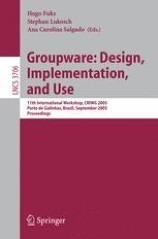
Groupware : design, implementation, and use ; Vol. 3706 ; 11th International workshop, CRIWG 2005, Porto de Galinhas, Brazil, September 25-29, 2005, Proceedings
This book constitutes the refereed proceedings of the 11th International Workshop on Groupware, CRIWG 2005, held in Porto de Galinhas, Brazil in September 2005. The 16 revised full papers and 13 revised short papers presented together with a keynote paper were carefully reviewed and selected from 67 submissions. The papers are organized in topical sections on groupware development, collaborative applications, workflow management, knowledge management, computer supported collaborative learning, group decision support systems, mobile collaborative work, and work modeling in CSCW.
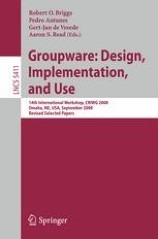
Groupware : Design, Implementation, and Use ; 14th International Workshop, CRIWG 2008, Omaha, NE, USA, September 14-18, 2008, Revised Selected Papers
This book constitutes the refereed post-conference proceedings of the 14th International Workshop on Groupware: Design, Implementation, and Use, held in Omaha, Nebraska, USA, during September 14-18, 2008.The 30 papers presented were carefully reviewed and selected from numerous submission. The topics covered are groupware solutions, co-located groups, groupware for health care, collaborative systems development, collaborative emergency response, groupware approaches, patterns of collaboration.

Groupware : Design, implementation, and use ; 13th International Workshop, CRIWG 2007, Bariloche, Argentina, September 16-20, 2007, Proceedings
This volume constitutes the proceedings of the 13th International Workshop on Groupware (CRIWG 2007). This workshop aims at providing a forum for academic researchers and professionals to exchange their experiences and their ideas about problems and solutions related to the design, development and use of groupware applications.

Grid computing : Achievements and prospects
Grid Computing: Achievements and Prospects, the 9th edited volume of the CoreGRID series, includes selected papers from the CoreGRID Integration Workshop, held April 2008 in Heraklion-Crete, Greece. This event brings together representatives of the academic and industrial communities performing Grid research in Europe. The workshop was organized in the context of the CoreGRID Network of Excellence in order to provide a forum for the presentation and exchange of views on the latest developments in grid technology research.

Graph Transformations ; 3rd International Conference, ICGT 2006, Rio Grande do Norte, Brazil, September 17-23, 2006, Proceedings
ICGT 2006 was the 3rd International Conference on Graph Transformation, following the previous two in Barcelona (2002) and Rome (2004), and a series of six international workshops between 1978 and 1998. The scope of the conference concerned graphical structures of various kinds (like graphs, diagrams and visual sentences) that are useful when describing complex structures and systems in a direct and intuitive way. These structures are often enriched with formalisms that model their evolution via suitable kinds of transformations. The ?eld of the conference was concerned with the theory, applications, and implementation issues of such formalisms. Particularemphasis wasputonmetamodelswhichcanaccommodateavarietyofgraphicalstructures within the same abstract theory.

Genetic algorithms: theory, design and programming
We present a series of scientific contributions that delve into the intricate theoretical foundations and practical nuances of genetic algorithms (GAs). Beyond the academic realm, GAs have demonstrated profound applications in societal decision-making and engineering optimization, showcased through real-world examples and case studies. A dedicated section on programming principles offers a thorough guide for implementing GAs across diverse languages. This edition, tailored for researchers and academics, serves as a testament to the scientific advancements within the field, inviting readers to explore the nuanced journey from theoretical constructs to pragmatic applications in the dynamic landscape of GAs.

Generator remote controlling using internet connection
The traditional technique of monitoring the electricity generated through regular checks on the alternator variables: oil, temperature, voltage and current on a daily basis. Therefore, maintaining a normal performance cycle requires hard work and is often imprecise. The idea is to create an application that monitors wireless generators using the popular smartphone Android operating system. Implemented sensors deliver analog signals that provide real-time data on the status of the generator. This data is converted and programmed through the Node MCU microcontroller, which reads the results from the sensors and then converts into a signal, which is transmitted to the android phone, through a router. Thus live feedback of the generator status is ensured. In addition, this project provides a control button that can actually turn this generator on and off. This project is the first step towards bringing systems and control together as it revolutionizes the ideology of monitoring and displaying real-time data that can be implemented in different fields according to different needs. These fields include electricity, mechanics, and communications.
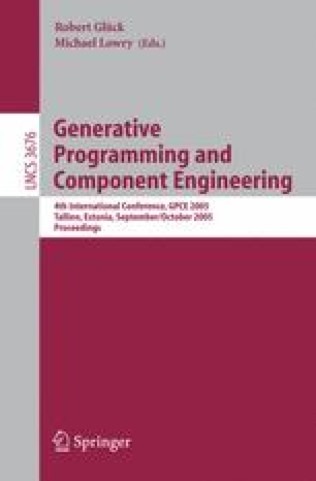
Generative programming and component engineering ; 4th International conference, GPCE 2005, Tallinn, Estonia, September 29 - October 1, 2005, Proceedings
Generative Programming and Component Engineering (GPCE) is a leading - searchconferenceonautomaticprogrammingandcomponentengineering.These approaches to software engineering have the potential to revolutionize software development as automation and components revolutionized manufacturing. The conference brings together researchers and practitioners interested in adva- ing automation for software development. It is also a premier forum for cro- fertilization between the programming language and software engineering - search communities. GPCEaroseasajointconference, mergingthepriorconferenceonGenerative and Component-Based Software Engineering (GCSE) and the Workshop on - mantics, Applications, andImplementationofProgramGeneration(SAIG). The proceedingsofthepreviousGPCEconferenceswerepublishedintheLNCSseries of Springer as volumes2487,2830, and 3286.In 2005 GPCE wasco-locatedwith the International Conference on Functional Programming (ICFP) and the s- posium on Trends in Functional Programming (TFP), re?ecting the vigorous interaction between the functional programming and generative programming research communities. GPCE and ICFP are both sponsored by the Association for Computing Machinery. The quality and breadth of the papers submitted to GPCE 2005 was impr- sive. All 86 papers, including 5 papers for tool demonstrations, were rigorously reviewed by 17 highly quali?ed Program Committee members. The members of the Program Committee ?rst provided in-depth individual reviews of the s- mitted papers, and then debated the merits of the papers through an extended electronicProgramCommitteemeeting.After much(friendly) argument,25r- ular papers and 2 tool demonstration papers were selected for publication. The ProgramCommittee provided extensive technical feedback to the authors of the submittedpapers.Theconferenceprogramwascomplementedwiththreeinvited talks, three extended tutorials, and three all-day workshops.
