



الصفحة 4
الصفحة 4

Foundation ASP.NET for Flash
If you're a reasonably experienced Flash user who has mastered the basics but wants to empower your SWFs, taking them further toward rich Internet applications, then you've come to the right place! Foundation ASP.NET for Flash will teach you everything you need to know to integrate two of the most exciting technologies used on the Web today. Using Flash and ASP.NET, it's possible to utilize the amazing user interface capabilities of Flash along with the extensive power of ASP.NET to create dynamic, data-driven web applications. In this book, advanced topics are made easy by providing intuitive step-by-step examples. This book covers Flash MX 2004 and Flash 8, ASP.NET 2.0, Visual Studio 2005, and Access and SQL Server 2005. It is an essential part of any Flash or ASP.NET web developer's arsenal.

Foundation ASP for Dreamweaver 8
Dreamweaver 8 takes a lot of the hard work out of performing tasks such as integrating a database into your website, but it can't do everything. That's why this book not only shows you how to use all of Dreamweaver's functions, but also shows you how the underlying code functions, so you can then work around Dreamweaver's shortcomings. There's no attempt to turn you into a code guru, but you'll come away with sufficient knowledge of basic ASP to have the confidence to dive into the Dreamweaver code and tweak it to your own requirements. The emphasis is exclusively on ASP, so you don't waste any time on information that's not relevant to what you want to do.
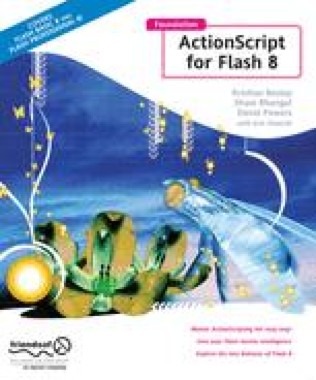
Foundation ActionScript for Flash 8
This book contains all you need to understand and make use of ActionScript, and to have some fun while learning. The Foundation series teaching style is ideal if you're a non-programmer who wants to learn Flash programming quickly and thoroughly. The authors teach the basics, and provide an all-around proficiency in ActionScript, as well as Flash components within Flash 8. You'll gain the practical skills to build ActionScript based Flash projects, including making initial design decisions, structuring code, and testing. An ongoing case study means that by the end of the book, you'll have constructed a cutting-edge Flash site to showcase your newly learned skills.
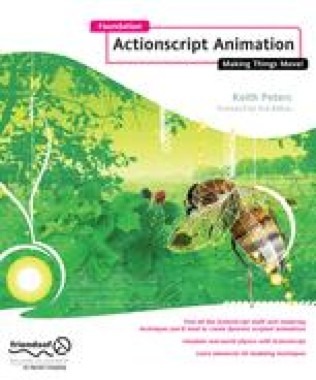
Foundation ActionScript animation : Making things move!
In this book Keith Peters guides you through some basic animation theory and then demystifies the math and physics behind creating realistic animation, looking at trigonometry, velocity and acceleration, and bouncing & friction. This book will teach you how to use Flash ActionScript to move the objects in your movies, rather than letting Flash's tween engine do it for you. The benefit of this is smaller, more realistic, more dynamic interactive movies that seem to come alive on your screen. Almost all of the code featured in this book will work fine in either Flash MX 2004 or Flash 8, and with a few minor adjustments, most of it can even be applied to Flash MX.
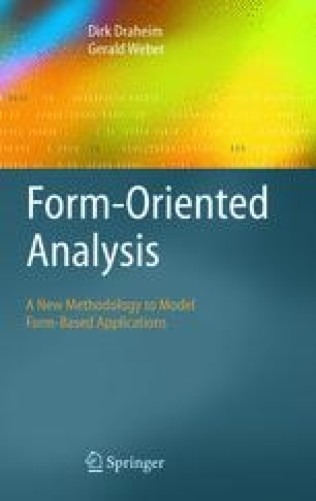
Form-oriented analysis : A new methodology to model form-based applications
Form-based applications range from simple web shops to complex enterprise resource planning systems. Draheim and Weber adapt well-established basic modeling techniques in a novel way to achieve a modeling framework optimized for this broad application domain. They introduce new modeling artifacts, such as page diagrams and form storyboards, and separate dialogue patterns to allow for reuse. In their implementation they have developed new constructs such as typed server pages, and tools for forward and reverse engineering of presentation layers. The methodology is explained using an online bookshop as a running example in which the user can experience the modeling concepts in action. The combination of theoretical achievements and hands-on practical advice and tools makes this book a reference work for both researchers in the areas of software architectures and submit-response style user interfaces, and professionals designing and developing such applications. More information and additional material is also available online.

Flash 8 Essentials
As a creative professional or interactive developer, you’ll be amazed at the exciting possibilities presented to you by the features available in Flash 8; but as a busy designer, we know you won't have as much time as you’d like to explore these new additions. Never fear; this book wastes no time looking at timeline basics, tweens, or movie-publishing options—it focuses exclusively on the new Flash 8 features, getting you quickly up to speed with a combination of illustrative tutorials, handy references, and inspirational examples. By the end of the book, you’ll know that there’s no shortage of new tools to enhance and inspire your Flash development; and since this book is written by some of the community's leading Flash experts, you’ll know you’re in good hands.

First course on fuzzy theory and applications
This basic textbook gives an easily accessible introduction to Fuzzy theory and its applications. It provides basic and concrete concepts of the field in a self-contained, condensed and understandable style. This "First Course on Fuzzy Theory and Applications" includes numerous examples, descriptive illustrations and figures of the basic concepts, as well as exercises at the end of each chapter. The author has long time experience in teaching on fuzzy theory and its applications and continuously developed and summarized his didactic lecture notes into this book. This book can be used in introductory graduate and undergraduate courses in Fuzziness and Soft Computing and is recommendable to students, scientists, engineers, or professionals in the field for self-study.

Finite Difference Computing with PDEs : A Modern Software Approach
This easy-to-read book introduces the basics of solving partial differential equations by means of finite difference methods. Unlike many of the traditional academic works on the topic, this book was written for practitioners. Accordingly, it especially addresses: the construction of finite difference schemes, formulation and implementation of algorithms, verification of implementations, analyses of physical behavior as implied by the numerical solutions, and how to apply the methods and software to solve problems in the fields of physics and biology.

Finite Difference Computing with Exponential Decay Models
This text provides a very simple, initial introduction to the complete scientific computing pipeline: models, discretization, algorithms, programming, verification, and visualization. The pedagogical strategy is to use one case study – an ordinary differential equation describing exponential decay processes – to illustrate fundamental concepts in mathematics and computer science. The book is easy to read and only requires a command of one-variable calculus and some very basic knowledge about computer programming. Contrary to similar texts on numerical methods and programming, this text has a much stronger focus on implementation and teaches testing and software engineering in particular.

Extreme NXT : Extending the LEGO MINDSTORMS NXT to the Next Level
Extreme NXT: Extending the LEGO MIDSTORMS NXT to the Next Level is for intermediate-level users of NXT who would like to advance their capabilities by learning some of the basics of electronics. Plenty of examples are provided, and easy-to-follow instructions are included for building over 15 different sensors.

Explosively Driven Pulsed Power : Helical Magnetic Flux Compression Generators
While the basic operating principles of Helical Magnetic Flux Compression Generators are easy to understand, the details of their construction and performance limits have been described only in government reports, many of them classified. Conferences in the field of flux compression are also dominated by contributions from government (US and foreign) laboratories. And the government-sponsored research has usually been concerned with very large generators with explosive charges that require elaborate facilities and safety arrangements. This book emphasizes research into small generators (less than 500 grams of high explosives) and explains in detail the physical fundamentals, construction details, and parameter-variation effects related to them.

Expert VB 2005 Business Objects
Rockford Lhotka started writing his Business Objects books in 1996, and over the years, he’s become one of the world's foremost authorities on building distributed object-oriented systems. This second edition of his industry-standard VB .NET Business Objects book not only addresses changes in .NET 2.0 and Visual Studio 2005, but also reflects substantial enhancements and improvements to the CSLA .NET Framework and how it can be used to create enterprise-level .NET applications.

Expert Oracle JDBC Programming
JDBC is the most commonly used API in Java to access and manipulate data in a database. Oracle is one of the most popular and scalable databases in the world. This book is a must-have for any developer building an application that employs JDBC on Oracle database. Unlike other JDBC books, this book has been written to complement not rehash the contents of Oracle JDBC documentation and the JDBC specification. The book teaches you not just how to write JDBC code, but how to write effective JDBC code in a step-by-step fashion. This book does not assume any prior knowledge of JDBC, though it does assume basic knowledge of SQL and PL/SQL. It covers JDBC with a focus on writing high-performing, scalable and secure applications for Oracle 10g and 9i.

Excel 2007 : Beyond the Manual
Excel 2007: Beyond the Manual will introduce those who are already familiar with Excel basics to more advanced features, like consolidation, what-if analysis, PivotTables, sorting and filtering, and some commonly used functions.

Evolvable Hardware
The contributions in this book provide the basics of reconfigurable devices so that readers will be fully prepared to understand what EHW is, why it is necessary and how it is designed. The book also discusses the leading research in digital, analog and mechanical EHW. Selections from leading international researchers offer examples of cutting-edge research and applications, placing particular emphasis on their practical usefulness.
Evolutionary Synthesis of Pattern Recognition Systems
Evolutionary Synthesis of Pattern Recognition Systems presents novel effective approaches based on evolutionary computational techniques, such as genetic programming (GP), linear genetic programming (LGP), coevolutionary genetic programming (CGP) and genetic algorithms (GA) to automate the synthesis and analysis of object detection and recognition systems. The book’s concepts, principles, and methodologies will enable readers to automatically build robust and flexible systems—in a systematic manner—that can provide human-competitive performance and reduce the cost of designing and maintaining these systems. Its content covers all key aspects of object recognition: object detection, feature selection, feature discovery, object recognition, domain knowledge. Basic knowledge of programming and data structures, and some calculus, is presupposed.ing the book’s novel ideas

Evolutionary Equations : Picard's Theorem for Partial Differential Equations, and Applications
This book provides a solution theory for time-dependent partial differential equations, which classically have not been accessible by a unified method. Instead of using sophisticated techniques and methods, the approach is elementary in the sense that only Hilbert space methods and some basic theory of complex analysis are required. Nevertheless, key properties of solutions can be recovered in an elegant manner.

Ethical and Social Issues in the Information Age
This book takes off where the second ended to examine ethical, social, and policy challenges stemming from the emergence of cyberspace, the convergence of telecommunication and computing technologies, and the miniaturalization of computing, telecommunication, and information-enabling devices. This accessible volume broadly surveys thought-provoking questions about the impact of these new technologies, with particular emphasis on the rapid growth of a multitude of computer networks, including the Internet. It assumes only a very modest familiarity with the basic computer literacy.

Essential Renderman
RenderMan has long been associated with top-end film production and is an essential tool for creating many of the effects and images in recent animated films (such as Monsters, Inc., Finding Nemo and The Incredibles). RenderMan is widely available and, with the demand for higher quality images, is now used by computer-based artists at all levels of the graphics industry. Intended to provide a straightforward and easy introduction to the basic techniques involved, this book provides an excellent grounding, enabling readers to confidently move to more advanced texts.

Ergodic Dynamics : From Basic Theory to Applications
This textbook provides a broad introduction to the fields of dynamical systems and ergodic theory. Motivated by examples throughout, the author offers readers an approachable entry-point to the dynamics of ergodic systems. Modern and classical applications complement the theory on topics ranging from financial fraud to virus dynamics, offering numerous avenues for further inquiry. Starting with several simple examples of dynamical systems, the book begins by establishing the basics of measurable dynamical systems, attractors, and the ergodic theorems. From here, chapters are modular and can be selected according to interest. Highlights include the Perron–Frobenius theorem, which is presented with proof and applications that include Google PageRank. An in-depth exploration of invariant measures includes ratio sets and type III measurable dynamical systems using the von Neumann factor classification. Topological and measure theoretic entropy are illustrated and compared in detail, with an algorithmic application of entropy used to study the papillomavirus genome. A chapter on complex dynamics introduces Julia sets and proves their ergodicity for certain maps. Cellular automata are explored as a series of case studies in one and two dimensions, including Conway’s Game of Life and latent infections of HIV. Other chapters discuss mixing properties, shift spaces, and toral automorphisms.
