



الصفحة 36
الصفحة 36
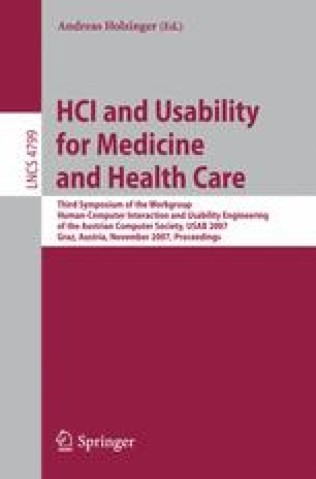
HCI and usability for medicine and health care ; 3rd Symposium of the Workgroup Human-computer interaction and usability engineering of the Austrian Computer Society, USAB 2007 Graz, Austria, November, 22, 2007, Proceedings
The work group Human–Computer Interaction & Usability Engineering (HCI&UE) of the Austrian Computer Society (OCG) serves as a platform for interdisciplinary exchange, research and development. Our 2007 topic was “Human–Computer Interaction for Medicine and Health Care” (HCI4MED), Medical information systems are already extremely sophisticated and technological performance increases exponentially.
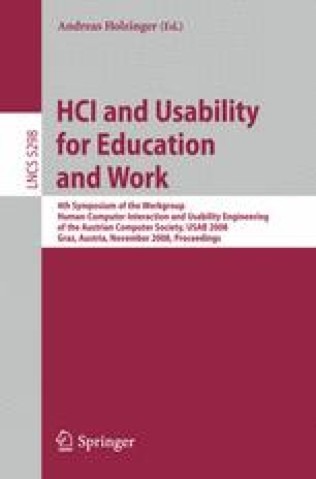
HCI and usability for education and work ; 4th Symposium of the Workgroup Human-Computer Interaction and Usability Engineering of the Austrian Computer Society, USAB 2008, Graz, Austria, November 20-21, 2008. Proceedings
This book constitutes the refereed proceedings of the 4th Usability Symposium of the Human-Computer Interaction and Usability Engineering Workgroup of the Austrian Computer Society, USAB 2008, held in Graz, Austria, in November 2008.The 7 revised full papers and 26 revised short papers presented were carefully reviewed and selected from 85 submissions. The papers are organized in topical sections on cognitive processes and end user experience, social software and collaborative knowledge development, knowledge processing, assessment and human performance.

Hardy Inequalities on Homogeneous Groups : 100 Years of Hardy Inequalities
This book provides an extensive treatment of Hardy inequalities and closely related topics from the point of view of Folland and Stein's homogeneous (Lie) groups. The place where Hardy inequalities and homogeneous groups meet is a beautiful area of mathematics with links to many other subjects.In this environment, the theory of Hardy inequalities becomes intricately intertwined with the properties of sub-Laplacians and subelliptic partial differential equations.

Hardware and software, verification and testing ; 2nd International Haifa Verification Conference, HVC 2006, Haifa, Israel, October 23-26, 2006, Revised Selected Papers
The Haifa Verification Conference 2006 took place for the second year in a row at the IBM Haifa Research Lab and at the Haifa University in Israel during October 23–26, 2006. The verification conference was a three-day, single-track conference followed by a one-day tutorial on PSL.

Hardware and software : Verification and testing ; 3rd International Haifa Verification Conference, HVC 2007, Haifa, Israel, October 23-25, 2007. Proceedings
These are the conference proceedings of the 4th Haifa Verifcation Conference, held October 27–30, 2008 in Haifa, Israel. This international conference is a unique venue that brings together leading researchers and practitioners of both formal and dynamic verifcation, for both hardware and software systems. This year’s conference extended the successes of the previous years, with a largejumpinthenumberofsubmitted papers. with many more high-quality papers than we had room to accept. Submissions came from 19 di?erent countries, re?ecting the growing international visibility of the conference. Of the 49 submissions, 43 were regular papers, 2 of which were later withdrawn, and 6 were tool papers. After a rigorous review process.

Hardware and software : Verification and testing ; 1st International Haifa Verification Conference, Haifa, Israel, November 13-16, 2005, Revised Selected Papers
The First Haifa Verification Conference was held at the IBM Haifa Research Lab and at the Haifa University in Israel from November 13 to16, 2005. The conference incorporated three different workshops that took place separately in previous years. The IBM Verification Workshop is now its sixth year, the IBM Software Testing Workshop is now in its fourth year, and the PADTAD Workshop on testing and debugging multi-threaded and parallel software was held for the third time. The Verification Conference was a three-day, single-track conference followed by a one-day tutorial on the testing and review of multi-threaded code. The conference presented a unique combination of fields that brought together the hardware and software testing communities. Merging the different communities under a single roof gave the conference a distinctive flavor and provided the participants with added benefits. While the applications in these separate fields are different, the techniques used are often very similar. By offering lectures in these disparate but related disciplines, the conference engendered an environment of collaboration and discovery.

Hardening Windows
Hardening is the process of protecting a system against unknown threats. System administrators harden against that which they think could be a threat. Administrators know the Internet is a hostile environment. Although they can't tell, for example, that a hacker will attempt to gain access to the SQL server next Tuesday, they can bet money there'll be an attempt soon and should "batten down the hatches" in anticipation. Hardening Windows, Second Edition is the definitive "counterintelligence" guide to performing preventative security measures for the Windows operating system. This second edition covers the release of Windows XP Service Pack 2 and its new security features, including the Windows Firewall and the Security Center. It also covers Windows Server 2003 Service Pack 1, Windows Server R2's new Security Configuration Wizard, Windows NT, Windows 2000, branch-office security features, and new setup options.

Hardening Linux
“Hardening” is the process of protecting a system and its applications against unknown threats. Hardening Linux identifies many of the risks of running Linux hosts and applications and provides practical examples and methods to minimize those risks. The book is written for Linux/UNIX administrators who do not necessarily have in-depth knowledge of security but need to know how to secure their networks.
Haptics: Science, Technology, Applications ; 12th International Conference, EuroHaptics 2020, Leiden, The Netherlands, September 6–9, 2020, Proceedings
This book constitutes the proceedings of the 12th International Conference on Human Haptic Sensing and Touch Enabled Computer Applications, EuroHaptics 2020, held in Leiden, The Netherlands, in September 2020.

Haptics : Perception, Devices and Scenarios ; 6th International Conference, EuroHaptics 2008 Madrid, Spain, June 10-13, 2008 Proceedings
This book constitutes the refereed proceedings of the 6th International Conference on Human Haptic Sensing and Touch Enabled Computer Applications, EuroHaptics 2008, held in Madrid, Spain, in June 2008.The 119 revised full papers presented were carefully reviewed and selected from 150 submissions. The papers are organized in topical sections on control and technology, haptic perception and psychophysics, haptic devices, haptics rendering and display, multimodal interaction and telepresence, as well as haptic applications.

Haptic and Audio Interaction Design ; 3rd International Workshop, HAID 2008 Jyväskylä, Finland, September 15-16, 2008 Proceedings
This book constitutes the refereed proceedings of the Third International Workshop on Haptic and Audio Interaction Design, HAID 2008 held in Jyväskylä, Finland, in September 2008.The 13 revised full papers presented were carefully reviewed and selected for inclusion in the book. The papers are organized in topical sections on visual impairment, applications of multimodality, evaluation, conceptual integration of audio and haptics, interaction techniques, and perception.

Haptic and Audio Interaction Design ; 2nd International Workshop, HAID 2007 Seoul, Korea, November 29-30, 2007 Proceedings
This book constitutes the refereed proceedings of the Second International Workshop on Haptic and Audio Interaction Design, HAID 2007 held in Seoul, South Korea, in November 2007. The papers are organized in topical sections on tactile displays, communication and games, accessibility and navigation, as well as design.

Haptic and Audio Interaction Design ; 1st International Workshop, HAID 2006, Glasgow, UK, August 31 - September 1, 2006, Proceedings
Overview The International Workshop on Haptic and Audio Interaction Design was - ganized as part of the EPSRC-funded MultiVis project. The main focus of the workshop was to investigate how the modalities of sound and haptics (touch) could be used together in interaction, and what novel interfaces could be p- vided when they are used in conjunction. What are the relative advantages of each of the modalities when used alone and together? Are there reasons why haptic-based information is moreuseful in certain situations than equivalent - dio information? How can di?erent modalities be used together to create c- pelling and useful interaction with computer-based systems?

Hands-on question answering systems with BERT : Applications in neural networks and natural language processing
Begins with an overview of the technology landscape behind BERT. It takes you through the basics of NLP, including natural language understanding with tokenization, stemming, and lemmatization, and bag of words. Next, you’ll look at neural networks for NLP starting with its variants such as recurrent neural networks, encoders and decoders, bi-directional encoders and decoders, and transformer models. Along the way, you’ll cover word embedding and their types along with the basics of BERT. After this solid foundation, you’ll be ready to take a deep dive into BERT algorithms such as masked language models and next sentence prediction. You’ll see different BERT variations followed by a hands-on example of a question answering system. You will: Examine the fundamentals of word embeddings / Apply neural networks and BERT for various NLP tasks / Develop a question-answering system from scratch / Train question-answering systems for your own data

Handbook on Craniofacial Superimposition : The MEPROCS Project
This book is the first comprehensive guide to a new soft computing technique which is used in complex forensic cases. The chapters include detailed technical and practical overviews, and discussions about the latest tools, open problems and ethical and legal issues involved. The book will be of interest to researchers and practitioners in forensic medicine and computational intelligence.

Handbook on artificial intelligence -empowered applied software engineering ; Vol.1 : Novel methodologies to engineering smart software systems
Provides a structured overview of artificial intelligence-empowered applied software engineering. Evolving technological advancements in big data, smartphone and mobile software applications, the Internet of Things and a vast range of application areas in all sorts of human activities and professions lead current research towards the efficient incorporation of artificial intelligence enhancements into software and the empowerment of software with artificial intelligence.

Handbook of vascular biometrics
This handbook provides the first comprehensive overview of biometrics exploiting the shape of human blood vessels for biometric recognition, i.e. vascular biometrics, including finger vein recognition, hand/palm vein recognition, retina recognition, and sclera recognition.

Handbook of smart cities
This Handbook presents a comprehensive and rigorous overview of the state-of-the-art on Smart Cities. It provides the reader with an authoritative, exhaustive one-stop reference on how the field has evolved and where the current and future challenges lie. From the foundations to the many overlapping dimensions (human, energy, technology, data, institutions, ethics etc.)

Handbook of networked and embedded control systems
The Handbook of Networked and Embedded Control Systems, the first of its kind, provides engineers, computer scientists, mathematicians, and students a broad, comprehensive source of information and technology to address many questions and aspects of embedded and networked control. A carefully organized collection of important results, tools, software, and technology, this work unifies into a single reference many scattered articles, websites, and specification sheets—information that might otherwise be difficult to find.

Handbook of Nature-Inspired and Innovative Computing : Integrating Classical Models with Emerging Technologies
This comprehensive handbook, the first of its kind to address the connection between nature-inspired and traditional computational paradigms, is a repository of case studies dealing with different problems in computing and solutions to these problems based on nature-inspired paradigms. The "Handbook of Nature-Inspired and Innovative Computing: Integrating Classical Models with Emerging Technologies" is an essential compilation of models, methods, and algorithms for researchers, professionals, and advanced-level students working in all areas of computer science, IT, biocomputing, and network engineering.
