



الصفحة 36
الصفحة 36

Advances in Artificial Intelligence ; Vol. 4013 : 19th Conference of the Canadian Society for Computational Studies of Intelligence, Canadian AI 2006, Quebec City, Quebec, Canada, June 7-9, Proceedings
Constitutes the refereed proceedings of the 4th Hellenic Conference on Artificial Intelligence, SETN 2006, held at Heraklion, Crete, Greece in May 2006. The 43 revised full papers and extended abstracts of 34 revised short papers presented together with 2 invited contributions were carefully reviewed and selected from 125 submissions. The papers address any area of artificial intelligence; particular fields of interest include; logic programming, knowledge-based systems, intelligent information retrieval, machine learning, neural nets, genetic algorithms, data mining and knowledge discovery, hybrid intelligent systems and methods, intelligent agents, multi-agent systems, intelligent distributed systems, intelligent/natural interactivity, intelligent virtual environments, planning, scheduling, and robotics.

Advances in Artificial Intelligence ; Vol. 3955 : 4th Helenic Conference on AI, SETN 2006, Heraklion, Crete, Greece, May 18-20, 2006, Proceedings
Constitutes the refereed proceedings of the 4th Hellenic Conference on Artificial Intelligence, SETN 2006, held at Heraklion, Crete, Greece in May 2006. The 43 revised full papers and extended abstracts of 34 revised short papers presented together with 2 invited contributions were carefully reviewed and selected from 125 submissions. The papers address any area of artificial intelligence; particular fields of interest include; logic programming, knowledge-based systems, intelligent information retrieval, machine learning, neural nets, genetic algorithms, data mining and knowledge discovery, hybrid intelligent systems and methods, intelligent agents, multi-agent systems, intelligent distributed systems, intelligent/natural interactivity, intelligent virtual environments, planning, scheduling, and robotics.

Advances in Artificial Intelligence ; 20th Conference of the Canadian Society for Computational Studies of Intelligence, Canadian AI 2007, Montreal, Canada, May 28-30, 2007, Proceedings
This book cover agents, bioinformatics, classification, constraint satisfaction, data mining, knowledge representation and reasoning, learning, natural language, and planning.

Advances in Artificial Intelligence - SBIA 2008 ; 19th Brazilian Symposium on Artificial Intelligence Savador, Brazil, October 26-30, 2008. Proceedings
Constitutes the refereed proceedings of the 19th Brazilian Symposium on Artificial Intelligence, SBIA 2008, held in Salvador, Brazil, in October 2008.

Advances in Artificial Intelligence - IBERAMIA 2008 ; 11th Ibero-American Conference on AI, Lisbon, Portugal, October 14-17, 2008. Proceedings
Constitutes the refereed proceedings of the 11th Ibero-American Conference on Artificial Intelligence, IBERAMIA 2008, held in Lisbon, Portugal, in October 2008.

Advances in Applied Artificial Intelligence ; 19th International Conference on Industrial, Engineering and Other Applications of Applied Intelligent Systems, IEA/AIE 2006, Annecy, France, June 27-30, 2006, Proceedings
Intelligent Design and complex problem solving are twined like wife and husband.” In the current competitive global industrial environment there are many pr- lems which need intelligent systems technology for optimal solutions. The central theme of the 19th International Conference on Industrial, Engineering & Other Applications of Applied Intelligent Systems (IEA/AIE 2006) is to focus on the research methodologies and practical implementations of these methodologies for intelligent solutions of problems in real-world applications. We are pleased to present the papers in these proceedings which cover va- ous aspects of applications of applied intelligent systems. We received more than 330 papers from many countries and each paper was reviewed by at least two reviewers. Only 134 papers were selected for presentation in the normal and special sessions.

Advances in Ad Hoc Networking ; Proceedings of the Seventh Annual Mediterranean Ad Hoc Networking Workshop, Palma de Mallorca, Spain, June 25–27, 2008
The IFIP series publishes state-of-the-art results in the sciences and technologies of information and communication. The principal aim of the IFIP series is to encourage education and the dissemination and exchange of information about all aspects of computing.
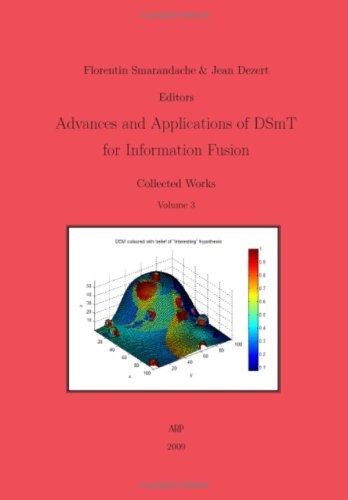
Advances and applications of DSmT for information fusion: Collected works ; Vol.3
One of the most comprehensive and flexible fusion theory based on belief functions. It can work in all fusion spaces: power set, hyper-power set, and super-power set, and has various fusion and conditioning rules that can be applied depending on each application. Some new generalized rules are introduced in this volume with codes for implementing some of them. For the qualitative fusion, the DSm Field and Linear Algebra of Refined Labels (FLARL) is proposed which can convert any numerical fusion rule to a qualitative fusion rule. When one needs to work on a refined frame of discernment, the refinement is done using Smarandache s algebraic codification. New interpretations and implementations of the fusion rules based on sampling techniques and referee functions are proposed, including the probabilistic proportional conflict redistribution rule.
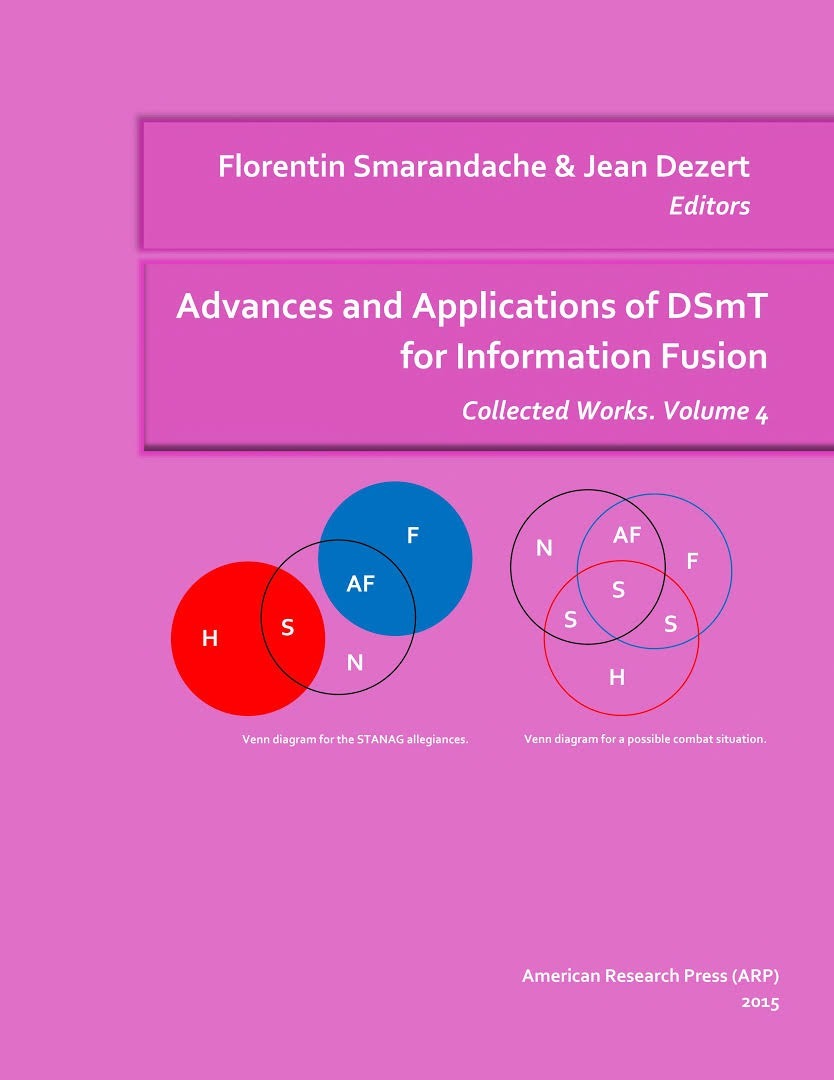
Advances and applications of DSmT for information fusion ; Vol. 4
One of the most comprehensive and flexible fusion theory based on belief functions. It can work in all fusion spaces: power set, hyper-power set, and super-power set, and has various fusion and conditioning rules that can be applied depending on each application. Some new generalized rules are introduced in this volume with codes for implementing some of them. For the qualitative fusion, the DSm Field and Linear Algebra of Refined Labels (FLARL) is proposed which can convert any numerical fusion rule to a qualitative fusion rule. When one needs to work on a refined frame of discernment, the refinement is done using Smarandache s algebraic codification. New interpretations and implementations of the fusion rules based on sampling techniques and referee functions are proposed, including the probabilistic proportional conflict redistribution rule.

Advanced Wired and Wireless Networks
ADVANCED WIRED AND WIRELESS NETWORKS brings the reader a sample of recent research efforts representative of advances in the areas of recognized importance for the future Internet, In Part I, we bring ad-hoc networking closer to the reality of practical use. The focus is on more advanced scalable routing suitable for large networks, directed flooding useful in information dissemination networks, as well as self-configuration and security issues important in practical deployments. Part II illustrates the efforts towards development of advanced mobility support techniques (beyond traditional "mobile phone net") and Mobile IP technologies. The issues range from prediction based mobility support, through context transfer during Mobile IP handoff, to service provisioning platforms for heterogeneous networks. The focus of the final section concerns the performance of networks and protocols. Furthermore this section illustrates researchers’ interest in protocol enhancement requests for improved performance with advanced networks, reliable and efficient multicast methods in unreliable networks, and composite scheduling in programmable/active networks where computing resources equal network performance as transmission bandwidth.

Advanced Web and Network Technologies, and Applications ; APWeb 2008 International Workshops : BIDM, IWHDM, and DeWeb Shenyang, China, April 26-28, 2008. Revised Selected Papers
Constitutes the thoroughly refereed joint post-workshop proceedings of three international workshops held in conjunction with the 10th Asia-Pacific Web Conference, APWeb 2008, in Shenyang, China, in April 2008.

Advanced Web and Network Technologies, and Applications ; APWeb 2006 International Workshops : XRA, IWSN, MEGA, and ICSE, Harbin, China, January 16-18, 2006, Proceedings
The QOS evaluating model for computational grid nodes put forward can help greatly improving the self-adaptability of resource management and accelerating the appli- tion and development of Computational Grid. Now this model has been applied in NPU Campus Computational Grid. And the good effect brought by it has effectively proved its function. References 1. Foster, I. and C. Kesselman, eds. The Grid: Blueprint for a New Computing Infrastructure. Morgan Kaufmann, 1999. 2. Liu Liang, Zhou Xing-she, and Gu Jian-hua: A Multi-Agent System for Grid Computing. The Second International Conference on Active Media Technology, 2003 3. Yao Wang, Julita Vassileva: Trust and Reputation Model in Peer-to-Peer Networks. Farag Azzedin and Muthucumaru Maheswaran: Integrating Trust into Grid Resource M- agement Systems.

Advanced Techniques in Knowledge Discovery and Data Mining
This explosion is a result of the growing use of electronic media. But what is data mining (DM)? A Web search using the Google search engine retrieves many (really many) definitions of data mining. We include here a few interesting ones. One of the simpler definitions is: “As the term suggests, data mining is the analysis of data to establish relationships and identify patterns” [1]. It focuses on identifying relations in data. Our next example is more elaborate: An information extraction activity whose goal is to discover hidden facts contained in databases. Using a combination of machine learning, statistical analysis, modeling techniques and database technology, data mining finds patterns and subtle relationships in data and infers rules that allow the prediction of future results. Typical applications include market segmentation, customer profiling, fraud detection, evaluation of retail promotions, and credit risk analysis .

Advanced technique and future perspective for next generation optical fiber communications
Optical fiber communication industry has gained unprecedented opportunities and achieved rapid progress in recent years. However, with the increase of data transmission volume and the enhancement of transmission demand, the optical communication field still needs to be upgraded to better meet the challenges in the future development. Artificial intelligence technology in optical communication and optical network is still in its infancy, but the existing achievements show great application potential. In the future, with the further development of artificial intelligence technology, AI algorithms combining channel characteristics and physical properties will shine in optical communication. This reprint introduces some recent advances in optical fiber communication and optical network, and provides alternative directions for the development of the next generation optical fiber communication technology.

Advanced Software Engineering : Expanding the Frontiers of Software Technology ; IFIP 19th World Computer Congress, First International Workshop on Advanced Software Engineering, August 25, 2006, Santiago, Chile
The scope of the series includes: foundations of computer science; software theory and practice; education; computer applications in technology; communication systems; systems modeling and optimization; information systems; computers and society; computer systems technology; security and protection in information processing systems; artificial intelligence; and human-computer interaction. Proceedings and post-proceedings of referred international conferences in computer science and interdisciplinary fields are featured. These results often precede journal publication and represent the most current research. The principal aim of the IFIP series is to encourage education and the dissemination and exchange of information about all aspects of computing.

Advanced parallel processing technologies ; 7th International Symposium, APPT 2007 Guangzhou, China, November 22-23, 2007 Proceedings
APPT was upgraded to the International Symposium on Advanced Parallel Processing Technologies. However, it kept its traditional flavor by sharing of the underlying theories and applications, and the establishment of new and long-term collaborative channels. And it will continue to provide a forum for researchers, professionals, and industrial practitioners from around the world to report on new advances in high-performance architecture and software, as well as to identify issues and directions for research and development in the new era of evolving technologies.

Advanced parallel processing technologies ; 6th International Workshop, APPT 2005, Hong Kong, China, October 27-28, 2005, Proceedings
APPT 2005: the 6th International Workshop on Advanced Parallel Processing Technologies. APPT is a biennial workshop on parallel and distributed processing. Its scope covers all aspects of parallel and distributed computing technologies , including architectures, software systems and tools, algorithms, and applications. This year, APPT 2005 received over 220 submissions from researchers all over the world. . The papers in this volume represent the forefront of research on parallel processing and related ?elds by researchers from China, Germany, USA, Korea, India, and other countries. The papers - cepted cover a wide range of exciting topics, including architectures, software, networking, and applications.

Advanced Methods for Inconsistent Knowledge Management
This book presents a unified and systematic description of a wide class of miscellaneous problems of inconsistent knowledge management, analyzed by traditional mathematical methods using relational and logical representations.

Advanced mathematical science for mobility society
The automotive industry has made steady progress in technological innovations under the names of Connected Autonomous-Shared-Electric (CASE) and Mobility as a Service (MaaS). Needless to say, mathematics and informatics are important to support such innovations. As the concept of cars and movement itself is diversifying, they are indispensable for grasping the essence of the future mobility society and building the foundation for the next generation. This book contains three main contents. 1. Mathematical models of flow 2. Mathematical methodsfor huge data and network analysis 3. Algorithm for mobility society The first one discusses mathematical models of pedestrian and traffic flow, as they are important for preventing accidents and achieving efficient transportation.

Advanced machine learning and deep learning approaches for remote sensing
Provides research on how technologies such as artificial intelligence-based machine learning and deep learning can be applied to remote sensing. Through this, we can see the process of solving the existing problems of image and image signal processing for remote sensing. These techniques are computationally intensive and require the help of high-performance computing devices. With the development of devices such as GPUs, remote sensing technology, and aerial sensing technology, it is possible to monitor the Earth with high-resolution images and to obtain vast amounts of Earth observation data. The papers published in this reprint describe recent advances in big data processing and artificial intelligence-based technologies for remote sensing technology.
