



الصفحة 33
الصفحة 33
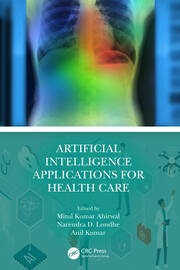
Artificial Intelligence Applications for Health Care
Covers topics on health care and artificial intelligence. Data sets related to biomedical signals (ECG, EEG, EMG) and images (X-rays, MRI, CT) are explored, analyzed, and processed through different computation intelligence methods. Applications of computational intelligence techniques like artificial and deep neural networks, swarm optimization, expert systems, decision support systems, clustering, and classification techniques on medial datasets are explained. Survey of medical signals, medial images, and computation intelligence methods are also provided.

Artificial intelligence applications and innovations ; 16th IFIP WG 12.5 International Conference, AIAI 2020, Neos Marmaras, Greece, June 5–7, 2020, Proceedings, Part I
This 2 volume-set of IFIP AICT 583 and 584 constitutes the refereed proceedings of the 16th IFIP WG 12.5 International Conference on Artificial Intelligence Applications and Innovations, AIAI 2020, held in Neos Marmaras, Greece, in June 2020.* The 70 full papers and 5 short papers presented were carefully reviewed and selected from 149 submissions. They cover a broad range of topics related to technical, legal, and ethical aspects of artificial intelligence systems and their applications

Artificial intelligence and symbolic computation ; 8th International Conference, AISC 2006, Beijing, China, September 20-22, 2006, Proceedings
This book constitutes the refereed proceedings of the 8th International Conference on Artificial Intelligence and Symbolic Computation, AISC 2006, held in Beijing, China in September 2006. The 18 revised full papers presented together with 4 invited papers were carefully reviewed and selected from 39 submissions. Based on heuristics and mathematical algorithmics, artificial intelligence and symbolic computation are two views and approaches for automating (mathematical) problem solving. The papers address all current aspects in the area of symbolic computing and AI: mathematical foundations, implementations, and applications in industry and academia. The papers are organized in topical sections on artificial intelligence and theorem proving, symbolic computation, constraint satisfaction/solving, and mathematical knowledge management.
Artificial intelligence and soft computing – ICAISC 2006 ; 8th International Conference, Zakopane, Poland, June 25-29, 2006, Proceedings
This book constitutes the refereed proceedings of the 8th International Conference on Artificial Intelligence and Soft Computing, ICAISC 2006, held in Zakopane, Poland, in June 2006. The 128 revised contributed papers presented are organized in topical sections on neural networks and their applications, fuzzy systems and their applications, evolutionary algorithms and their applications, rough sets, classification and clustering, image analysis and robotics, bioinformatics and medical applications, various problems of artificial intelligence.

Artificial intelligence and security ; 6th International Conference, ICAIS 2020, Hohhot, China, July 17–20, 2020, Proceedings, Part II
This two-volume set LNCS 12239-12240 constitutes the refereed proceedings of the 6th International Conference on Artificial Intelligence and Security, ICAIS 2020, which was held in Hohhot, China, in July 2020. The conference was formerly called “International Conference on Cloud Computing and Security” with the acronym ICCCS. The total of 142 full papers presented in this two-volume proceedings was carefully reviewed and selected from 1064 submissions. The papers were organized in topical sections as follows: Part I: Artificial intelligence and internet of things. Part II: Internet of things, information security, big data and cloud computing, and information processing.

Artificial intelligence and security ; 6th International Conference, ICAIS 2020, Hohhot, China, July 17–20, 2020, Proceedings, Part I
This two-volume set LNCS 12239-12240 constitutes the refereed proceedings of the 6th International Conference on Artificial Intelligence and Security, ICAIS 2020, which was held in Hohhot, China, in July 2020. The conference was formerly called “International Conference on Cloud Computing and Security” with the acronym ICCCS. The total of 142 full papers presented in this two-volume proceedings was carefully reviewed and selected from 1064 submissions. The papers were organized in topical sections as follows: Part I: Artificial intelligence and internet of things. Part II: Internet of things, information security, big data and cloud computing, and information processing.
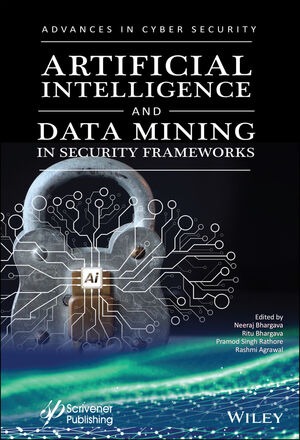
Artificial intelligence and data mining approaches in security frameworks
Offers solutions to the problems of security, outlining the concepts behind allowing computers to learn from experience and understand the world in terms of a hierarchy of concepts, with each concept defined through its relation to simpler concepts. provides state of the art approaches of artificial intelligence and data mining in these areas. It includes areas of detection, prediction, as well as future framework identification, development, building service systems and analytical aspects. In all these topics, applications of AI and data mining, such as artificial neural networks, fuzzy logic, genetic algorithm and hybrid mechanisms, are explained and explored. This book is aimed at the modeling and performance prediction of efficient security framework systems, bringing to light a new dimension in the theory and practice. This groundbreaking new volume presents these topics and trends, bridging the research gap on AI and data mining to enable wide-scale implementation. Whether for the veteran engineer or the student, this is a must-have for any library. This groundbreaking new volume: Clarifies the understanding of certain key mechanisms of technology helpful in the use of artificial intelligence and data mining in security frameworks ; Covers practical approaches to the problems engineers face in working in this field, focusing on the applications used every day ; Contains numerous examples, offering critical solutions to engineers and scientists ; Presents these new applications of AI and data mining that are of prime importance to human civilization as a whole

Artificial intelligence : Methodology, systems, and applications ; 12th International Conference, AIMSA 2006, Varna, Bulgaria, September 12-15, 2006, Proceedings
This book constitutes the refereed proceedings of the 12th International Conference on Artificial Intelligence: Methodology, Systems, and Applications, AIMSA 2006. The 28 revised full papers presented together with the abstracts of 2 invited lectures were carefully reviewed and selected from 81 submissions. The papers are organized in topical sections on agents, constraints and optimization, user concerns, decision support, models and ontologies, machine learning, ontology manipulation, natural language processing, and applications.

Articulated Motion and Doformable Objects ; 4th International Conference, AMDO 2006, Port d'Andratx, Mallorca, Spain, July 11-14, 2006, Proceedings
The subject of the conference was ongoing research in articulated motionon a sequence of images and sophisticated models for deformable objects. Thegoals of these areas are to understand and interpret the motion of complexobjects that can be found in sequences of images in the real world. The maintopics considered as priority were: geometric and physical deformable models,motion analysis, articulated models and animation, modelling and visualizationof deformable models, deformable models applications, motion analysis applica-tions, single or multiple human motion analysis and synthesis, face modelling,tracking, recovering and recognition models, virtual and augmentedreality, haptics devices, biometrics techniques.

Argumentation in multi-agent systems ; Vol. 4049 ; 2nd International Workshop, ArgMAS 2005, Utrecht, Netherlands, July 26, 2005, revised selected and invited papers
This book constitutes the thoroughly refereed post-proceedings of the Second International Workshop on Argumentation in Multi-Agent Systems held in Utrecht, Netherlands in July 2005 as an associated event of AAMAS 2005, the main international conference on autonomous agents and multi-agent systems. The 10 revised full papers presented together with an invited paper were carefully reviewed and selected from 17 submissions. The papers are organized in topical sections on foundations, negotiation, protocols, deliberation and coalition formation, and consensus formation.

Architecture of computing systems ; 34th International Conference, ARCS 2021, Virtual Event, June 7–8, 2021, Proceedings
This book constitutes the proceedings of the 34th International Conference on Architecture of Computing Systems, ARCS 2021, held virtually in July 2021. The 12 full papers in this volume were carefully reviewed and selected from 24 submissions. 2 workshop papers (VEFRE) are also included. ARCS has always been a conference attracting leading-edge research outcomes in Computer Architecture and Operating Systems, including a wide spectrum of topics ranging from fully integrated, self-powered embedded systems up to high-performance computing systems. It also provides a platform covering newly emerging and cross-cutting topics, such as autonomous and ubiquitous systems, reconfigurable computing and acceleration, neural networks and artificial intelligence. The selected papers cover a variety of topics from the ARCS core domains, including heterogeneous computing, memory optimizations, and organic computing.

Architecture of computing systems - ARCS 2007 ; 20th International Conference, Zurich, Switzerland, March 12-15, 2007, Proceedings
The ARCS is reporting hi- quality results in computer architecture and operating systems research.It is also represent a - namic, evolving community that closely follows new research trends and topics. ARCS has evolved towards a strong focus on s- tem aspects of pervasive computing and self-organization techniques (organic and autonomic computing).

Architecting dependable systems III
As software systems become ubiquitous, the issues of dependability become more and more crucial. Given that solutions to these issues must be considered from the very beginning of the design process, it is reasonable that dependability is addressed at the architectural level. This book comes as a result of an effort to bring together the research communities of software architectures and dependability. The papers are organised in topical sections on architectures for dependable services, monitoring and reconfiguration in software architectures, dependability support for software architectures, architectural evaluation, and architectural abstractions for dependability
Approximation, randomization, and combinatorial optimization algorithms and techniques ; 9th International Workshop on approximation algorithms for combinatorial optimization problems, APPROX 2006 and 10th International Workshop on Randomization and Computation, RANDOM 2006, Barcelona, Spain, August 28-30, 2006, Proceedings
This is the joint refereed proceedings of the 9th International Workshop on Approximation Algorithms for Combinatorial Optimization Problems, APPROX 2006 and the 10th International Workshop on Randomization and Computation, RANDOM 2006. The book presents 44 carefully reviewed and revised full papers. Among the topics covered are design and analysis of approximation algorithms, hardness of approximation problems, small spaces and data streaming algorithms, embeddings and metric space methods, and more.

Approximation and online algorithms ; Vol.3351 ; 2nd international workshop, WAOA 2004, Bergen, Norway, September 14-16, 2004, Revised Selected Papers
The 2nd Workshop on Approximation and Online Algorithms (WAOA 2004) focused on the design and analysis of algorithms for online and computationally hard problems. Both kinds of problems have a large number of applications arising from a variety of fields. The workshop was part of the ALGO 2004 event which also hosted ESA, WABI, IWPEC, and ATMOS. Topics of interests for WAOA2004 were : applications to game theory, appr- imation classes, coloring and partitioning, competitive analysis, computational finance, cuts and connectivity, geometric problems, in approximability results, mechanism design, network design, routing, packing and covering, paradigms, randomization techniques, and scheduling problems. on the reviews, This volume contains the 21 selected papers
Applied Informatics; Third International Conference, ICAI 2020, Ota, Nigeria, October 29–31, 2020, Proceedings
This book constitutes the thoroughly refereed papers of the Second International Conference on Applied Informatics, ICAI 2020, held in Ota, Nigeria, in October 2020. The 35 full papers were carefully reviewed and selected from 101 submissions. The papers are organized in topical sections on artificial intelligence; business process management; cloud computing; data analysis; decision systems; health care information systems; human-computer interaction; image processing; learning management systems; software design engineering.
Applied Deep Learning with TensorFlow 2 : Learn to Implement Advanced Deep Learning Techniques with Python
Focuses on the fundamental concepts and at the same time on practical aspects of implementing neural networks and deep learning for your research projects. This book is designed so that you can focus on the parts you are interested in. You will explore topics as regularization, optimizers, optimization, metric analysis, and hyper-parameter tuning. In addition, you will learn the fundamentals ideas behind autoencoders and generative adversarial networks. All the code presented in the book will be available in the form of Jupyter notebooks which would allow you to try out all examples and extend them in interesting ways. A companion online book is available with the complete code for all examples discussed in the book and additional material more related to TensorFlow and Keras. All the code will be available in Jupyter notebook format and can be opened directly in Google Colab (no need to install anything locally) or downloaded on your own machine and tested locally. You will: Understand the fundamental concepts of how neural networks work / Learn the fundamental ideas behind autoencoders and generative adversarial networks / Be able to try all the examples with complete code examples that you can expand for your own projects / Have available a complete online companion book with examples and tutorials.

Applied cryptography and network security ; 5th International Conference, ACNS 2007, Zhuhai, China, June 5-8, 2007, Proceedings
The book is organized in topical sections on signature schemes, computer and network security, cryptanalysis, group-oriented security, cryptographic protocols, anonymous authentication, identity-based cryptography, security in wireless, ad-hoc, and peer-to-peer networks, as well as efficient implementation.

Applied cryptography and network security ; 19th International Conference, ACNS 2021, Kamakura, Japan, June 21–24, 2021, Proceedings, Part I
The two-volume set LNCS 12726 + 12727 constitutes the proceedings of the 19th International Conference on Applied Cryptography and Network Security, ACNS 2021, which took place virtually during June 21-24, 2021. The 37 full papers presented in the proceedings were carefully reviewed and selected from a total of 186 submissions. They were organized in topical sections as follows: Part I: Cryptographic protocols; secure and fair protocols; cryptocurrency and smart contracts; digital signatures; embedded system security; lattice cryptography; Part II: Analysis of applied systems; secure computations; cryptanalysis; system security; and cryptography and its applications.

Applied cryptography and network security ; 18th International Conference, ACNS 2020, Rome, Italy, October 19–22, 2020, Proceedings, Part II
This two-volume set of LNCS 12146 and 12147 constitutes the refereed proceedings of the 18th International Conference on Applied Cryptography and Network Security, ACNS 2020, held in Rome, Italy, in October 2020.The conference was held virtually due to the COVID-19 pandemic. The 46 revised full papers presented were carefully reviewed and selected from 214 submissions. The papers were organized in topical sections named: cryptographic protocols cryptographic primitives, attacks on cryptographic primitives, encryption and signature, blockchain and cryptocurrency, secure multi-party computation, post-quantum cryptography.
