



الصفحة 3
الصفحة 3

Enabling Technologies for Wireless E-Business
Kou and Yesha and their contributors provide comprehensive information on these technologies, including, for example, wireless security, mobile payment, location-based services, mobile data management, and RFID technologies. The presentation is targeted at students, lecturers, e-business developers, consultants, and business managers, and this book is an ideal introduction for both self-study and taught e-business classes or commercial training courses.

ECOOP 2005 - object-oriented programming ; 19th European Conference, Glasgow, UK, July 25-29, 2005. Proceedings
The 19th Annual Meeting of the European Conference on Object-Oriented Programming—ECOOP 2005—took place during the last week of July in Glasgow, Scotland, UK. This volume includes the refereed technical papers p- sented at the conference, and two invited papers. It is traditional to preface a volume of proceedings such as this with a note that emphasizes the importance of the conference in its respective ?eld. Although such self-evaluations should always be taken with a large grain of salt, ECOOP is undisputedly the pre- inent conference on object-orientation outside of the United States. In its turn, object-orientationis today’s principaltechnology not only for programming,but also for design, analysisand speci?cation of softwaresystems.

Dynamics of Rods
The book consists of nine chapters and appendices and may be conventionally divided into two parts. That is, Chapters 1 to 6 contain, in the main, theoretical material, whereas Chapters 7 to 9 illustrate the application of the theoretical results to problems of practical interest. Problems for self-study are found in Chapters 3, 5, and 7. The solutions to most of the problems are given in Appendix B.
DNA Computing ; Vol. 4287 ; 12th International Meeting on DNA Computing, DNA12, Seoul, Korea, June 5-9, 2006, Revised Selected Papers
This book constitutes the thoroughly refereed postproceedings of the 12th International Meeting on DNA Computing, DNA12, held in Seoul, Korea in June 2006. The 34 revised full papers presented are organized in topical sections on molecular and membrane computing models, complexity analysis, sequence and tile designs and their properties, DNA tile self-assembly models, simulator and software for DNA computing, DNA computing algorithms and new applications, novel experimental approaches, and experimental solutions.

Distributed computing in sensor systems Vol. 4026 ; 2nd IEEE International Conference, DCOSS 2006, San Francisco, CA, USA, June 18-20, 2006, Proceedings
The book constitutes the refereed proceedings of the Second International Conference on Distributed Computing in Sensor Systems, DCOSS 2006, held in San Francisco, California, USA in June 2006. The papers focus on distributed computing issues in large-scale networked sensor systems, including systematic design techniques and tools; they cover topics such as distributed algorithms and applications, programming support and middleware, data aggregation and dissemination, security, information fusion, lifetime maximization, and localization.

Digital twin : Architectures, networks, and applications
Offers comprehensive, self-contained knowledge on digital twin (DT), which is a very promising technology for achieving digital intelligence in the next-generation wireless communications and computing networks. DT is a key technology to connect physical systems and digital spaces in Metaverse. The objectives of this book are to provide the basic concepts of DT, to explore the promising applications of DT integrated with emerging technologies, and to give insights into the possible future directions of DT. For easy understanding, this book also presents several use cases for DT models and applications in different scenarios. The book starts with the basic concepts, models, and network architectures of DT. Then, we present the new opportunities when DT meets edge computing, Blockchain and Artificial Intelligence, and distributed machine learning (e.g., federated learning, multi-agent deep reinforcement learning).
Digital self-tuning controllers : Algorithms, implementation and applications
Digital Self-tuning Controllers presents you with a complete course in self-tuning control, beginning with a survey of adaptive control and the formulation of adaptive control problems. Modelling and identification are dealt with before passing on to algebraic design methods and particular PID and linear-quadratic forms of self-tuning control. Finally, laboratory verification and experimentation will show you how to ground your theoretical knowledge in real plant control.

Digital Image Processing : An Algorithmic Introduction using Java
This modern, self-contained, textbook explains the fundamental algorithms of digital image processing through practical examples and complete Java implementations.

Digital image processing
Completely self-contained and heavily illustrated, this introduction to basic concepts and methodologies for digital image processing is written at a level that is suitable for seniors and first-year graduate students in almost any technical discipline

Digital Holography : Digital Hologram Recording, Numerical Reconstruction, and Related Techniques
This book presents a self-contained treatment of the principles and major applications of digital hologram recording and numerical reconstruction (Digital Holography). The first part deals with optical foundations and the theory of holography. The next section describes how to record holograms directly with an electronic sensor (CCD) and describes the various reconstruction techniques. A special chapter is designated to digital holographic interferometry with applications in deformation and shape measurement and refractive index determination. Applications in imaging and microscopy are also described. The next part discusses special techniques such as digital light-in-flight holography, holographic endoscopy, information encrypting and comparative holography. In the last chapter related techniques of speckle metrology are treated briefly.
Deployment and operation of complex software in heterogeneous execution environments : The SODALITE approach
This book provides an overview of the work developed within the SODALITE project, which aims at facilitating the deployment and operation of distributed software on top of heterogeneous infrastructures, including cloud, HPC and edge resources. The experts participating in the project describe how SODALITE works and how it can be exploited by end users. While multiple languages and tools are available in the literature to support DevOps teams in the automation of deployment and operation steps, still these activities require specific know-how and skills that cannot be found in average teams. The SODALITE framework tackles this problem by offering modelling and smart editing features to allow those we call Application Ops Experts to work without knowing low level details about the adopted, potentially heterogeneous, infrastructures. The framework offers also mechanisms to verify the quality of the defined models, generate the corresponding executable infrastructural code, automatically wrap application components within proper execution containers, orchestrate all activities concerned with deployment and operation of all system components, and support on-the-fly self-adaptation and refactoring.
Deep Learning with PyTorch Lightning : Build and train high-performance artificial intelligence and self-supervised models using Python
You’ll learn how to configure PyTorch Lightning on a cloud platform, understand the architectural components, and explore how they are configured to build various industry solutions. You’ll build a neural network architecture, deploy an application from scratch, and see how you can expand it based on your specific needs, beyond what the framework can provide. In the later chapters, you’ll also learn how to implement capabilities to build and train various models like Convolutional Neural Nets (CNN), Natural Language Processing (NLP), Time Series, Self-Supervised Learning, Semi-Supervised Learning, Generative Adversarial Network (GAN) using PyTorch Lightning.

Deep learning for computational problems in hardware security : Modeling attacks on strong physically unclonable function circuits
Discusses a broad overview of traditional machine learning methods and state-of-the-art deep learning practices for hardware security applications, in particular the techniques of launching potent "modeling attacks" on Physically Unclonable Function (PUF) circuits, which are promising hardware security primitives. The volume is self-contained and includes a comprehensive background on PUF circuits, and the necessary mathematical foundation of traditional and advanced machine learning techniques such as support vector machines, logistic regression, neural networks, and deep learning. This book can be used as a self-learning resource for researchers and practitioners of hardware security, and will also be suitable for graduate-level courses on hardware security and application of machine learning in hardware security.
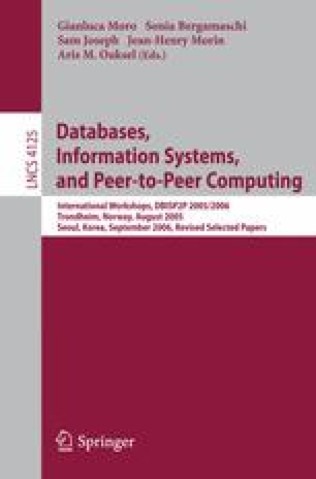
Databases, Information Systems, and Peer-to-Peer Computing ; International Workshops, DBISP2P 2005/2006, Trondheim, Norway, August 28-29, 2006, Revised Selected Papers
The P2P paradigm lends itself to constructing large-scale, complex, adaptive, autonomous and heterogeneous database and information systems, endowed with clearly specified and difierential capabilities to negotiate, bargain, coordinate and self-organize the information exchanges in large-scale networks. This vision will have a radical impact on the structure of complex organizations (business, sci- tific or otherwise) and on the emergence and the formation of social communities, and on how the information is organized and processed. The P2P information paradigm naturally encompasses static and wireless connectivity and static and mobile architectures. Wireless connectivity combined with the increasingly small and powerful mobile devices and sensors poses new challenges as well as opp- tunities to the database community. Information becomes ubiquitous, highly distributed and accessible anywhere and at any time over highly dynamic, - stable networks with very severe constraints on the information management and processing capabilities.

Databases, information systems, and peer-to-peer computing ; 2nd international workshop, DBISP2P 2004, Toronto, Canada, August 29-30, 2004, revised selected papers
Peer-to-peer (P2P) paradigm lends itself to constructing large-scale complex, adaptive, - tonomous and heterogeneous database and information systems, endowed with clearly speci?ed and di?erential capabilities to negotiate, bargain, coordinate, and self-organize the information exchanges in large-scale networks. This vision will have a radical impact on the structure of complex organizations (business, scienti?c, or otherwise) and on the emergence and the formation of social c- munities, and on how the information is organized and processed. The P2P information paradigm naturally encompasses static and wireless connectivity, and static and mobile architectures. Wireless connectivity c- bined with the increasingly small and powerful mobile devices and sensors pose new challenges to as well as opportunities for the database community. Inf- mation becomes ubiquitous, highly distributed and accessible anywhere and at any time over highly dynamic, unstable networks with very severe constraints on the information management and processing capabilities.

Data augmented design : Embracing new data for sustainable urban planning and design
This book offers an essential introduction to a new urban planning and design methodology called Data Augmented Design (DAD) and its evolution and progresses, highlighting data driven methods, urban planning and design applications and related theories. The authors draw on many kinds of data, including big, open, and conventional data, and discuss cutting-edge technologies that illustrate DAD as a future-oriented design framework in terms of its focus on multi-data, multi-method, multi-stage and multi-scale sustainable urban planning. In four sections and ten chapters, the book presents case studies to address the core concepts of DAD, the first type of applications of DAD that emerged in redevelopment-oriented planning and design, the second type committed to the planning and design for urban expansion, and the future-oriented applications of DAD to advance sustainable technologies and the future structural form of the built environment. The book is geared towards a broad readership, ranging from researchers and students of urban planning, urban design, urban geography, urban economics, and urban sociology, to practitioners in the areas of urban planning and design.

Control Theory Tutorial : Basic Concepts Illustrated by Software Examples
Introduces the basic principles of control theory in a concise self-study guide. It complements the classic texts by emphasizing the simple conceptual unity of the subject. A novice can quickly see how and why the different parts fit together. The concepts build slowly and naturally one after another, until the reader soon has a view of the whole. Each concept is illustrated by detailed examples and graphics. The full software code for each example is available, providing the basis for experimenting with various assumptions, learning how to write programs for control analysis, and setting the stage for future research projects. The topics focus on robustness, design trade-offs, and optimality. Most of the book develops classical linear theory. The last part of the book considers robustness with respect to nonlinearity and explicitly nonlinear extensions, as well as advanced topics such as adaptive control and model predictive control.

Continuous Semigroups of Holomorphic Self-maps of the Unit Disc
The book faces the interplay among dynamical properties of semigroups, analytical properties of infinitesimal generators and geometrical properties of Koenigs functions. The book includes precise descriptions of the behavior of trajectories, backward orbits, petals and boundary behavior in general, aiming to give a rather complete picture of all interesting phenomena that occur. In order to fulfill this task, we choose to introduce a new point of view, which is mainly based on the intrinsic dynamical aspects of semigroups in relation with the hyperbolic distance and a deep use of Carathéodory prime ends topology and Gromov hyperbolicity theory.

Concise Guide to Quantum Computing : Algorithms, Exercises, and Implementations
This textbook is intended for practical, laboratory sessions associated with the course of quantum computing and quantum algorithms, as well as for self-study. It contains basic theoretical concepts and methods for solving basic types of problems and gives an overview of basic qubit operations, entangled states, quantum circuits, implementing functions, quantum Fourier transform, phase estimation, etc. The book serves as a basis for the application of new information technologies in education and corporate technical training: theoretical material and examples of practical problems, as well as exercises with, in most cases, detailed solutions, have relation to information technologies. A large number of detailed examples serve to better develop professional competencies in computer science.

Computational intelligence in economics and finance ; Vol. II
Computational intelligence (CI), as an alternative to statistical and econometric approaches, has been applied to a wide range of economics and finance problems in recent years, for example to price forecasting and market efficiency. This book contains research ranging from applications in financial markets and business administration to various economics problems. Not only are empirical studies utilizing various CI algorithms presented, but so also are theoretical models based on computational methods. In addition to direct applications of computational intelligence, readers can also observe how these methods are combined with conventional analytical methods such as statistical and econometric models to yield preferred results.
