



الصفحة 3
الصفحة 3

Cybersecurity of Digital Service Chains : Challenges, Methodologies, and Tools
This book presents the main scientific results from the H2020 GUARD project. The GUARD project aims at filling the current technological gap between software management paradigms and cybersecurity models, the latter still lacking orchestration and agility to effectively address the dynamicity of the former. This book provides a comprehensive review of the main concepts, architectures, algorithms, and non-technical aspects developed during three years of investigation; the description of the Smart Mobility use case developed at the end of the project gives a practical example of how the GUARD platform and related technologies can be deployed in practical scenarios.

Cybersecurity Law
Written by an experienced cybersecurity lawyer and law professor, the second edition includes new and expanded information that reflects the latest changes in laws and regulations. The book includes material on recent FTC data security consent decrees and data breach litigation.

Cybersecurity for business : Organization-wide strategies to ensure cyber risk Is not just an IT Issue
Important and cost-effective innovations can substantially increase cyber risk and the loss of intellectual property, corporate reputation and consumer confidence. Over the past several years, organizations around the world have increasingly come to appreciate the need to address cybersecurity issues from a business perspective, not just from a technical or risk angle. Cybersecurity for Business builds on a set of principles developed with international leaders from technology, government and the boardroom to lay out a clear roadmap of how to meet goals without creating undue cyber risk.

Cyber-physical systems of systems : Foundations : A conceptual model and some derivations : The AMADEOS legacy
Technical Systems-of-Systems (SoS) – in the form of networked, independent constituent computing systems temporarily collaborating to achieve a well-defined objective – form the backbone of most of today’s infrastructure. The energy grid, most transportation systems, the global banking industry, the water-supply system, the military equipment, many embedded systems, and a great number more, strongly depend on systems-of-systems. The correct operation and continuous availability of these underlying systems-of-systems are fundamental for the functioning of our modern society.

Cyber-physical systems : Foundations and techniques
Covers the various aspects associated with Cyber-Physical Systems (CPS) such as algorithms, application areas, and the improvement of existing technology such as machine learning, big data and robotics. The scope of CPS is tremendous. In CPS, one sees the applications of various emerging technologies such as artificial intelligence (AI), Internet of Things (IoT), machine learning (ML), deep learning (DL), big data (BD), robotics, quantum technology, etc. In almost all sectors, whether it is education, health, human resource development, skill improvement, startup strategy, etc., one sees an enhancement in the quality of output because of the emergence of CPS into the field.

Cyber-physical systems : A model-based approach
In this concise yet comprehensive textbook, future inventors are introduced to the key concepts of Cyber-Physical Systems (CPS). Using modeling as a way to develop deeper understanding of the computational and physical components of these systems, one can express new designs in a way that facilitates their simulation, visualization, and analysis. Concepts are introduced in a cross-disciplinary way.
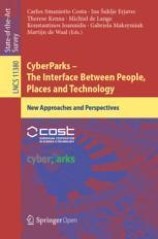
CyberParks – The Interface Between People, Places and Technology: New Approaches and Perspectives
This book is about public open spaces, about people, and about the relationship between them and the role of technology in this relationship. It is about different approaches, methods, empirical studies, and concerns about a phenomenon that is increasingly being in the centre of sciences and strategies – the penetration of digital technologies in the urban space. As the main outcome of the CyberParks Project, this book aims at fostering the understanding about the current and future interactions of the nexus people, public spaces and technology. It addresses a wide range of challenges and multidisciplinary perspectives on emerging phenomena related to the penetration of technology in people’s lifestyles - affecting therefore the whole society, and with this, the production and use of public spaces. Cyberparks coined the term cyberpark to describe the mediated public space, that emerging type of urban spaces where nature and cybertechnologies blend together to generate hybrid experiences and enhance quality of life.

Cyber Security and Digital Forensics : Challenges and Future Trends
This groundbreaking new volume, written and edited by a wide range of professionals in this area, covers broad technical and socio-economic perspectives for the utilization of information and communication technologies and the development of practical solutions in cyber security and digital forensics. Not just for the professional working in the field, but also for the student or academic on the university level, this is a must-have for any library.

Cyber Security ; 18th China Annual Conference, CNCERT 2021, Beijing, China, July 20–21, 2021, revised selected papers
This book constitutes the refereed proceedings of the 17th International Annual Conference on Cyber Security, CNCERT 2021, held in Beijing, China, in AJuly 2021. The 14 papers presented were carefully reviewed and selected from 51 submissions. The papers are organized according to the following topical sections: data security; privacy protection; anomaly detection; traffic analysis; social network security; vulnerability detection; text classification.

Cyber security ; 17th China Annual Conference, CNCERT 2020, Beijing, China, August 12, 2020, revised selected papers
This book constitutes the refereed proceedings of the 16th International Annual Conference on Cyber Security, CNCERT 2020, held in Beijing, China, in August 2020.

Cyber Security ; 15th International Annual Conference, CNCERT 2018, Beijing, China, August 14–16, 2018, Revised Selected Papers
This book cover the following topics: emergency response, mobile internet security, IoT security, cloud security, threat intelligence analysis, vulnerability, artificial intelligence security, IPv6 risk research, cybersecurity policy and regulation research, big data analysis and industrial security.

Cyber Security : Critical Infrastructure Protection
Focus on critical infrastructure protection. The chapters present detailed analysis of the issues and challenges in cyberspace and provide novel solutions in various aspects. The first part of the book focus on digital society, addressing critical infrastructure and different forms of the digitalization, strategic focus on cyber security, legal aspects on cyber security, citizen in digital society, and cyber security training. The second part focus on the critical infrastructure protection in different areas of the critical infrastructure. The chapters cover the cybersecurity situation awareness, aviation and air traffic control, cyber security in smart societies and cities, cyber security in smart buildings, maritime cyber security, cyber security in energy systems, and cyber security in healthcare. The third part presents the impact of new technologies upon cyber capability building as well as new challenges brought about by new technologies. These new technologies are among others are quantum technology, firmware and wireless technologies, malware analysis, virtualization.

Cryptology and Network Security ; 19th International Conference, CANS 2020, Vienna, Austria, December 14–16, 2020, Proceedings
This book constitutes the refereed proceedings of the 19th International Conference on Cryptology and Network Security, CANS 2020, held in Vienna, Austria, in December 2020.* The 30 full papers were carefully reviewed and selected from 118 submissions. The papers focus on topics such as cybersecurity; credentials; elliptic curves; payment systems; privacy-enhancing tools; lightweight cryptography; and codes and lattices.

Cryptography, information theory, and error-correction : A handbook for the 21st century ; 2nd ed.
A rich examination of the technologies supporting secure digital information transfers from respected leaders in the field. Is an indispensable resource for anyone interested in the secure exchange of financial information. Identity theft, cybercrime, and other security issues have taken center stage as information becomes easier to access. Three disciplines offer solutions to these digital challenges: cryptography, information theory, and error-correction, all of which are addressed in this book. The book also: Shares vital, new research in the field of information theory / Provides quantum cryptography updates / Includes over 350 worked examples and problems for greater understanding of ideas.

Cooperative Design, Visualization, and Engineering ; 17th International Conference, CDVE 2020, Bangkok, Thailand, October 25–28, 2020, Proceedings
This book constitutes the proceedings of the 17th International Conference on Cooperative Design, Visualization, and Engineering, CDVE 2020, held in Bangkok, Thailand, in October 2020.* The 33 full papers and 7 short papers presented were carefully reviewed and selected from 74 submissions. The achievement, progress and future challenges are reported in areas such as health care, industrial design, banking IT systems, cultural activities support, operational maritime cybersecurity assurance, emotion communication, and social network data analytics.

Computer safety, reliability, and security ; 39th International Conference, SAFECOMP 2020, Lisbon, Portugal, September 16–18, 2020, Proceedings
This book constitutes the proceedings of the 39th International Conference on Computer Safety, Reliability and Security, SAFECOMP 2020, held in Lisbon, Portugal, in September 2020.* The 27 full and 2 short papers included in this volume were carefully reviewed and selected from 116 submissions. They were organized in topical sections named: safety cases and argumentation; formal verification and analysis; security modelling and methods; assurance of learning-enabled systems; practical experience and tools; threat analysis and risk mitigation; cyber-physical systems security; and fault injection and fault tolerance.

Computer Network Security
As society becomes increasingly dependent on computers and computer networks, computer problems continue to rise in number. Yet despite the proliferation of expert remedies, a viable solution to these security issues remains elusive, and society continues to suffer at the hands of cyber vandalism and computer viruses. This comprehensive text outlines and discusses today’s most important issues and concerns in computer network and information safety and security, and promises to ignite debate and participation in the ongoing global security dialog Computer Network Security is foremost an educational tool that aims to explore computer network infrastructure and protocol design security flaws and discusses current security solutions and best practices. It explores the security threats and vulnerabilities in the current network infrastructure and protocols and outlines current efforts including: Access Control and Authorization, Cryptography, Firewalls and VPNs, Web Security and Content Filtering, among others. The text further discusses various security proposals This text is an invaluable instructional and research tool for courses in computer and information security. Students or practitioners in computer science, information science, technology studies, library sciences, and information management studies will find this text particularly useful for their purposes. In addition, it is a rich resource for those looking to gain an understanding of computer infrastructures and network security threats.

Computer Aided Verification ; 33rd International Conference, CAV 2021, Virtual Event, July 20–23, 2021, Proceedings, Part II
This two-volume set LNCS 12759 and 12760 constitutes the refereed proceedings of the 33rd International Conference on Computer Aided Verification, CAV 2021, held virtually in July 2021. The 63 full papers presented together with 16 tool papers and 5 invited papers were carefully reviewed and selected from 290 submissions. The papers were organized in the following topical sections: Part I: invited papers; AI verification; concurrency and blockchain; hybrid and cyber-physical systems; security; and synthesis. Part II: complexity and termination; decision procedures and solvers; hardware and model checking; logical foundations; and software verification.

Computer Aided Verification ; 33rd International Conference, CAV 2021, Virtual Event, July 20–23, 2021, Proceedings, Part I
This two-volume set LNCS 12759 and 12760 constitutes the refereed proceedings of the 33rd International Conference on Computer Aided Verification, CAV 2021, held virtually in July 2021. The 63 full papers presented together with 16 tool papers and 5 invited papers were carefully reviewed and selected from 290 submissions. The papers were organized in the following topical sections: Part I: invited papers; AI verification; concurrency and blockchain; hybrid and cyber-physical systems; security; and synthesis. Part II: complexity and termination; decision procedures and solvers; hardware and model checking; logical foundations; and software verification.

Computer Aided Verification ; 31st International Conference, CAV 2019, New York City, NY, USA, July 15-18, 2019, Proceedings, Part I
This volume presented automata and timed systems; security and hyperproperties; synthesis; model checking; cyber-physical systems and machine learning; probabilistic systems, runtime techniques; dynamical, hybrid, and reactive systems.
