



الصفحة 25
الصفحة 25

Flexible and Efficient Information Handling ; 23rd British National Conference on Databases, BNCOD 23, Belfast, Northern Ireland, UK, July 18-20, 2006, Proceedings
This book constitutes the refereed proceedings of the 23rd British National Conference on Databases, BNCOD 23, held in Belfast, Northern Ireland, July 2006. The volume presents 12 revised full papers and 6 revised short papers, together with 2 invited lectures and 13 poster papers. Topical sections include data modelling and architectures and transaction management, data integration and interoperability and information retrieval, query processing and optimisation, data mining, data warehousing and more.
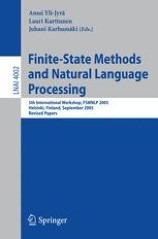
Finite-state methods and natural language processing ; 5th International Workshop, FSMNLP 2005, Helsinki, Finland, September 1-2, 2005, Revised Papers
This book constitutes the thoroughly refereed post-proceedings of the 5th International Workshop on Finite-State Methods in Natural Language Processing, FSMNLP 2005, held in Helsinki, Finland, September 2005. The book presents 24 revised full papers and seven revised poster papers together with two invited contributions and abstracts of six software demos. Topics include morphology, optimality theory, some special FSM families, weighted FSM algorithms, FSM representations, exploration, ordered structures, and surface parsing.
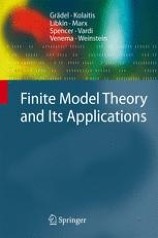
Finite model theory and its applications
This book gives a broad overview of core topics of finite model theory: expressive power, descriptive complexity, and zero-one laws, together with selected applications to database theory and artificial intelligence, especially, constraint databases and constraint satisfaction problems. The final chapter provides a concise modern introduction to modal logic, which emphasizes the continuity in spirit and technique with finite model theory. This underlying spirit involves the use of various fragments of, and hierarchies within, first order, second order, fixed point, and infinitary logics to gain insight into phenomena in complexity theory and combinatorics.

Finite Difference Computing with Exponential Decay Models
This text provides a very simple, initial introduction to the complete scientific computing pipeline: models, discretization, algorithms, programming, verification, and visualization. The pedagogical strategy is to use one case study – an ordinary differential equation describing exponential decay processes – to illustrate fundamental concepts in mathematics and computer science. The book is easy to read and only requires a command of one-variable calculus and some very basic knowledge about computer programming. Contrary to similar texts on numerical methods and programming, this text has a much stronger focus on implementation and teaches testing and software engineering in particular.

Fifth World Conference on Information Security Education ; Proceedings of the IFIP TC 11 WG 11.8, WISE 5, 19 to 21 June 2007, United States Military Academy, West Point, NY, USA
The scope of This book includes: foundations of computer science; software theory and practice; education; computer applications in technology; communication systems; systems modeling and optimization; information systems; computers and society; computer systems technology; security and protection in information processing systems; artificial intelligence; and human-computer interaction. Proceedings and post-proceedings of referred international conferences in computer science and interdisciplinary fields are featured. These results often precede journal publication and represent the most current research.
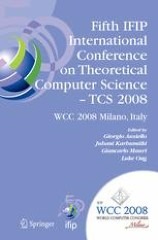
Fifth IFIP International Conference On Theoretical Computer Science - Tcs 2008 ; IFIP 20th World Computer Congress, TC 1, Foundations of Computer Science, September 7-10, 2008, Milano, Italy
Includes: foundations of computer science; software theory and practice; education; computer applications in technology; communication systems; systems modeling and optimization; information systems; computers and society; computer systems technology; security and protection in information processing systems; artificial intelligence; and human-computer interaction. Proceedings and post-proceedings of refereed international conferences in computer science and interdisciplinary fields are featured. These results often precede journal publication and represent the most current research. The principal aim of the IFIP series is to encourage education and the dissemination and exchange of information about all aspects of computing.

Field-Based Coordination for Pervasive Multiagent Systems
Software systems involve autonomous and distributed software components that have to execute and interact in open and dynamic environments, such as in pervasive, autonomous, and mobile applications. The requirements with respect to dynamics, openness, scalability, and decentralization call for new approaches to software design and development, capable of supporting spontaneous configuration, tolerating partial failures, or arranging adaptive reorganization of the whole system.

Explosively Driven Pulsed Power : Helical Magnetic Flux Compression Generators
While the basic operating principles of Helical Magnetic Flux Compression Generators are easy to understand, the details of their construction and performance limits have been described only in government reports, many of them classified. Conferences in the field of flux compression are also dominated by contributions from government (US and foreign) laboratories. And the government-sponsored research has usually been concerned with very large generators with explosive charges that require elaborate facilities and safety arrangements. This book emphasizes research into small generators (less than 500 grams of high explosives) and explains in detail the physical fundamentals, construction details, and parameter-variation effects related to them.

Exploring Resilience : A Scientific Journey from Practice to Theory
Resilience has become an important topic on the safety research agenda and in organizational practice. Most empirical work on resilience has been descriptive, identifying characteristics of work and organizing activity which allow organizations to cope with unexpected situations. Fewer studies have developed testable models and theories that can be used to support interventions aiming to increase resilience and improve safety. In addition, the absent integration of different system levels from individuals, teams, organizations, regulatory bodies, and policy level in theory and practice imply that mechanisms through which resilience is linked across complex systems are not yet well understood. Scientific efforts have been made to develop constructs and models that present relationships; however, these cannot be characterized as sufficient for theory building. There is a need for taking a broader look at resilience practices as a foundation for developing a theoretical framework that can help improve safety in complex systems.
Explainable Artificial Intelligence : An Introduction to Interpretable Machine Learning
Offers a curriculum for introducing interpretability to machine learning at every stage. The authors provide compelling examples that a core teaching practice like leading interpretive discussions can be taught and learned by teachers and sustained effort. And what better way to strengthen the quality of AI and Machine learning outcomes. I hope that this book will become a primer for teachers, data Science educators, and ML developers, and together we practice the art of interpretive machine learning.
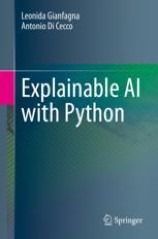
Explainable AI with Python
This book provides a full presentation of the current concepts and available techniques to make “machine learning” systems more explainable. The approaches presented can be applied to almost all the current “machine learning” models: linear and logistic regression, deep learning neural networks, natural language processing and image recognition, among the others.

Expert Oracle Database 10g Administration
This book covers the new 10g management and performance tools and provides essential primers on Unix, Linux and Windows NT administration and on core SQL and PL/SQL programming techniques. And it provides everything the new and aspring Oracle database administrator needs to build and administer complex Oracle 10g databases.

Evolving Connectionist Systems : The Knowledge Engineering Approach
Evolving Connectionist Systems is aimed at all those interested in developing and using intelligent computational models and systems to solve challenging real world problems in computer science, engineering, bioinformatics and neuroinformatics. The book challenges scientists and practitioners with open questions about future creation of new information models inspired by Nature. This edition includes new methods for adaptive, knowledge-based learning, such as online incremental feature selection, spiking neural networks, transductive neuro-fuzzy inference, adaptive data and model integration, cellular automata and artificial life systems, particle swarm optimisation, ensembles of evolving systems, and quantum inspired neural networks. New applications to gene and protein interaction modelling, brain data analysis and brain model creation, computational neuro-genetic modelling, adaptive speech, image and multimodal recognition, language modelling, adaptive robotics, modelling dynamic financial and socio-economic systems, and ecological modelling, are covered. An important new feature of the book is the attempt to connect different structural and functional levels of a complex, intelligent system, looking for inspiration from functional relationships in natural systems, such as the genetic and the brain activity.

Evolutionary Computer Music
The evolutionary computation approach to music is an exciting new development for composers and musicologists alike. For composers, it provides an innovative and natural means for generating musical ideas from a specifiable set of primitive components and processes. For musicologists, these techniques are used to model the cultural transmission and change of a population's body of musical ideas over time. In both cases, musical evolution can be guided by a variety of constraints and tendencies built into the system, such as realistic psychological factors that influence the way music is expressed, experienced, learned, stored, modified, and passed on among individuals. This book discusses not only the applications of evolutionary computation to music, but also the tools needed to create and study such systems. These tools are drawn in part from research into the origins and evolution of biological organisms, ecologies, and cultural systems on the one hand, and from computer simulation methodologies on the other. They can be combined to create surrogate artificial worlds populated by interacting simulated organisms in which complex musical experiments can be performed that would otherwise be impossible.
Evolutionary computation, machine learning and data mining in bioinformatics ; 6th European Conference, EvoBIO 2008, Naples, Italy, March 26-28, 2008. Proceedings
The feld of bioinformatics has two main objectives: the creation and main- nance of biological databases, and the discovery of knowledge from life sciences data in order to unravel the mysteries of biological function, leading to new drugs and therapies for human disease. Life sciences data come in the form of biological sequences, structures, pathways, or literature. One major aspect of discovering biological knowledge is to search, predict, or model specifc infortioninagivendatasetinorderto generate new in teresting knowledge.Computer science methods such as evolutionary computation, machine learning, and data mining all have a great deal to ofer the feld of bioinformatics.

Evolutionary computation, machine learning and data mining in bioinformatics ; 5th European Conference, EvoBIO 2007, Valencia, Spain, April 11-13, 2007, Proceedings
This book Covers brings together experts in computer science with experts in bioinformatics and the biological sciences. It presents contributions on fundamental and theoretical issues along with papers dealing with different applications areas.

Euro-Par 2020 : Parallel Processing ; 26th International Conference on Parallel and Distributed Computing, Warsaw, Poland, August 24–28, 2020, Proceedings
This book constitutes the proceedings of the 26th International Conference on Parallel and Distributed Computing, Euro-Par 2020, held in Warsaw, Poland, in August 2020. The conference was held virtually due to the coronavirus pandemic. The 39 full papers presented in this volume were carefully reviewed and selected from 158 submissions. They deal with parallel and distributed computing in general, focusing on support tools and environments; performance and power modeling, prediction and evaluation; scheduling and load balancing; high performance architectures and compilers; data management, analytics and machine learning; cluster, cloud and edge computing; theory and algorithms for parallel and distributed processing; parallel and distributed programming, interfaces, and languages; multicore and manycore parallelism; parallel numerical methods and applications; and accelerator computing.
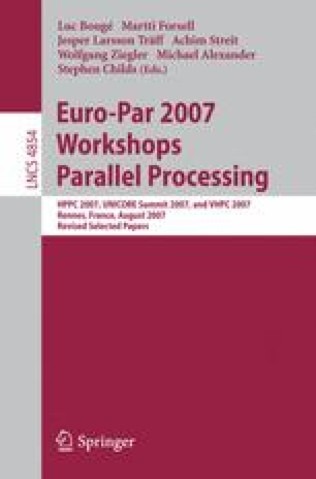
Euro-Par 2007 Workshops : Parallel Processing ; HPPC 2007, UNICORE Summit 2007, and VHPC 2007, Rennes, France, August 28-31, 2007, Revised Selected Papers
Parallel and distributed processing , although within the focus of computer science research for along time ,is gainingmore and more importance in awidespectrum of applications. These proceedings aim to demonstrate the use of parallel and distributed processing concepts in diferent application felds, and attempt to spark interest in novel research directions to advance the embracing model of high-performance computing research in general. The objective of these workshops is to specifcally address researchers c- ing from university, industry and governmental research organizations and application-oriented companies, in order to close the gap between purely sentifc research and the applicability of the research ideas to real-life problems.

Euro-Par 2006 Parallel Processing ; 12th International Euro-Par Conference, Dresden, Germany, August 28-September 1, 2006, Proceedings
This book constitutes the refereed proceedings of the 12th International Conference on Parallel Computing, Euro-Par 2006. parallel and distributed databases, data mining and knowledge discovery; grid and cluster computing: models, middleware and architectures; parallel computer architecure and instruction-level parallelism.
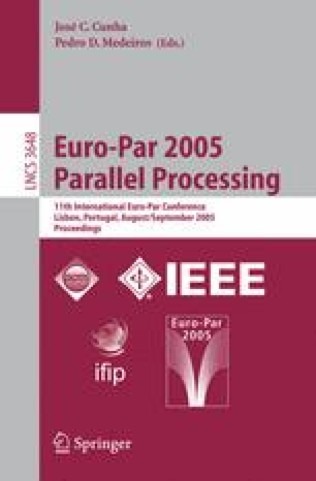
Euro-Par 2005 Parallel Processing ; 11th International Euro-Par Conference, Lisbon, Portugal, August 30 - September 2, 2005, Proceedings
This book constitutes the refereed proceedings of the 11th International Conference on Parallel Computing, Euro-Par 2005, held in Lisbon, Portugal, in August/September 2005. The 120 revised papers presented together with 4 invited papers were carefully reviewed and selected from 388 submissions. The papers are organized in topical sections on support tools and environments, performance prediction and evaluation, scheduling and load balancing, compilers for high performance, parallel and distributed databases, data mining and knowledge discovery, grid and cluster computing: models, middleware and architectures, parallel computer architecture and instruction distributed systems and algorithms, parallel programming: models, methods, and languages, parallel numerical algorithms.
