



الصفحة 25
الصفحة 25

Constraint satisfaction techniques for agent-based reasoning
Constraint satisfaction problems are significant in the domain of automated reasoning for artificial intelligence. They can be applied to the modeling and solving of a wide range of combinatorial applications such as planning, scheduling and resource sharing in a variety of practical domains such as transportation, production, supply-chains, network management and human resource management. In this book we study new techniques for solving constraint satisfaction problems, with a special focus on solution adaptation applied to agent reasoning.

Constraint handling rules : Current research topics
The Constraint Handling Rules (CHR) language is a declarative concurrent committed-choice constraint logic programming language consisting of guarded rules that transform multisets of relations called constraints until no more change occurs. The aim of this volume was to attract high-quality research papers on these recent advances in Constraint Handling Rules.

Conditionals, Information, and Inference
Conditionals are fascinating and versatile objects of knowledge representation. On the one hand, they may express rules in a very general sense, representing, for example, plausible relationships, physical laws, and social norms. On the other hand, as default rules or general implications, they constitute a basic tool for reasoning, even in the presence of uncertainty. In this sense, conditionals are intimately connected both to information and inference. Due to their non-Boolean nature, however, conditionals are not easily dealt with. They are not simply true or false — rather, a conditional “if A then B” provides a context, A, for B to be plausible (or true) and must not be confused with “A entails B” or with the material implication “not A or B.” This ill- trates how conditionals represent information, understood in its strict sense as reduction of uncertainty. To learn that, in the context A, the proposition B is plausible, may reduce uncertainty about B and hence is information. The ab- ity to predict such conditioned propositions is knowledge and as such (earlier) acquired information. The ?rst work on conditional objects dates back to Boole in the 19th c- tury, and the interest in conditionals was revived in the second half of the 20th century, when the emerging Arti?cial Intelligence made claims for appropriate formaltoolstohandle“generalizedrules.”Sincethen,conditionalshavebeenthe topic of countless publications, each emphasizing their relevance for knowledge representation, plausible reasoning, nonmonotonic inference, and belief revision.

Concurrency, Graphs and Models : Essays Dedicated to Ugo Montanari on the Occasion of His 65th Birthday
The volume consists of seven sections, six of which are dedicated to the main research areas to which Ugo Montanari has contributed: Graph Transformation; Constraint and Logic Programming; Software Engineering; Concurrency; Models of Computation; and Software Verification.

Conceptual Structures: Knowledge Architectures for Smart Applications ; 15th International Conference on Conceptual Structures, ICCS 2007, Sheffield, UK, July 22-27, 2007, Proceedings
Conceptual structures focus on the representation and analysis of concepts, events, actions and objects with applications in - search,softwareengineering,manufacturing and business.The book covers computer science, information technology,artificial int- ligence, philosophy and a variety of applied disciplines to explore novel ways that information technologies can be leveraged to assist human reasoning and interaction for tangible business or social benefits. Conceptual structures can be used to augment human intelligence by facilitating knowledge integration, desion making, the creation of intelligent software systems and the exploration of implicit structures.

Conceptual Structures : Knowledge Visualization and Reasoning; 16th International Conference on Conceptual Structures, ICCS 2008 Toulouse, France, July 7-11, 2008 Proceedings
This book constitutes the refereed proceedings of the 16th International Conference on Conceptual Structures, ICCS 2008, held in Toulouse, France, in July 2008.

Conceptual Structures : Inspiration and Application ; 14th International Conference on Conceptual Structures, ICCS 2006, Aalborg, Denmark, July 16-21, 2006, Proceedings
th The 14 International Conference on Conceptual Structures (ICCS 2006) was held in Aalborg, Denmark during July 16 – 21, 2006. Responding to the Call for Papers, we received 62 papers from 20 different countries, representing six different continents. This clearly indicates the international nature of the ICCS community as well as the widespread interest which was spawned by the previous conferences.

Concept Lattices and Their Applications ; Fourth International Conference, CLA 2006 Tunis, Tunisia, October 30-November 1, 2006 Selected Papers
This book constitutes the refereed proceedings of the Fourth International Conference on Concept Lattices and their Applications, CLA 2006, held in Tunis, Tunisia, October 30-November 1, 2006.

Computing science, communication and security ; 2nd International Conference, COMS2 2021, Gujarat, India, February 6–7, 2021, Revised Selected Papers
This book constitutes revised selected papers of the Second International Conference on Computing Science, Communication and Security, COMS2 2021, held in Gandhinagar, India, in February 2021. Due to the COVID-19 pandemic the conference was held virtually. The 19 full papers were thoroughly reveiwed and selected from 105 submissions. Papers are organised according to the topical sections on artificial intelligence and machine learning; networking and communications.

Computing science, communication and security ; 1st International Conference, COMS2 2020, Gujarat, India, March 26–27, 2020, revised selected papers
Constitutes revised selected papers of the First International Conference on Computing Science, Communication and Security, COMS2 2020, held in March 2020. Due to the COVID-19 pandemic the conference was held virtually. The 26 full papers and 1 short paper were thoroughly reveiwed and selected from 79 submissions. Papers are organised according to the topical sections on artificial intelligence and machine learning; network, communication and security; computing science.
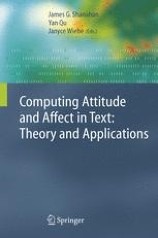
Computing Attitude and Affect in Text : Theory and Applications
Human Language Technology (HLT) and Natural Language Processing (NLP) systems have typically focused on the “factual” aspect of content analysis. Other aspects, including pragmatics, opinion, and style, have received much less attention. However, to achieve an adequate understanding of a text, these aspects cannot be ignored. The chapters in this book address the aspect of subjective opinion, which includes identifying different points of view, identifying different emotive dimensions, and classifying text by opinion. Various conceptual models and computational methods are presented.

Computers helping people with special needs ; 17th International Conference, ICCHP 2020, Lecco, Italy, September 9–11, 2020, Proceedings, Part II
The two-volume set LNCS 12376 and 12377 constitutes the refereed proceedings of the 17th International Conference on Computers Helping People with Special Needs, ICCHP 2020, held in Lecco, Italy, in September 2020. The conference was held virtually due to the COVID-19 pandemic.

Computers helping people with special needs ; 17th International Conference, ICCHP 2020, Lecco, Italy, September 9–11, 2020, Proceedings, Part I
The two-volume set LNCS 12376 and 12377 constitutes the refereed proceedings of the 17th International Conference on Computers Helping People with Special Needs, ICCHP 2020, held in Lecco, Italy, in September 2020. The conference was held virtually due to the COVID-19 pandemic.

Computers and Games ; 6th International Conference, CG 2008, Beijing, China, September 29 - October 1, 2008. Proceedings
This book constitutes the refereed proceedings of the 6th International Conference on Computers and Games, CG 2008, held in Beijing, China, in September/October 2008 co-located with the 13th Computer Olympiad and the 16th World Computer-Chess Championship.

Computers and Games ; 5th International Conference, CG 2006, Turin, Italy, May 29-31, 2006, Revised Papers
This book covers all aspects of artificial intelligence in computer-game playing. Topics addressed are evaluation and learning, search, combinatorial games and theory opening and endgame databases, single-agent search and planning, and computer Go.

Computers and Games ; 4th International Conference, CG 2004, Ramat-Gan, Israel, July 5-7, 2004. Revised Papers
This book constitutes the thoroughly refereed post-proceedings of the 4th International Conference on Computers and Games, CG 2004, held in July 2004. Topics addressed include evaluation and learning, search, single-agent search and planning, and computer Go.

Computer-Human Interaction ; 8th Asia-Pacific Conference, APCHI 2008 Seoul, Korea, July 6-9, 2008 Proceedings
This book constitutes the refereed proceedings of the 8th Asia Pacific Conference on Computer Human Interaction, APCHI 2008, held in Seoul, Korea, in July 2008.

Computer vision in human-computer interaction ; Vol. 3766
Human-Computer Interaction (HCI) lies at the crossroads of many scienti?c areas including arti?cial intelligence, computer vision, face recognition, motion tracking, etc. In order for HCI systems to interact seamlessly with people, they need to understand their environment through vision and auditory input. Mo- over, HCI systems should learn how to adaptively respond depending on the situation. The goal of this workshop was to bring together researchers from the ?eld of computer vision whose work is related to human-computer interaction. The selected articles for this workshop address a wide range of theoretical and - plication issues in human-computer interaction ranging from human-robot - teraction, gesture recognition, and body tracking, to facial features analysis and human-computer interaction systems.

Computer vision and machine learning for intelligent sensing systems
Offers a selection of high-quality research articles that tackle the major difficulties in computer vision and machine learning for intelligent sensing systems from both theoretical and practical standpoints. This publication includes intelligent sensing techniques, twelve foundational investigations into sense-making methods, and discusses particular uses of intelligent sensing systems in autonomous driving and virtual reality.

Computer Vision and Internet of Things : Technologies and Applications
Explores the utilization of Internet of Things (IoT) with computer vision and its underlying technologies in different applications areas. Using a series of present and future applications – including business insights, indoor-outdoor securities, smart grids, human detection and tracking, intelligent traffic monitoring, e-health departments, and medical imaging – this book focuses on providing a detailed description of the utilization of IoT with computer vision and its underlying technologies in critical application areas, such as smart grids, emergency departments, intelligent traffic cams, insurance, and the automotive industry.
