



الصفحة 24
الصفحة 24

Cyber-physical systems : Foundations and techniques
Covers the various aspects associated with Cyber-Physical Systems (CPS) such as algorithms, application areas, and the improvement of existing technology such as machine learning, big data and robotics. The scope of CPS is tremendous. In CPS, one sees the applications of various emerging technologies such as artificial intelligence (AI), Internet of Things (IoT), machine learning (ML), deep learning (DL), big data (BD), robotics, quantum technology, etc. In almost all sectors, whether it is education, health, human resource development, skill improvement, startup strategy, etc., one sees an enhancement in the quality of output because of the emergence of CPS into the field.

Cyber Security ; 18th China Annual Conference, CNCERT 2021, Beijing, China, July 20–21, 2021, revised selected papers
This book constitutes the refereed proceedings of the 17th International Annual Conference on Cyber Security, CNCERT 2021, held in Beijing, China, in AJuly 2021. The 14 papers presented were carefully reviewed and selected from 51 submissions. The papers are organized according to the following topical sections: data security; privacy protection; anomaly detection; traffic analysis; social network security; vulnerability detection; text classification.

Cyber Security ; 15th International Annual Conference, CNCERT 2018, Beijing, China, August 14–16, 2018, Revised Selected Papers
This book cover the following topics: emergency response, mobile internet security, IoT security, cloud security, threat intelligence analysis, vulnerability, artificial intelligence security, IPv6 risk research, cybersecurity policy and regulation research, big data analysis and industrial security.

Current aopics in artificial intelligence ; 12th Conference of the Spanish Association for Artificial Intelligence, CAEPIA 2007, Salamanca, Spain, November 12-16, 2007, Selected Papers
The book presented address all current issues of artificial intelligence ranging from methodological and foundational aspects to advanced applications in various fields.
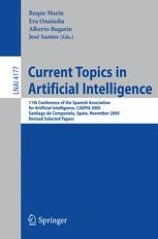
Current aopics in artificial intelligence ; 11th Conference of the Spanish Association for Artificial Intelligence, CAEPIA 2005, Santiago de Compostela, Spain, November 16-18, 2005, Revised Selected Papers
This book constitutes the thoroughly refered post-proceedings of the 11th Conference of the Spanish Association for Artificial Intelligence, CAEPIA 2005, held in Santiago de Compostela, Spain in November 2005.

Cryptology and Network Security ; 19th International Conference, CANS 2020, Vienna, Austria, December 14–16, 2020, Proceedings
This book constitutes the refereed proceedings of the 19th International Conference on Cryptology and Network Security, CANS 2020, held in Vienna, Austria, in December 2020.* The 30 full papers were carefully reviewed and selected from 118 submissions. The papers focus on topics such as cybersecurity; credentials; elliptic curves; payment systems; privacy-enhancing tools; lightweight cryptography; and codes and lattices.

Creative applications of artificial intelligence in education
Explores the synergy between AI and education, highlighting its potential impact on pedagogical practices. It navigates the evolving landscape of AI-powered educational technologies and suggests practical ways to personalise instruction, nurture human-AI co-creativity, and transform the learning experience. Spanning from primary to higher education, this short and engaging volume proposes concrete examples of how educational stakeholders can be empowered in their AI literacy to foster creativity, inspire critical thinking, and promote problem-solving by embracing AI as a tool for expansive learning. Structured in three parts, the book starts developing the creative engagement perspective for learning and teaching to then present practical applications of AI in K-12 and higher education, covering different fields (teacher education, professional education, business education) as well as different types of AI supported tools (games, chatbots, and AI assisted assessment).

Creating New Learning Experiences on a Global Scale ; 2nd European Conference on Technology Enhanced Learning, EC-TEL 2007, Crete, Greece, September 17-20, 2007, Proceedings
It is holding more than 500 pages of combined wisdom on Technology Enhanced Learning (TEL) in your hands! With the advance of metadata, standards, learning objects, Web 2. 0 approaches to rip, mix and burn learning, wikis, blogs, syndication, user-generated content, W- based video, games and the ubiquitous availability of computing devices we can and have to offer more flexible learning services on a global scale.It provided a unique forum for all research related to technology enhanced learning, including its interactions with knowledge management, business processes and work environments.

Countering Counterfeit Trade : Illicit Market Insights, Best-Practice Strategies, and Management Toolbox
The book constitutes a unique combination of in-depth insights into the counterfeit market, best-practice strategies, novel management tools, and product protection technologies.

Coordination, organizations, institutions, and norms in agent systems II ; AAMAS 2006 and ECAI 2006 International Workshops, COIN 2006 Hakodate, Japan, May 9, 2006 Riva del Garda, Italy, August 28, 2006, Revised Selected Papers
In recent years, social and organizational aspects of agency have become major research topics in MAS. Recent applications of MAS on Web services, grid c- puting and ubiquitous computing highlight the need for using these aspects in order to ensure social order within such environments. Openness, heterogeneity, and scalability of MAS, in turn, pose new demands on traditional MAS int- action models and bring forward the need to look into the environment where agents interact and at di?erent ways of constraining or regulating interactions.it provide theoretically demanding and interdisciplinary research questions at d- ferent levels of abstraction.

Coordination, organizations, institutions, and norms in agent system III ; COIN 2007 International Workshops COIN@AAMAS 2007, Honolulu, HI, USA, May 14, 2007 COIN@MALLOW 2007, Durham, UK, September 3-4, 2007 Revised Selected Papers
This book constitutes the refereed post-workshop proceedings of the International Workshop on Coordination, Organization, Institutions and Norms in Agent Systems, COIN 2007.

Coordination models and languages ; 23rd IFIP WG 6.1 International Conference, COORDINATION 2021, Held as Part of the 16th International Federated Conference on Distributed Computing Techniques, DisCoTec 2021, Valletta, Malta, June 14–18, 2021, Proceedings
This book constitutes the refereed proceedings of the 23rd IFIP WG 6.1 International Conference on Coordination Models and Language, COORDINATION 2021, held in Valletta, Malta, in June 2021, as part of the 16th International Federated Conference on Distributed Computing Techniques, DisCoTec 2021. The 15 regular papers, 2 short papers, and 1 tutorial paper presented in this book were carefully reviewed and selected from 31 submissions. COORDINATION provides a well-established forum for the growing community of researchers interested in coordination models and languages, architectures, verification and implementation techniques necessary to cope with the complexity induced by the demands of today's software development.

Coordination models and languages ; 22nd IFIP WG 6.1 International Conference, COORDINATION 2020, Held as Part of the 15th International Federated Conference on Distributed Computing Techniques, DisCoTec 2020, Valletta, Malta, June 15–19, 2020, Proceedings
This book constitutes the proceedings of the 22nd International Conference on Coordination Models and Languages, COORDINATION 2020, which was due to be held in Valletta, Malta, in June 2020, as part of the 15th International Federated Conference on Distributed Computing Techniques, DisCoTec 2020. The conference was held virtually due to the COVID-19 pandemic. The 12 full papers and 6 short papers included in this volume were carefully reviewed and selected from 30 submissions. They are presented in this volume together with 2 invited tutorials and 4 tool papers. The papers are organized in the following topical sections: tutorials; coordination languages; message-based communication; communications: types & implementations; service-oriented computing; large-scale decentralized systems; smart contracts; modelling; verification & analysis.

Coordination models and languages ; 10th International Conference, COORDINATION 2008, Oslo, Norway, June 4-6, 2008. Proceedings
This book constitutes the refereed proceedings of the 10th International Conference on Coordination Models and Languages, COORDINATION 2008, held in Oslo, Norway, in June 2008, as one of the federated conferences on Distributed Computing Techniques, DisCoTec 2008.

Cooperative tool
Online collaboration is fast becoming a permanent feature of the modern workplace. Companies and organizations are attracted by the cost-effective technology allowing employees to work together anywhere, at any time using any internet-enabled device. Online collaboration gives team members the tools they need to work with others from any location, including from home and while travelling. This drastically reduces “downtime” and allows people to be productive when it best suits them therefore we propose a website that provides content (videoconference, real-time Chat, whiteboard).

Cooperative Information Agents XII ; 12th International Workshop, CIA 2008, Prague, Czech Republic, September 10-12, 2008. Proceedings
This book constitutes the refereed proceedings of the 12th International Workshop on Cooperative Information Agents, CIA 2008, held in Prague, Czech Republik, in September 2008.

Cooperative Information Agents XI ; Matthias Klusch, Koen V. Hindriks, Mike P. Papazoglou, Leon Sterling
In today’s world of ubiquitously connected heterogeneous information systems and computing devices, the intelligent coordination and provision of relevant added-value information at any time, anywhere is of key importance to a va- ety of applications. This challenge is envisioned to be coped with by means of appropriate intelligent and cooperative information agents. An information agent is a computational software entity that has access to one or multiple heterogeneous and geographically dispersed data and infor- tion sources. It pro-actively searches for and maintains information on behalf of its human users, or other agents preferably just in time. In other words, it is managing and overcoming the di?culties associated with information overload in open, pervasive information and service landscapes. Each component of a modern cooperative information system is represented by an appropriate intelligent information agent capable of resolving system and semantic heterogeneities in a given context on demand. Cooperative infor- tion agents are supposed to accomplish both individual and shared joint goals depending on the actual user preferences in line with given or deduced limits of time, budget and resources available.

Cooperative Design, Visualization, and Engineering ; 17th International Conference, CDVE 2020, Bangkok, Thailand, October 25–28, 2020, Proceedings
This book constitutes the proceedings of the 17th International Conference on Cooperative Design, Visualization, and Engineering, CDVE 2020, held in Bangkok, Thailand, in October 2020.* The 33 full papers and 7 short papers presented were carefully reviewed and selected from 74 submissions. The achievement, progress and future challenges are reported in areas such as health care, industrial design, banking IT systems, cultural activities support, operational maritime cybersecurity assurance, emotion communication, and social network data analytics.

Content based social platform optimization “Fashion Platform"
The purpose of this project is to design a platform that concentrates on Fashion in addition to assisting users with gathering an informative feedback, as well as linking local stores to those users. This platform will be delivered as a mobile application that is available to any user who is interested in expressing and sharing his/her prevailing taste in fashion simply by posting photos, interacting with other people’s posts and leaving comments for them. The app will also provide some features in an attempt to push the users to be more enthusiastic and to be more encouraged about trying and continuously using this app. Moreover, this platform will incorporate a Shop section, which will be the actual local stores that are connected to it, so the user can buy an item that he/she is fond of.

Constructing Ambient Intelligence ; AmI 2007 Workshops Darmstadt, Germany, November 7-10, 2007 Revised Papers
This book constitutes the refereed proceedings of the workshops of the First European Conference on Ambient Intelligence, AmI 2007, held in Darmstadt, Germany, in November 2007.
