



الصفحة 23
الصفحة 23

Logic-Based Program Synthesis and Transformation ; 17th International Symposium, LOPSTR 2007, Kongens Lyngby, Denmark, August 23-24, 2007, Revised Selected Papers
Contains a selectionofthe the paperspresentedatthe 17thInter- tional Symposium on Logic-Based Program Synthesis and Transformation, that was held in Kongens Lyngby, Denmark, August 23-24,2007. LOPSTR thus traditionally solicits papers in the areas of: specification, synthesis, verification, transformation, analysis, optimization, composition, security, reuse, applications andtools, component-baseds of tware development, software architectures, age- based software development and program refnement. Formal proceedings are produced only after the symposium, so that authors can incorporate this feed back in the published papers.
Logical and Relational Learning
This textbook covers logical and relational learning in depth, and hence provides an introduction to inductive logic programming (ILP), multirelational data mining (MRDM) and (statistical) relational learning (SRL). These subfields of data mining and machine learning are concerned with the analysis of complex and structured data sets that arise in numerous applications, such as bio- and chemoinformatics, network analysis, Web mining, natural language processing, within the rich representations offered by relational databases and computational logic.

Logic, language, information and computation ; 15th International Workshop, WoLLIC 2008 Edinburgh, UK, July 1-4, 2008 Proceedings
The papers cover all pertinent subjects in computer science with particular interest in cross-disciplinary topics. Typical areas of interest are: foundations of computing and programming; novel computation models and paradigms; broad notions of proof and belief; formal methods in software and hardware development; logical approach to natural language and reasoning; logics of programs, actions and resources; foundational aspects of information organization, search, flow, sharing, and protection.
Logic Programming with Prolog
Logic Programming is the name given to a distinctive style of programming, very different from that of conventional programming languages such as C++ and Java. By far the most widely used Logic Programming language is Prolog. Prolog is a good choice for developing complex applications, especially in the field of Artificial Intelligence. This book does not assume that the reader is an experienced programmer or has a background in Mathematics, Logic or Artificial Intelligence. It starts from scratch and aims to arrive at the point where quite powerful programs can be written in the language. It is intended both as a textbook for an introductory course and as a self-study book. On completion the reader will know enough to use Prolog in their own research or practical projects. Each chapter has self-assessment exercises so that the reader may check their own progress. A glossary of the technical terms used completes the book.

Logic Programming : 24th International Conference, ICLP 2008 Udine, Italy, December 9-13 2008 Proceedings
The 35 revised full papers together with 2 invited talks, 2 invited tutorials, 11 papers of the co-located first Workshop on Answer Set Programming and Other Computing Paradigms (ASPOCP 2008), as well as 26 poster presentations and the abstracts of 11 doctoral consortium articles were carefully reviewed and selected from 177 initial submissions. The papers cover all issues of current research in logic programming - they are organized in topical sections on applications, algorithms, systems, and implementations, semantics and foundations, analysis and transformations, CHRs and extensions, implementations and systems, answer set programming and extensions, as well as constraints and optimizations.

Logic for Programming, Artificial Intelligence, and Reasoning ; Vol. 3835 : 12th International Conference, LPAR 2005, Montego Bay, Jamaica, December 2-6, 2005, Proceedings
Constitutes the refereed proceedings of the 12th International Conference on Logic for Programming, Artificial Intelligence, and Reasoning, LPAR 2005. This book presents 46 revised papers with 3 abstracts, addressing issues in logic programming, logic-based program manipulation, formal method, automated reasoning, and various kinds of AI logics.

Logic for Programming, Artificial Intelligence, and Reasoning ; Vol. 3452 : 11th International Workshop, LPAR 2004, Montevideo, Uruguay, March 14-18, 2005, Proceedings
Contains the papers presented at the 11th International Conference on Logic for Programming, Arti'cial Intelligence, and Reasoning (LPAR), held from March 14 to 18, 2005, in Montevideo, Uruguay, together with the 5th - ternational Workshop on the Implementation of Logics (organized by Stephan Schulz and Boris Konev) and the Workshop on Analytic Proof Systems (or- nized by Matthias Baaz). The call for papers attracted 77 paper submissions, each of which was - viewed by at least three expert reviewers. The ?nal decisions on the papers were taken during an electronic Program Committee meeting held on the Internet. The Internet-based submission, reviewing, and discussion software EasyChair, provided by the second PC co-chair, supported each stage of the reviewing p- cess.

Logic for Programming, Artificial Intelligence, and Reasoning ; 15th International Conference, LPAR 2008, Doha, Qatar, November 22-27, 2008. Proceedings
This book constitutes the refereed proceedings of the 15th International Conference on Logic for Programming, Artificial Intelligence, and Reasoning, LPAR 2008, which took place in Doha, Qatar, during November 22-27, 2008.The 45 revised full papers presented together with 3 invited talks were carefully revised and selected from 153 submissions. The papers address all current issues in automated reasoning, computational logic, programming languages and their applications and are organized in topical sections on automata, linear arithmetic, verification knowledge representation, proof theory, quantified constraints, as well as modal and temporal logics.

Logic for programming, artificial intelligence, and reasoning ; 14th International Conference, LPAR 2007, Yerevan, Armenia, October 15-19, 2007, Proceedings
This book constitutes the refereed proceedings of the 14th International Conference on Logic for Programming, Artificial Intelligence, and Reasoning, LPAR 2007, held in Yerevan, Armenia.

Logic for Programming, Aritficial Intelligence, and Reasoning ; 13th International Conference, LPAR 2006, Phnom Penh, Cambodia, November 13-17, 2006, Proceedings
This book constitutes the refereed proceedings of the 13th International Conference on Logic for Programming, Artificial Intelligence, and Reasoning, LPAR 2006, held in Phnom Penh, Cambodia in November 2006. The 38 revised full papers presented together with one invited talk were carefully reviewed and selected from 96 submissions.
Logic for Computer Scientists
This book introduces the notions and methods of formal logic from a computer science standpoint, covering propositional logic, predicate logic, and foundations of logic programming. It presents applications and themes of computer science research such as resolution, automated deduction, and logic programming in a rigorous but readable way.The style and scope of the work, rounded out by the inclusion of exercises, make this an excellent textbook for an advanced undergraduate course in logic for computer scientists.
Linked Open Data -- Creating Knowledge Out of Interlinked Data : Results of the LOD2 Project
Linked Open Data (LOD) is a pragmatic approach for realizing the Semantic Web vision of making the Web a global, distributed, semantics-based information system. This book presents an overview on the results of the research project “LOD2 -- Creating Knowledge out of Interlinked Data”. LOD2 is a large-scale integrating project co-funded by the European Commission within the FP7 Information and Communication Technologies Work Program. Commencing in September 2010, this 4-year project comprised leading Linked Open Data research groups, companies, and service providers from across 11 European countries and South Korea.
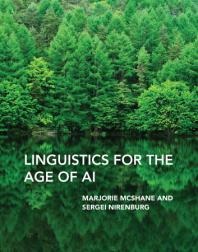
Linguistics for the age of AI
One of the original goals of artificial intelligence research was to endow intelligent agents with human-level natural language capabilities. Recent AI research, however, has focused on applying statistical and machine learning approaches to big data rather than attempting to model what people do and how they do it. In this book, Marjorie McShane and Sergei Nirenburg return to the original goal of recreating human-level intelligence in a machine. They present a human-inspired, linguistically sophisticated model of language understanding for intelligent agent systems that emphasizes meaning—the deep, context-sensitive meaning that a person derives from spoken or written language.

Leveraging Data Science for Global Health
Explores ways to leverage information technology and machine learning to combat disease and promote health, especially in resource-constrained settings. It focuses on digital disease surveillance through the application of machine learning to non-traditional data sources.

Leveraging applications of formal methods, verification and validation : Verification Principles ; 9th International Symposium on Leveraging Applications of Formal Methods, ISoLA 2020, Rhodes, Greece, October 20–30, 2020, Proceedings, Part I
Constitutes the refereed proceedings of the 9th International Symposium on Leveraging Applications of Formal Methods, ISoLA 2020, which was planned to take place during October 20–30, 2020, on Rhodes, Greece. The papers presented were carefully reviewed and selected for inclusion in the proceedings. Each volume focusses on an individual topic with topical section headings within the volume : Part I, Verification Principles : Modularity and (De-)Composition in Verification ; X-by-Construction: Correctness meets Probability ; 30 Years of Statistical Model Checking ; Verification and Validation of Concurrent and Distributed Systems.

Leveraging applications of formal methods, verification and validation : Engineering Principles ; 9th International Symposium on Leveraging Applications of Formal Methods, ISoLA 2020, Rhodes, Greece, October 20–30, 2020, Proceedings, Part II
Constitutes the refereed proceedings of the 9th International Symposium on Leveraging Applications of Formal Methods, ISoLA 2020, which was planned to take place during October 20–30, 2020, on Rhodes, Greece. The event itself was postponed to 2021 due to the COVID-19 pandemic. The papers presented were carefully reviewed and selected for inclusion in the proceedings. Each volume focusses on an individual topic with topical section headings within the volume: Part II, Engineering Principles : Automating Software Re-Engineering ; Rigorous Engineering of Collective Adaptive Systems.

Leveraging applications of formal methods, verification and validation : Applications ; 9th International Symposium on Leveraging Applications of Formal Methods, ISoLA 2020, Rhodes, Greece, October 20–30, 2020, Proceedings, Part III
The three-volume set LNCS 12476 - 12478 constitutes the refereed proceedings of the 9th International Symposium on Leveraging Applications of Formal Methods, ISoLA 2020, which was planned to take place during October 20–30, 2020, on Rhodes, Greece. The event itself was postponed to 2021 due to the COVID-19 pandemic. The papers presented were carefully reviewed and selected for inclusion in the proceedings. Each volume focusses on an individual topic with topical section headings within the volume: Part III, Applications: Reliable Smart Contracts: State-of-the-art, Applications, Challenges and Future Directions; Automated Verification of Embedded Control Software; Formal methods for DIStributed COmputing in future RAILway systems.

Learning to Live in the Knowledge Society ; IFIP 20th World Computer Congress, IFIP TC 3 ED-L2L Conference September 7–10, 2008, Milano, Italy
The IFIP series publishes state-of-the-art results in the sciences and technologies of information and communication. The scope of the series includes: foundations of computer science; software theory and practice; education; computer applications in technology; communication systems; systems modeling and optimization; information systems; computers and society; computer systems technology; security and protection in information processing systems; artificial intelligence; and human-computer interaction. Proceedings and post-proceedings of refereed international conferences in computer science and interdisciplinary fields are featured. These results often precede journal publication and represent the most current research.

Learning Classifier Systems ; 10th International Workshop, IWLCS 2006, Seattle, MA, USA, July 8, 2006 and 11th International Workshop, IWLCS 2007, London, UK, July 8, 2007, Revised Selected Papers
Constitutes the thoroughly refereed joint post-conference proceedings of two consecutive International Workshops on Learning Classifier Systems that took place in Seattle, WA, USA in July 2006, and in London, UK, in July 2007 - all hosted by the Genetic and Evolutionary Computation Conference, GECCO.The 14 revised full papers presented were carefully reviewed and selected from the workshop contributions. The papers are organized in topical sections on knowledge representation, analysis of the system, mechanisms, new directions, as well as applications.

Learning and Intelligent Optimization ; 2nd International Conference, LION 2007 II, Trento, Italy, December 8-12, 2007. Selected Papers
The papers cover current issues of machine learning, artificial intelligence, mathematical programming and algorithms for hard optimization problems and are organized in topical sections on improving optimization through learning, variable neighborhood search, insect colony optimization, applications, new paradigms, cliques, stochastic optimization, combinatorial optimization, fitness and landscapes, and particle swarm optimization.
