



الصفحة 22
الصفحة 22

Cooperative Design, Visualization, and Engineering ; Vol. 4101 ; 3rd International Conference, CDVE 2006, Mallorca, Spain, September 17-20, 2006, Proceedings
This book constitutes the refereed proceedings of the Third International Conference on Cooperative Design, Visualization, and Engineering, CDVE 2006, held in Mallorca, Spain in September 2006.

Cooperative Design, Visualization, and Engineering ; 4th International Conference, CDVE 2007, Shanghai,China, September 16-20, 2007
The cooperative design, visualization and engineering community sensed the economic pulse of a new giant economy where cooperation is vital for its success. This year we received a large number of papers from all over the world.From a technical point of view, as a major trend in cooperative design, vi- alization, engineering and other applications, advanced Web-based cooperation technology stands out by itself. Web-based cooperative working applications have been emerging strongly since the wide availability and accessibility of the WWW. It is a form of sharing and collaborating by its nature.

Control problems for conservation laws with traffic applications: modeling, analysis, and numerical methods
Conservation and balance laws on networks have been the subject of much research interest given their wide range of applications to real-world processes, particularly traffic flow. This open access monograph is the first to investigate different types of control problems for conservation laws that arise in the modeling of vehicular traffic. Four types of control problems are discussed - boundary, decentralized, distributed, and Lagrangian control - corresponding to, respectively, entrance points and tolls, traffic signals at junctions, variable speed limits, and the use of autonomy and communication. Because conservation laws are strictly connected to Hamilton-Jacobi equations, control of the latter is also considered.

Contributions to Simulation Speed-Up : Rare Event Simulation and Short-Term Dynamic Simulation for Mobile Network Planning
Eugen Lamers explains the principle of simulation speed-up in general, demonstrates the technique RESTART for the simulation of rare events, and addresses its efficiency on distributed systems.

Continuous System Simulation
Continuous System Simulation describes systematically and methodically how mathematical models of dynamic systems, usually described by sets of either ordinary or partial differential equations possibly coupled with algebraic equations, can be simulated on a digital computer.

Construction and analysis of safe, secure, and interoperable smart devices ; Vol. 3362 : International workshop, CASSIS 2004, Marseille, France, March 10-14, 2004, Revised Selected Papers
History based access control and secure information flow / The spec# programming system / Mastering test generation from smart card software formal models / A mechanism for secure, fine-grained dynamic provisioning of applications on small devices / A type system for checking applet isolation in java card / Verification of safety properties in the presence of transactions / Modelling mobility aspects of security policies / Smart devices for next generation mobile services / A flexible framework for the estimation of coverage metrics in explicit state software model checking / Combining several paradigms for circuit validation and verification / Smart card research perspectives

Constraint satisfaction techniques for agent-based reasoning
Constraint satisfaction problems are significant in the domain of automated reasoning for artificial intelligence. They can be applied to the modeling and solving of a wide range of combinatorial applications such as planning, scheduling and resource sharing in a variety of practical domains such as transportation, production, supply-chains, network management and human resource management. In this book we study new techniques for solving constraint satisfaction problems, with a special focus on solution adaptation applied to agent reasoning.

Concurrency, Graphs and Models : Essays Dedicated to Ugo Montanari on the Occasion of His 65th Birthday
The volume consists of seven sections, six of which are dedicated to the main research areas to which Ugo Montanari has contributed: Graph Transformation; Constraint and Logic Programming; Software Engineering; Concurrency; Models of Computation; and Software Verification.

Concurrency Theory : Calculi an Automata for Modelling Untimed and Timed Concurrent Systems
Concurrency Theory is a synthesis of one of the major threads of theoretical computer science research focusing on languages and graphical notations for describing collections of simultaneously evolving components that interact through synchronous communication. The main specification notation focused on in this book is LOTOS. An extensive introduction to this particular process calculus is given, highlighting how the approach differs from competitor techniques, such as CCS and CSP.

CONCUR 2006 - Concurrency Theory ; 17th International Conference, CONCUR 2006, Bonn, Germany, August 27-30, 2006
This volume contains the proceedings of the 17th International Conference on Concurrency Theory (CONCUR) held in Bonn, Germany, August 27–30, 2006. The scope of CONCUR covers all areas of semantics, logics, and verification techniques for concurrent systems.

Conceptual Structures: Knowledge Architectures for Smart Applications ; 15th International Conference on Conceptual Structures, ICCS 2007, Sheffield, UK, July 22-27, 2007, Proceedings
Conceptual structures focus on the representation and analysis of concepts, events, actions and objects with applications in - search,softwareengineering,manufacturing and business.The book covers computer science, information technology,artificial int- ligence, philosophy and a variety of applied disciplines to explore novel ways that information technologies can be leveraged to assist human reasoning and interaction for tangible business or social benefits. Conceptual structures can be used to augment human intelligence by facilitating knowledge integration, desion making, the creation of intelligent software systems and the exploration of implicit structures.

Conceptual Structures : Knowledge Visualization and Reasoning; 16th International Conference on Conceptual Structures, ICCS 2008 Toulouse, France, July 7-11, 2008 Proceedings
This book constitutes the refereed proceedings of the 16th International Conference on Conceptual Structures, ICCS 2008, held in Toulouse, France, in July 2008.

Conceptual Structures : Inspiration and Application ; 14th International Conference on Conceptual Structures, ICCS 2006, Aalborg, Denmark, July 16-21, 2006, Proceedings
th The 14 International Conference on Conceptual Structures (ICCS 2006) was held in Aalborg, Denmark during July 16 – 21, 2006. Responding to the Call for Papers, we received 62 papers from 20 different countries, representing six different continents. This clearly indicates the international nature of the ICCS community as well as the widespread interest which was spawned by the previous conferences.

Conceptual Modelling in Information Systems Engineering
Conceptual modeling has always been one of the cornerstones for information systems engineering as it describes the general knowledge of the system in the so-called conceptual schema.It contiant data modeling, goal-oriented modeling, agent-oriented modeling, and process-oriented modeling. Overall, the contributions reflect the most important developments and application areas of conceptual modeling in recent years, and they also pinpoint trends in conceptual modeling for the next decade.

Conceptual Modeling of Information Systems
When designing an information system, conceptual modeling is the activity that elicits and describes the general knowledge the system needs to know. This description, called the conceptual schema, is necessary in order to develop an information system.textbook explains in detail the principles of conceptual modeling independently from particular methods and languages and shows how to apply them in real-world projects. It covers all aspects of the engineering process from structural modeling over behavioral modeling to meta-modeling, and completes the presentation with an extensive case study based on the osCommerce system, an online store-management software program freely available under the GNU General Public License. His presentation is based on well-known industry standards like UML and OCL as a particular conceptual modeling language, yet also delivers the basics of the formal logical language background.

Conceptual Modeling for Traditional and Spatio-Temporal Applications : The MADS Approach
This book shows that a conceptual design approach for spatio-temporal databases is both feasible and easy to apprehend. While providing a firm basis through extensive discussion of traditional data modeling concepts, the major focus of the book is on modeling spatial and temporal information. Parent, Spaccapietra and Zimányi provide a detailed and comprehensive description of an approach that fills the gap between application conceptual requirements and system capabilities, covering both data modeling and data manipulation features.

Conceptual Modeling for New Information Systems Technologies ; ER 2001 Workshops, HUMACS, DASWIS, ECOMO, and DAMA, Yokohama Japan, November 27-30, 2001. Revised Papers
The objective of the workshops associated with ER 2001, the 20th International Con- rence on Conceptual Modeling, was to give participants the opportunity to present and discuss emerging hot topics, thus adding new perspectives to conceptual modeling.

Conceptual Modeling - ER 2008 ; 27th International Conference on Conceptual Modeling, Barcelona, Spain, October 20-24, 2008. Proceedings
This book constitutes the refereed proceedings of the 27th International Conference on Conceptual Modeling, ER 2008, held in Barcelona, Spain, in October 2008.

Conceptual Modeling - ER 2007 ; 26th International Conference on Conceptual Modeling, Auckland, New Zealand, November 5-9, 2007, Proceedings
Conceptual modeling is fundamental to the development of complex systems, because it provides the key communication means between systems developers, end-users and customers.Conceptua lmodeling provides languages,methods and tools to understand and represent the application domain;to elicitate,concepalize and formalize system requirements and user needs;to communicate systems designs to all stakeholders; to formally verify and validate system designs on high levels of abstractions; and to minimize ambiguities in system development. Initially, conceptual modeling mainly addressed data-intensive information s- tems and contributed to data modeling and database application engineering. The area of conceptual modeling has now matured to encompass all kinds of application areas such as e-applications (including e-business and e-learning), web-based systems (including the semantic web and ubiquitous systems), life science and geographic applications.
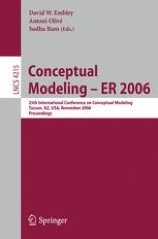
Conceptual Modeling - ER 2006 ; 25th International Conference on Conceptual Modeling, Tucson, AZ, USA, November 6-9, 2006, Proceedings
The International Conference on Conceptual Modeling provides the premiere - rum for presenting and discussing current research and applications in which the - jor emphasis is on conceptual modeling. Topics of interest span the entire spectrum of conceptual modeling including research and practice in areas such as theories of c- cepts and ontologies underlying conceptual modeling, methods and tools for devel- ing and communicating conceptual models, and techniques for transforming conc- tual models into effective implementations.
