



الصفحة 20
الصفحة 20

Advances in Artificial Reality and Tele-Existence ; 16th International Conference on Artificial Reality and Telexistence, ICAT 2006, Hangzhou, China, November 28 - December 1, 2006, Proceedings
ICAT is the oldest international conference on virtual reality and tele-existence. ICAT 2006 not only looked for innovations in the technology itself, but also explored novel ways to transfer and express information and creative ideas to the society and people. The 16th International Conference on Artificial Reality and Telexistence was held at the Zhejiang University of Technology, Hangzhou, P. R. China from November 29 to December 1, 2006. The main purpose of the conference is to provide opportunities for researchers and practitioners to present their research findings and exchange opinions on the development and use of such systems.

Advances in Ad Hoc and Sensor Networks
This volume provides a complete survey of the state-of-the-art research that encompasses all areas of ad hoc and sensor networks. These chapters focus on the theoretical and experimental study of advanced research topics involving security and trust, broadcasting and multicasting, power control and energy efficiency, and QoS provisioning.

Advanced Web and Network Technologies, and Applications ; APWeb 2006 International Workshops : XRA, IWSN, MEGA, and ICSE, Harbin, China, January 16-18, 2006, Proceedings
The QOS evaluating model for computational grid nodes put forward can help greatly improving the self-adaptability of resource management and accelerating the appli- tion and development of Computational Grid. Now this model has been applied in NPU Campus Computational Grid. And the good effect brought by it has effectively proved its function. References 1. Foster, I. and C. Kesselman, eds. The Grid: Blueprint for a New Computing Infrastructure. Morgan Kaufmann, 1999. 2. Liu Liang, Zhou Xing-she, and Gu Jian-hua: A Multi-Agent System for Grid Computing. The Second International Conference on Active Media Technology, 2003 3. Yao Wang, Julita Vassileva: Trust and Reputation Model in Peer-to-Peer Networks. Farag Azzedin and Muthucumaru Maheswaran: Integrating Trust into Grid Resource M- agement Systems.
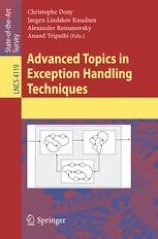
Advanced Topics in Exception Handling Techniques
Modern software systems are becoming more complex in many ways and are having to cope with a growing number of abnormal situations which, in turn, are increasingly complex to handle.This book is composed of five parts; the first four deal with topics related to exception handling in the context of programming languages, concurrency and operating systems, pervasive computing systems, and requirements and specifications. The last part focuses on case studies, experimentation and qualitative comparisons. The 16 coherently written chapters by leading researchers competently address a wide range of issues in exception handling.

Advanced sensors technologies applied in mobile robot
Contains contributions on the latest developments in mobile robotic systems and related research. Various topics with different ideas and applications from mobile robotics have found their place. New ideas are presented for mobile robots that specialise in cleaning floors, power lines and HVAC systems. We also find innovative approaches for navigation path planning using local minima-free potential fields, novel path primitives and/or their parameterisation for minimum-time planning, and various control approaches ranging from visual serving to model predictive and adaptive trajectory tracking, applied to wheeled robots, humanoid manipulators and flying robots. Localisation approaches using LiDAR, motion capture systems, fingerprint-based and biomechanical gait systems are also discussed.
Advanced methods for knowledge discovery from complex data
An overview of the field, looking at the issues and challenges involved is followed by coverage of recent trends in data mining, including descriptions of some currently popular tools like genetic algorithms, neural networks and case-based reasoning. This provides the context for the subsequent chapters on methods and applications. Part I is devoted to the foundations of mining different types of complex data like trees, graphs, links and sequences. A knowledge discovery approach based on problem decomposition is also described. Part II presents important applications of advanced mining techniques to data in unconventional and complex domains, such as life sciences, world-wide web, image databases, cyber security and sensor networks. With a good balance of introductory material on the knowledge discovery process, advanced issues and state-of-the-art tools and techniques, as well as recent working applications this book provides a representative selection of the available methods and their evaluation in real domains. It will be useful to students at Masters and PhD level in Computer Science, as well as practitioners in the field.

AdvancED Flex 3
Divided into three parts. The first part discusses the architectural and design aspects of Flex 3 application development. It explains the internals of a Flex 3 application and advocates a few best practices to fine-tune your application to ensure maximum performance. It includes tutorials on creating custom components, data binding, and creating AIR-powered desktop applications. The second part concentrates on effectively integrating Flex 3 with server- and client-side technologies. Techniques for integration with Java and PHP are covered in detail, and content covering interaction with client-side technologies is also included. After reading the chapter on JavaScript integration, you will be ready to create applications that can use Ajax and Flex 3 together. The third and final part of the book is a unique and eclectic mix of some advanced topics like mash-ups, collaborative applications, 3D rendering, highly interactive visualization, and audio and video streaming.

Addressing Global Challenges and Quality Education ; 15th European Conference on Technology Enhanced Learning, EC-TEL 2020, Heidelberg, Germany, September 14–18, 2020, Proceedings
The chapters: “Designing an Online Self-Assessment for Informed Study Decisions: The User Perspective”; “Living with Learning Difficulties: Two Case Studies Exploring the Relationship Between Emotion and Performance in Students With Learning Difficulties”; “Applying Instructional Design Principles on Augmented Reality Cards for Computer Science Education”; and “Teaching Simulation Literacy With Evacuations - Concept, Technology, and Material for a Novel Approach” are available open access under a Creative Commons Attribution 4.0 International License via link.springer.com.
Adaptive-robust control with limited knowledge on systems dynamics : An artificial input delay approach and beyond
investigates the role of artificial input delay in approximating unknown system dynamics, referred to as time-delayed control (TDC), and provides novel solutions to current design issues in TDC. Its central focus is on designing adaptive-switching gain-based robust control (ARC) for a class of Euler–Lagrange (EL) systems with minimal or no knowledge of the system dynamics parameters. The newly proposed TDC-based ARC tackles the commonly observed over- and under-estimation issues in switching gain. The consideration of EL systems lends a practical perspective on the proposed methods, and each chapter is supplemented by relevant experimental data

Adaptive Multimedial Retrieval : Retrieval, User, and Semantics ; 5th International Workshop, AMR 2007, Paris, France, July 5-6, 2007 Revised Selected Papers
This book constitutes the thoroughly refereed post-workshop proceedings of the 5th International Workshop on Adaptive Multimedia Retrieval, AMR 2007, held in Paris, France, in July 2007.

Adaptive Multimedia Retrieval : User, Context, and Feedback ; Third International Workshop, AMR 2005, Glasgow, UK, July 28-29, 2005, Revised Selected Papers
This book is an extended collection of revised contributions that were initially submitted to the International Workshop on Adaptive Multimedia Retrieval (AMR 2005). This workshop was organized during July 28-29, 2005, at the U- versity of Glasgow, UK, as part of an information retrieval research festival and in co-location with the 19th International Joint Conference on Arti?cial Int- ligence (IJCAI 2005). AMR 2005 was the third and so far the biggest event of the series of workshops that started in 2003 with a workshop during the 26th German Conference on Arti?cial Intelligence (KI 2003) and continued in 2004 as part of the 16th European Conference on Arti?cial Intelligence (ECAI 2004).

Adaptive Multimedia Retrieval : User, Context, and Feedback ; 4th International Workshop, AMR 2006, Geneva, Switzerland, July, 27-28, 2006, Revised Selected Papers
This book constitutes the thoroughly refereed post-proceedings of the 4th International Workshop on Adaptive Multimedia Retrieval, AMR 2006, held in Geneva, Switzerland in July 2006. this book provides a good and conclusive overview of the current research in the area of adaptive information retrieval.

Adaptive Motion of Animals and Machines
Apparently, the ability of animals and robots to adapt in a real world cannot be explained or realized by one single function in a control system and mechanism. That is, adaptation in motion is induced at every level from the central nervous system to the musculoskeletal system.Thus,weorganized the International Symposium on Adaptive Motion in Animals and Machines (AMAM) forscientist sandengineersconcerned with adaptation on various level stobebrought together todiscussprinciplesateachleveland to investigate principles governing total systems.
Adaptive Machine Learning Algorithms with Python : Solve Data Analytics and Machine Learing Problems on Edge Devices
Learn to use adaptive algorithms to solve real-world streaming data problems. This book covers a multitude of data processing challenges, ranging from the simple to the complex. At each step, you will gain insight into real-world use cases, find solutions, explore code used to solve these problems, and create new algorithms for your own use. You will: Apply adaptive algorithms to practical applications and examples / Understand the relevant data representation features and computational models for time-varying multi-dimensional data / Derive adaptive algorithms for mean, median, covariance, eigenvectors (PCA) and generalized eigenvectors with experiments on real data / Speed up your algorithms and put them to use on real-world stationary and non-stationary data / Master the applications of adaptive algorithms on critical edge device computation applications
Adaptive Learning of Polynomial Networks : Genetic Programming, Backpropagation and Bayesian Methods
This book provides theoretical and practical knowledge for develop ment of algorithms that infer linear and nonlinear models. It offers a methodology for inductive learning of polynomial neural network mod els from data. The design of such tools contributes to better statistical data modelling when addressing tasks from various areas like system identification, chaotic time-series prediction, financial forecasting and data mining. The main claim is that the model identification process involves several equally important steps: finding the model structure, estimating the model weight parameters, and tuning these weights with respect to the adopted assumptions about the underlying data distrib ution. When the learning process is organized according to these steps, performed together one after the other or separately, one may expect to discover models that generalize well.

Adaptive Hypermedia and Adaptive Web-Based Systems ; Second International Conference, AH 2002 Malaga, Spain, May 29 - 31, 2002 Proceedings
This book constitutes the refereed proceedings of the Second International Conference on Adaptive Hypermedia and Adaptive Web-Based Systems, AH 2002, held in Malaga, Spain, in May 2002.The 33 revised full papers and 23 short papers presented were carefully reviewed and selected from 109 submissions. Also included are three invited contributions, 30 posters, and 5 presentations given at the associated doctoral constortium. Among the topics covered are adaptive hypertext and hypermedia, user modeling, adaptive learning, adaptive tutoring systems, information retrieval, educational hypermedia systems, Web adaption, adaptive navigation, adaption and personalization.

Adaptive Hypermedia and Adaptive Web-Based Systems ; 4th International Conference, AH 2006, Dublin, Ireland, June 21-23, 2006, Proceedings
Here are the refereed proceedings of the 4th International Conference on Adaptive Hypermedia and Adaptive Web-Based Systems, AH 2006, held in Dublin, Ireland, June 2006. The book presents 22 revised full papers and 19 revised short papers together with abstracts of 3 keynotes, 12 poster papers, and 14 doctoral consortium posters. Topics include pioneering theories, techniques, and innovative technologies to provide dynamic personalization, adaptation, and contextualization of hypermedia resources and services.

Adaptive Hypermedia and Adaptive Web-Based Systems : 5th International Conference, AH 2008, Hannover, Germany, July 29 - August 1, 2008. Proceedings
This book constitutes the refereed proceedings of the 5th International Conference on Adaptive Hypermedia and Adaptive Web-Based Systems, AH 2008, held in Hannover, Germany in July 2008.
Adaptive Business Intelligence
In the modern information era, managers must recognize the competitive opportunities represented by decision-support tools. Adaptive business intelligence systems combine prediction and optimization techniques to assist decision makers in complex, rapidly changing environments. These systems address the fundamental questions: What is likely to happen in the future? And what is the best decision right now? Adaptive Business Intelligence includes elements of data mining, predictive modeling, forecasting, optimization, and adaptability.

Adaptive Bidding in Single-Sided Auctions under Uncertainty : An Agent-based Approach in Market Engineering
In the last years electronic markets, especially online auctions, have become very popular and received more and more attention in both, business (B2B) as well as in public practice (B2C and C2C). Science, however, is still far from having studied all phenomena and effects which can be observed on electronic markets. This book shows that and how software agents can be used to simulate bidding behaviour in electronic auctions. The main emphasis of this book is to apply computational economics to market theory. It summarizes the most common and up-to-date agent-based simulation methods and tools and develops the simulation software AMASE. On basis of the introduced methods a model is established to simulate bidding behaviour under uncertainty.
