



الصفحة 2
الصفحة 2

Mathematics of Program Construction ; 8th International Conference, MPC 2006, Kuressaare, Estonia, July 3-5, 2006, Proceedings
This volume contains the proceedings of the 8th International Conference on Mathematics of ProgramConstruction, MPC 2006,held at Kuressaare, Estonia, July 3-5, 2006, colocated with the 11th International Conference on Algebraic Methodology and Software Technology, AMAST 2006, July 5-8, 2006. TheMPCconferencesaimtopromotethedevelopmentofmathematicalpr- ciples and techniques that are demonstrably useful and usable in the process of constructing computer programs. Topics of interest range from algorithmics to support for program construction in programming languages and systems.

Introduction to PHP for Scientists and Engineers : Beyond JavaScript
This text presents key information needed to write your own online science and engineering applications, including reading, creating and manipulating data files stored as text on a server, thereby overcoming the limitations of a client-side language.

Introduction to C++ : 500+ Difficulty-Scaled Solved Programming Exercises
Includes more than 500 exercises and examples of progressive difficulty to aid the reader in understanding the C++ principles and to see how concepts can materialize in code. The examples are designed to be short, concrete, and substantial, quickly giving the reader the ability to understand how to apply correctly and efficiently the features of the C++ language and to get a solid programming know-how. Rest assured that if you are able to understand this book's examples and solve the exercises, you can safely go on to edit larger programs, you will be able to develop your own applications, and you will have certainly established a solid fundamental conceptual and practical background to expand your knowledge and skills

Introducing Blockchain with Java : Program, Implement, and Extend Blockchains with Java
Includes numerous exercises and test questions to help you solidify what you have learned as you progress through the book, and provides ideas on expanding the codebase to make it your own. You will have access to a fully-functioning repository with Java code. You will have the knowledge necessary to program your own blockchains with Java and you will have a completed project for your portfolio. You will: Know the most important theoretical concepts of the blockchain / Code the blockchain in Java / Create a user interface with JavaFX / Implement SQLite DB using JDBC Driver / Create a P2P multi-threaded app / Create your own cryptocurrency app with full functionality / Implement blockchain technology on a P2P network from scratch using Java, JavaFX, and SQL

Inside deep learning : Math, algorithms, models
Journey through the theory and practice of modern deep learning, and apply innovative techniques to solve everyday data problems. In Inside Deep Learning, you will learn how to: Implement deep learning with PyTorch Select the right deep learning components Train and evaluate a deep learning model Fine tune deep learning models to maximize performance Understand deep learning terminology Adapt existing PyTorch code to solve new problems Inside Deep Learning is an accessible guide to implementing deep learning with the PyTorch framework. It demystifies complex deep learning concepts and teaches you to understand the vocabulary of deep learning so you can keep pace in a rapidly evolving field. No detail is skipped--you'll dive into math, theory, and practical applications. Everything is clearly explained in plain English.
Innovations for requirement analysis : From stakeholders needs to formal designs ; 14th Monterey Workshop 2007, Monterey, CA, USA, September 10-13, 2007. Revised Selected Papers
This book presents the thoroughly refereed and revised proceedings of the 14th Monterey workshop, held in Monterey, CA, USA, September 10-13, 2007. The theme of the workshop was Innovations for Requirement Analysis: From Stakeholders' Needs to Formal Designs.The 10 revised full papers included in the book were carefully selected during two rounds of reviewing and revision. These are preceded by the abstracts of the three keynote talks as well as a detailed introduction to the theme of the workshop, including a case study used by many participants to frame their analyses, and a summary of the workshop's results.
Implementation of functional languages ; 15th International Workshop, IFL 2003, Edinburgh, UK, September 8-11, 2003. Revised Papers
This book constitutes the thoroughly refereed post-proceedings of the 15th International Workshop on the Implementation of Functional Languages, IFL 2003, held in Edinburgh, UK in September 2003. The 11 revised full papers presented were carefully selected during two rounds of reviewing and revision from 32 workshop presentations. The papers are organized in topical sections on language constructs and programming, static analysis and types, parallelism, and generic programming.
Implementation and Applications of Automata ; 13th International Conference, CIAA 2008, San Francisco, California, USA, July 21-24, 2008. Proceedings
This book constitutes the thoroughly refereed post-proceedings of the 13th International Conference on Implementation and Application of Automata, CIAA 2008, held in San Francisco, USA, in July 2008.The 26 revised full papers togehter with 4 invited papers were carefully reviewed and selected from 40 submissions and have gone through two rounds of reviewing and improvement. The papers cover various topics in the theory, implementation, and applications of automata and related structures.
Implementation and Application of Functional Languages ; Vol. 4015 ; 17th International Workshop, IFL 2005, Dublin, Ireland, September 19-21, 2005, Revised Selected Papers
The 17th International Workshop on Implementation and Application of Functional Languages (IFL 2005) was held in Dublin, Ireland, September 19–21, 2005. It was organized by the Department of Computer Science at Trinity College, University of Dublin. IFL 2005 was the 17th event in the annual series of IFL workshops. The aim of the workshop series is to bring together researchers actively engaged in the implementation and application of functional and function-based programming languages. It provides an open forum for researchers who wish to present and discuss new ideas and concepts, work in progress, preliminary results, etc., related primarily, but not exclusively, to the implementation and application of functional languages. Topics of interest cover a wide range from theoretical aspects over language design and implementation towards applications and tool support.
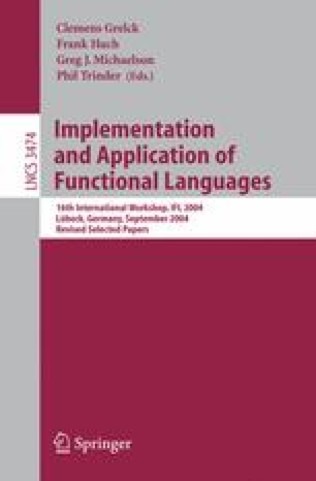
Implementation and application of functional languages ; Vol. 3474 ; 16th International Workshop, IFL 2004, Lübeck, Germany, September 8-10, 2004, Revised Selected Papers
The 16th International Workshop on Implementation and Application of Fu- tional Languages (IFL 2004) was held in Lub ¨ eck, Germany, September 8–10, 2004. It was jointly organized by the Institute of Computer Science and Applied Mathematics of the University of Kiel and the Institute of Software Technology and Programming Languages of the University of Lub ¨ eck. IFL 2004 was the sixteenth event in the annual series of IFL workshops. The aim of the workshop series is to bring together researchers actively engaged in the implementation and application of functional and function-based progr- ming languages. It provides an open forum for researchers who wish to present and discuss new ideas and concepts, work in progress, preliminary results, etc., related primarily, but not exclusively, to the implementation and application of functional languages. Topics of interest cover a wide range from theoretical - pects over language design and implementation towards applications and tool support.

Implementation and Application of Functional Languages ; 19th International Workshop, IFL 2007, Freiburg, Germany, September 27-29, 2007. Revised Selected Papers
This book constitutes the thoroughly refereed post-proceedings of the 19th International Workshop on Implementation and Applications of Functional Languages, IFL 2007, held in Freiburg, Germany in September 2007.The 15 revised full papers presented went through two rounds of reviewing and improvement and were selected from 33 submissions. The papers address all current theoretical and methodological issues on functional and function-based languages such as type checking, contract checking, compilation, parallelism, development and debugging, data structures, parsing as well as various performance related concepts.

Illustrated C# 2008
The unique, visual format of Illustrated C# 2008 has been specially created by author and teacher of development methods, Daniel Solis. The concise text, use of tables to clarify language features, frequent figures and diagrams, as well as focused code samples all combine to create a unique approach that will help you understand and get to work with C# fast. It was while teaching numerous seminars on various programming languages that the author realized the immense power that diagrams have in explaining programming language concepts. Most people learn quicker and retain information better when the material is presented in a clean, simple, visual format. To achieve this result in his book, Solis uses concise text and bulleted lists, tables to clarify and summarize language features, as well as his renowned and ubiquitous figures and diagrams.

High performance embedded architectures and compilers ; 3rd International Conference, HiPEAC 2008, Göteborg, Sweden, January 27-29, 2008. Proceedings
This book constitutes the refereed proceedings of the Third International Conference on High Performance Embedded Architectures and Compilers, HiPEAC 2008, held in Göteborg, Sweden, January 27-29, 2008. The 25 revised full papers presented together with 1 invited keynote paper were carefully reviewed and selected from 77 submissions. The papers are organized in topical sections on Multithreaded and Multicore Processors, Reconfigurable - ASIP, Compiler Optimizations, Industrial Processors and Application Parallelization, Power-Aware Techniques, High-Performance Processors, Profiles: Collection and Analysis as well as Optimizing Memory Performance.

Hardware and software : Verification and testing ; 3rd International Haifa Verification Conference, HVC 2007, Haifa, Israel, October 23-25, 2007. Proceedings
These are the conference proceedings of the 4th Haifa Verifcation Conference, held October 27–30, 2008 in Haifa, Israel. This international conference is a unique venue that brings together leading researchers and practitioners of both formal and dynamic verifcation, for both hardware and software systems. This year’s conference extended the successes of the previous years, with a largejumpinthenumberofsubmitted papers. with many more high-quality papers than we had room to accept. Submissions came from 19 di?erent countries, re?ecting the growing international visibility of the conference. Of the 49 submissions, 43 were regular papers, 2 of which were later withdrawn, and 6 were tool papers. After a rigorous review process.

Hands-On Software Architecture with Java - Learn key architectural techniques and strategies to design efficient and elegant Java applications
Starts with the fundamentals of architecture and takes you through the basic components of application architecture. You'll cover the different types of software architectural patterns and application integration patterns and learn about their most widespread implementation in Java. You'll then explore cloud-native architectures and best practices for enhancing existing applications to better suit a cloud-enabled world. Later, the book highlights some cross-cutting concerns and the importance of monitoring and tracing for planning the evolution of the software, foreseeing predictable maintenance, and troubleshooting. The book concludes with an analysis of the current status of software architectures in Java programming and offers insights into transforming your architecture to reduce technical debt.

Hands-On Design Patterns with Java : Learn Design Patterns That Enable the Building of Large-Scale Software Architectures
Java design patterns are reusable and proven solutions to software design problems. This book covers over 60 battle-tested design patterns used by developers to create functional, reusable, and flexible software. Hands-On Design Patterns with Java starts with an introduction to the Unified Modeling Language (UML), and delves into class and object diagrams with the help of detailed examples. You'll study concepts and approaches to object-oriented programming (OOP) and OOP design patterns to build robust applications. As you advance, you'll explore the categories of GOF design patterns, such as behavioral, creational, and structural, that help you improve code readability and enable large-scale reuse of software. You’ll also discover how to work effectively with microservices and serverless architectures by using cloud design patterns, each of which is thoroughly explained and accompanied by real-world programming solutions. By the end of the book, you’ll be able to speed up your software development process using the right design patterns, and you’ll be comfortable working on scalable and maintainable projects of any size.
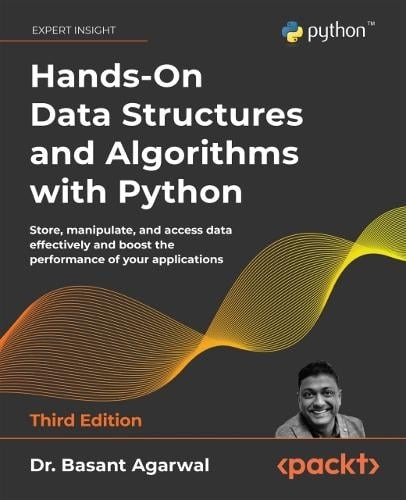
Hands-On Data Structures and Algorithms with Python : Store, manipulate, and access data effectively ; 3rd ed.
Expands your understanding of key structures, including stacks, queues, and lists, and also show you how to apply priority queues and heaps in applications. You'll learn how to analyze and compare Python algorithms, and understand which algorithms should be used for a problem based on running time and computational complexity. You will also become confident organizing your code in a manageable, consistent, and scalable way, which will boost your productivity as a Python developer. By the end of this Python book, you'll be able to manipulate the most important data structures and algorithms to more efficiently store, organize, and access data in your applications
Grammatical Inference ; Algorithms and Applications : 9th International Colloquium, ICGI 2008 Saint-Malo, France, September 22-24, 2008 Proceedings
This book constitutes the refereed proceedings of the 9th International Colloquium on Grammatical Inference, ICGI 2008, held in Saint-Malo, France, in September 2008.The 21 revised full papers and 8 revised short papers presented were carefully reviewed and selected from 36 submissions. The topics of the papers presented vary from theoretical results of learning algorithms to innovative applications of grammatical inference, and from learning several interesting classes of formal grammars to applications to natural language processing.

Fundamental approaches to software engineering ; 22nd International Conference, FASE 2019, Held as Part of the European Joint Conferences on Theory and Practice of Software, ETAPS 2019, Prague, Czech Republic, April 6–11, 2019, Proceedings
This book cover software verification; model-driven development and model transformation; software evolution and requirements engineering; specification, design, and implementation of particular classes of systems; and software testing.

Fundamental approaches to software engineering ; 21st International Conference, FASE 2018, Held as Part of the European Joint Conferences on Theory and Practice of Software, ETAPS 2018, Thessaloniki, Greece, April 14-20, 2018, Proceedings
This book contains the proceedings of FASE 2018, the 21th International Conference on Fundamental Approaches to Software Engineering, held in Thessaloniki, Greece, in April 2018, the volume contains regular research papers that cover a wide range of topics, such as program and system analysis, model transformations, configuration and synthesis, graph modeling and transformation,software product lines, test selection, as well as learning and inference.
