



الصفحة 2
الصفحة 2

Graph-theoretic concepts in computer science ; 46th International Workshop, WG 2020, Leeds, UK, June 24–26, 2020, Revised Selected Papers
This book constitutes the revised papers of the 46th International Workshop on Graph-Theoretic Concepts in Computer Science, WG 2020, held in Leeds, UK, in June 2020. The workshop was held virtually due to the COVID-19 pandemic. The 32 full papers presented in this volume were carefully reviewed and selected from 94 submissions. They cover a wide range of areas, aiming to present emerging research results and to identify and explore directions of future research of concepts on graph theory and how they can be applied to various areas in computer science.
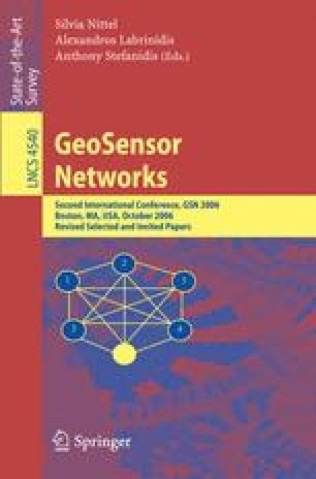
GeoSensor Networks : 2nd International Conference, GSN 2006, Boston, MA, USA, October 1-3, 2006, Revised Selected and Invited Papers
This book constitutes the thoroughly refereed proceedings of the Second GeoSensor Networks Conference, held in Boston, Massachusetts, USA, in October 2006. The conference addressed issues related to the collection, management, processing, analysis, and delivery of real-time geospatial data using distributed geosensor networks. This represents an evolution of the traditional static and centralized geocomputational paradigm.

Geographic Information Science ; 4th International Conference, GIScience 2006, Münster, Germany, September 20-23, 2006, Proceedings
The GIScience conference series (www. giscience. org) was created as a forum for all researchers who are interested in advancing research in the fundam- tal aspects of geographic information science.The conferences focus on emerging topics and basic research ?ndings across all s- tors of geographic information science. After three highly successful conferences in the United States, this year’s GIScience conference was held in Europe for the ?rst time. The GIScience conferences have been a meeting point for researchers coming from various disciplines, including cognitive science, computer science, engine- ing, geography,information science, mathematics, philosophy, psychology,social science, and statistics. The advancement of geographic information science - quiressuchinterdisciplinarybreadth,andthisisalsowhatmakestheconferences so exciting. In order to account for the di?erent needs of the involved scienti?c disciplines with regard to publishing their research results.

Frontiers of WWW Research and Development -- APWeb 2006 ; 8th Asia-Pacific Web Conference, Harbin, China, January 16-18, 2006, Proceedings
This book constitutes the refereed proceedings of the 8th Asia-Pacific Web Conference, APWeb 2006, held in Harbin, China in January 2006. The 56 revised full papers and 42 revised short papers presented together with 4 invited keynote papers, 6 industry papers, 19 demo papers, and 11 special papers on ICT advances for water resources management were carefully reviewed and selected from 413 submissions. The papers cover all current issues on WWW-related technologies and new advanced applications for researchers and practitioners from both academic and industry.

Formal Methods and Software Engineering ; 10th International Conference on Formal Engineering Methods, ICFEM 2008, Kitakyushu-City, Japan, October 27-31, 2008. Proceedings
This book constitutes the refereed proceedings of the 10th International Conference on Formal Engineering Methods, ICFEM 2008, held in Kitakyushu-City, Japan, October 2008.The 20 revised full papers together with 3 invited talks presented were carefully reviewed and selected from 62 submissions. The papers address all current issues in formal methods and their applications in software engineering. They are organized in topical sections on specification and verification; testing; verification; model checking and analysis; tools; application of formal methods; semantics.

Engineering self-organising systems Vol. 3910 ; 3rd International Workshop, ESOA 2005, Utrecht, The Netherlands, July 25, 2005, Revised Selected Papers
This book contains recent work from a broad range of areas with the common theme of utilising self-organisation productively. As distributed information infrastructures continue to spread (such as the Internet, wireless and mobile systems), new challenges have arisen demanding robust and scalable solutions. In these new challenging environments the - signers and engineers of global applications and services can seldom rely on centralised control or management, high reliability of devices, or secure en- ronments. At the other end of the scale, ad-hoc sensor networks and ubiquitous computing devices are making it possible to embed millions of smart computing agents into the local environment.

Engineering self-organising systems ; Vol. 3464 : Methodologies and applications
Self-organisation, self-regulation, self-repair, and self-maintenance are promising conceptual approaches to deal with the ever increasing complexity of distributed interacting software and information handling systems. Self-organising applications are able to dynamically change their functionality and structure without direct user intervention to respond to changes in requirements and the environment. This book comprises revised and extended papers presented at the International Workshop on Engineering Self-Organising Applications, ESOA 2004, held in New York, NY, USA in July 2004 at AAMAS as well as invited papers from leading researchers. The papers are organized in topical sections on state of the art, synthesis and design methods, self-assembly and robots, stigmergy and related topics, and industrial applications.
Emerging Technologies in Computing ; 3rd EAI International Conference, iCETiC 2020, London, UK, August 19–20, 2020, Proceedings
This book constitutes the refereed conference proceedings of the Third International Conference on Emerging Technologies in Computing, iCEtiC 2020, held in London, UK, in August 2020. Due to VOVID-19 pandemic the conference was helt virtually.The 25 revised full papers were reviewed and selected from 65 submissions and are organized in topical sections covering blockchain and cloud computing; security, wireless sensor networks and IoT; AI, big data and data analytics; emerging technologies in engineering, education and sustainable development.

Embedded and Ubiquitous Computing - EUC 2005 Workshops ; EUC 2005 Workshops : UISW, NCUS, SecUbiq, USN, and TAUES, Nagasaki, Japan, December 8-9, 2005
This book constitutes the refereed proceedings of the EUC 2005 workshops held in conjunction with the IFIP International Conference on Embedded and Ubiquitous Computing, EUC 2005, in Nagasaki, Japan in December 2005.The 132 revised full papers presented were carefully reviewed and selected from 352 submissions. Topics covered by the five workshops are ubiquitous intelligence and smart worlds (UISW 2005), network-centric ubiquitous systems (NCUS 2005), security in ubiquitous computing systems (SecUbiq 2005), RFID and ubiquitous sensor networks (USN 2005), and trusted and autonomic ubiquitous and embedded systems (TAUES 2005).

Distributed systems and mobile computing
About Distributed Systems and Mobile Computing. This is a branch of Computer Science devoted to the study of systems whose components are in different physical locations and have limited communication capabilities. Such components may be static, often organized in a network, or may be able to move in a discrete or continuous environment. The theoretical study of such systems has applications ranging from swarms of mobile robots (e.g., drones) to sensor networks, autonomous intelligent vehicles, the Internet of Things, and crawlers on the Web. The book includes five articles. Two of them are about networks: the first one studies the formation of networks by agents that interact randomly and have the ability to form connections; the second one is a study of clustering models and algorithms. The three remaining articles are concerned with autonomous mobile robots operating in continuous space.

Distributed computing in sensor systems Vol. 4026 ; 2nd IEEE International Conference, DCOSS 2006, San Francisco, CA, USA, June 18-20, 2006, Proceedings
The book constitutes the refereed proceedings of the Second International Conference on Distributed Computing in Sensor Systems, DCOSS 2006, held in San Francisco, California, USA in June 2006. The papers focus on distributed computing issues in large-scale networked sensor systems, including systematic design techniques and tools; they cover topics such as distributed algorithms and applications, programming support and middleware, data aggregation and dissemination, security, information fusion, lifetime maximization, and localization.

Distributed computing in sensor systems ; Vol. 3560 ; 1st IEEE International Conference, DCOSS 2005, Marina del Rey, CA, USA, June 30-July 1, 2005, Proceedings
Constitutes the refereed proceedings of the First International Conference on Distributed Computing in Sensor Systems, DCOSS 2005, held in Marina del Rey, California, USA in June/July 2005. The 26 revised full papers presented were carefully reviewed and selected from 85 submissions; also included are the abstracts of 3 invited talks, 2 short papers, 9 invited poster abstracts, and 10 contributed abstracts.The papers address all current aspects of distributed computing issues in large-scale networked sensor systems, including systematic design techniques and tools, algorithms, and applications.

Distributed computing in sensor systems ; 3rd IEEE International Conference, DCOSS 2007, Santa Fe, NM, USA, June 18-20, 2007, Proceedings
The book covering the areas of algorithms, applications, and systems, thus bridging the gap between theory and practice and between the broader field of distributed computing and the specific issues arising in sensor networks and related systems.
Distributed computing and networking ; 8th International conference, ICDCN 2006, Guwahati, India, December 27-30, 2006, Proceedings
VI realm between distributed computing and networking, namely, Modeling Biological Networks, Network Security, Algorithmic Issues in Wireless Sensor Networks, and Optical Networking. This was made possible by the efforts of the Tutorial Chairs, Sr- har Iyer and Pinaki Mitra. The Organizing Committee worked hard to ensure that the participants enjoyed a comfortable stay and the technical meetings proceeded as smoothly as possible.

Distributed computing and internet Technology ; Vol. 3816 ; 2nd International conference, ICDCIT 2005, Bhubaneswar, India, December 22-24, 2005, Proceedings
The opening ceremony and pre-conference tutorials on various related topics were held on December 21. The technical program started on December 22 and continued for three days. The program was arranged in single track so as to enable participants to attend sessions of di?erent tracks. Papers from the DM, IT, SE, and SS tracks were divided into two sessions, whereas DC track sessions were held on the ?rst two days of the conference. The program also included two plenary talks. The ?rst talk was delivered by S. S. Iyengar from Louisiana State University, USA. The second talk was delivered by He Jifeng from the International Institute for Software Technology (IIST) Macau. Prof. Iyenger’s talk on “The Distributed Sensor Networks — An Emerging Technology” was focused on new ideas about the use of distributed systems for emerging technology, while Prof. Jifeng’s talk on “Linking Theories of Concurrency by Retraction” dealt with semantics of concurrency.

Distributed computing and Internet Technology ; 1st International Conference, ICDCIT 2004, Bhubaneswar, India, December 22-24, 2004, Proceedings
Taming the Dynamics of Disributed Data - DISTRIBUTED COMPUTING -- Data in Your Space -- Enabling Technologies for Harnessing Information Explosion -- Fair Leader Election by Randomized Voting -- An Efficient Leader Election Algorithm for Mobile Ad Hoc Networks -- Distributed Balanced Tables: A New Approach - Performance Evaluation of Gigabit Ethernet and SCI in a Linux Cluster -- Performance Evaluation of a Modified-Cyclic-Banyan Based ATM / IP Switching Fabric -- A Scalable and Robust QoS Architecture for WiFi P2P Networks -- NEC: Node Energy Based Clustering Protocol for Wireless Sensor Networks with Guaranteed Connectivity,and other
Distributed computing – IWDC 2005 ; 7th International Workshop, Kharagpur, India, December 27-30, 2005, Proceedings
This book constitutes the refereed proceedings of the 7th International Workshop on Distributed Computing, IWDC 2004, held in Kharagpur, India in December 2005. The 28 revised full papers and 33 revised short papers presented together with 5 invited keynote talks were carefully reviewed and selected from 253 submissions. The papers are organized in topical sections on theory of distributed computing, sensor networks, fault tolerance, optical networks, peer-to-peer networks, wireless networks, network security, grid and networks, middleware and data management, mobility management, and distributed artificial intelligence.

Database Systems for Advanced Applications ; Vol. 3882 ; 11th International Conference, DASFAA 2006, Singapore, April 12-15, 2006, Proceedings
This book constitutes the refereed proceedings of the 11th International Conference on Database Systems for Advanced Applications, DASFAA 2006, held in Singapore in April 2006.

Data Streams : Models and Algorithms
It primarily discusses issues related to the mining aspects of data streams rather than the database management aspect of streams. This volume covers mining aspects of data streams in a comprehensive style. Each contributed chapter, from a variety of well known researchers in the data mining field, contains a survey on the topic, the key ideas in the field from that particular topic, and future research directions.

Computational Collective Intelligence ; 12th International Conference, ICCCI 2020, Da Nang, Vietnam, November 30 – December 3, 2020, Proceedings
This volume constitutes the refereed proceedings of the 12th International Conference on Computational Collective Intelligence, ICCCI 2020, held in Da Nang, Vietnam, in November 2020.* The 70 full papers presented were carefully reviewed and selected from 314 submissions. The papers are grouped in topical sections on: knowledge engineering and semantic web; social networks and recommender systems; collective decision-making; applications of collective intelligence; data mining methods and applications; machine learning methods; deep learning and applications for industry 4.0; computer vision techniques; biosensors and biometric techniques; innovations in intelligent systems; natural language processing; low resource languages processing; computational collective intelligence and natural language processing; computational intelligence for multimedia understanding; and intelligent processing of multimedia in web systems.
