



الصفحة 2
الصفحة 2

Central European Functional Programming School ; 1st Central European Summer School, CEFP 2005, Budapest, Hungary, July 4-15, 2005, Revised Selected Lectures
This volume presents eight carefully revised texts of selected lectures given by leading researchers of the field at the first Central European Functional Programming School, CEFP 2005, held in Budapest, Hungary, in July 2005. The eight revised full papers presented were carefully selected during two rounds of reviewing and improvement for inclusion in the book. The lectures cover a wide range of topics such as new programming language concepts for subtyping.

C# 10 Quick Syntax Reference : A Pocket Guide to the Language, APIs, and Library
Reviews the essential C# 10 and earlier syntax, not previously covered, in a well-organized format that can be used as a handy reference. Specifically, unions, generic attributes, CallerArgumentExpression, params span, Records, Init only setters, Top-level statements, Pattern matching enhancements, Native sized integers, Function pointers and more. You will: Employ nullable reference types / Work with ranges and indices / Apply recursive patterns to your applications / Use switch expressions

Beginning deep learning with TensorFlow : Work with Keras, MNIST data sets, and advanced neural networks
Stats with an introduction to AI, where you’ll learn the history of neural networks and what sets deep learning apart from other varieties of machine learning. Discovery the variety of deep learning frameworks and set-up a deep learning development environment. Next, you’ll jump into simple classification programs for hand-writing analysis. Once you’ve tackled the basics of deep learning, you move on to TensorFlow 2 specifically. Find out what exactly a Tensor is and how to work with MNIST datasets. Finally, you’ll get into the heavy lifting of programming neural networks and working with a wide variety of neural network types such as GANs and RNNs. Deep Learning is a new area of Machine Learning research widely used in popular applications, such as voice assistant and self-driving cars. Work through the hands-on material in this book and become a TensorFlow programmer! You will: Develop using deep learning algorithms Build deep learning models using TensorFlow 2 Create classification systems and other, practical deep learning applications
Azaheterocycles Based on -, ß-Unsaturated Carbonyls
Devoted to heterocyclizations of aliphatic and aromatic, -unsaturated carbonyls with various binucleophiles leading to three-, five-, six and seven-membered partially hydrogenated nitrogen-containing heterocycles. During the last decade interest in these classes of organic c- pounds has been experiencing a scientific renaissance owing to their significant role in biological processes in living cells and diverse effects on physiological activities. In addition, such compounds are also more prevalent from the vi- point of ''classical'' problems of organic chemistry, among them reactivity, chemo- and regioselectivity, tautomerism, conformational analysis and features of their electronic structure. The character of these problems in the case of partially hydrogenated heterocycles differs sufficiently from that for hetero- omatized and perhydrogenated heterocyclic compounds and investigations in this field very often lead to interesting and unusual results. Extensively characterized cyclocondensations of, -unsaturated carbonyls, their synthetic equivalents and their precursors are the most widespread, facile and generally valid pathway to dihydroazaheterocycles.

Artificial neural networks in Pattern Recognition ; 9th IAPR TC3 Workshop, ANNPR 2020, Winterthur, Switzerland, September 2–4, 2020, Proceedings
This book constitutes the refereed proceedings of the 9th IAPR TC3 International Workshop on Artificial Neural Networks in Pattern Recognition, ANNPR 2020, held in Winterthur, Switzerland, in September 2020. The conference was held virtually due to the COVID-19 pandemic. The 22 revised full papers presented were carefully reviewed and selected from 34 submissions. The papers present and discuss the latest research in all areas of neural network-and machine learning-based pattern recognition. They are organized in two sections: learning algorithms and architectures, and applications.
Artificial neural networks : Formal Models and Their Applications – ICANN 2005 ; 15th International Conference, Warsaw, Poland, September 11-15, 2005, Proceedings, Part II
The second volume contains 162 contributions related to Formal Models and their Applications and deals with new neural network models, supervised learning algorithms, ensemble-based learning, unsupervised learning, recurent neural networks, reinforcement learning, bayesian approaches to learning, learning theory, artificial neural networks for system modeling, decision making, optimalization and control, knowledge extraction from neural networks, temporal data analysis, prediction and forecasting, support vector machines and kernel-based methods, soft computing methods for data representation, analysis and processing, data fusion for industrial, medical and environmental applications, non-linear predictive models for speech processing, intelligent multimedia and semantics, applications to natural language processing, various applications, computational intelligence in games, and issues in hardware implementation.
Algorithms and Programming : Problems and Solutions
This book containing classical and well-known problems supplemented by clear and in-depth explanations. The material covered includes such topics as combinatorics, sorting, searching, queues, grammar and parsing, selected well-known algorithms and much more.

AI based Robot Safe Learning and Control
This book mainly focuses on the safe control of robot manipulators. The control schemes are mainly developed based on dynamic neural network, which is an important theoretical branch of deep reinforcement learning.
Advanced functional programming ; 5th International School, AFP 2004, Tartu, Estonia, August 14-21, 2004, Revised Lectures
Contains the revised lecture notes corresponding to nine of thelecture courses presented at the 5th International School on Advanced Functional Programming, AFP 2004, held in Tartu, Estonia, August 14–21, 2004. The goal of the AFP schools is to inform the wide international communitiesof computer science students and software production professionals about thenew and important developments in the area of functional programming. The schools put a special emphasis on practical applications of advanced techniques.
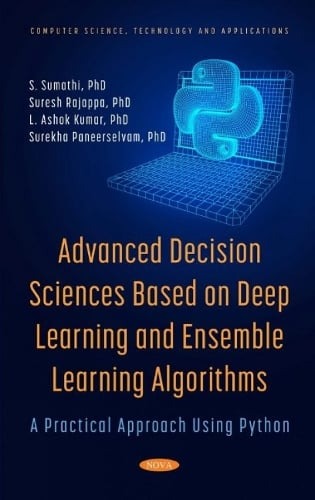
Advanced Decision Sciences Based on Deep Learning and Ensemble Learning Algorithms : A Practical Approach Using Python
Describes the deep learning models and ensemble approaches applied to decision-making problems. The authors have addressed the concepts of deep learning, convolutional neural networks, recurrent neural networks, and ensemble learning in a practical sense providing complete code and implementation for several real-world examples. The authors of this book teach the concepts of machine learning for undergraduate and graduate-level classes and have worked with Fortune 500 clients to formulate data analytics strategies and operationalise these strategies.
