



الصفحة 2
الصفحة 2

Computer algebra in scientific computing ; 23rd International Workshop, CASC 2021, Sochi, Russia, September 13–17, 2021, Proceedings
This book constitutes the proceedings of the 23rd International Workshop on Computer Algebra in Scientific Computing, CASC 2021, held in Sochi, Russia, in September 2021. The 24 full papers presented together with 1 invited talk were carefully reviewed and selected from 40 submissions. The papers cover theoretical computer algebra and its applications in scientific computing.

Computer algebra in scientific computing ; 22nd International Workshop, CASC 2020, Linz, Austria, September 14–18, 2020, Proceedings
This book constitutes the refereed proceedings of the 22nd International Workshop on Computer Algebra in Scientific Computing, CASC 2020, held in Linz, Austria, in September 2020. The conference was held virtually due to the COVID-19 pandemic. The 34 full papers presented together with 2 invited talks were carefully reviewed and selected from 41 submissions. They deal with cutting-edge research in all major disciplines of computer algebra. The papers cover topics such as polynomial algebra, symbolic and symbolic-numerical computation, applications of symbolic computation for investigating and solving ordinary differential equations, applications of CAS in the investigation and solution of celestial mechanics problems, and in mechanics, physics, and robotics.

Computer Algebra in Scientific Computing ; 10th International Workshop, CASC 2007, Bonn, Germany, September 16-20, 2007, Proceedings
The book covers not only various expanding applications of computer algebra to scientific computing but also the computer algebra systems themselves and the CA algorithms. Topics addressed are studies in polynomial and matrix algebra, quantifier elimination, and Gröbner bases, as well as stability investigation of both differential equations and difference methods for them. Several papers are devoted to the application of computer algebra methods and algorithms to the derivation of new mathematical models in biology and in mathematical physics.
Linear Systems, Signal Processing and Hypercomplex Analysis ; Chapman University, November 2017
includes contributions originating from a conference held at Chapman University during November 14-19, 2017. It presents original research by experts in signal processing, linear systems, operator theory, complex and hypercomplex analysis and related topics.
Boundary value problems, Weyl Functions, and differential operators
This book presents a comprehensive survey of modern operator techniques for boundary value problems and spectral theory, employing abstract boundary mappings and Weyl functions.
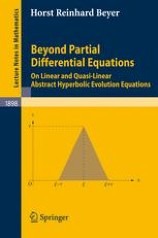
Beyond partial differential equations : On linear and Quasi-Linear abstract hyperbolic evolution equations
The present volume is self-contained and introduces to the treatment of linear and nonlinear (quasi-linear) abstract evolution equations by methods from the theory of strongly continuous semigroups.
Averaging Methods in Nonlinear Dynamical Systems
The authors have presented an extensive revision of the first edition of the Averaging Methods in Nonlinear Dynamical Systems book. There are many changes, corrections and updates in chapters on Basic Material and Asymptotics, Averaging, and Attraction.

Applied Parallel Computing ; State of the Art in Scientific Computing ; 8th International Workshop, PARA 2006, Umea, Sweden, June 18-21, 2006, Revised Selected Papers
It covers partial differential equations, parallel scientific computing algorithms, linear algebra, simulation environments, algorithms and applications for blue gene/L, scientific computing tools and applications, parallel search algorithms, peer-to-peer computing, mobility and security, algorithms for single-chip multiprocessors.
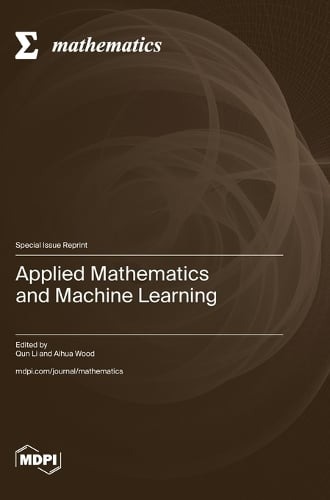
Applied mathematics and machine learning
The simultaneous availability of large datasets and high-performance computing capability in recent years has enabled the rapid development of powerful machine learning algorithms. On the one hand, state-of-the-art machine learning techniques have transformed many areas of science and engineering; on the other hand, theoretical discoveries in mathematical algorithms, differential equations, and statistical inferences, to name a few, have provided the foundation for the exploration of new multidisciplinary models for solving practical problems. This Special Issue endeavors to continue the journey that started in our previous Special Issue (Applied Mathematics and Computational Physics) by providing a platform for researchers from both academia and industry, as well as government, to present their new computational methods that have engineering and physics applications.
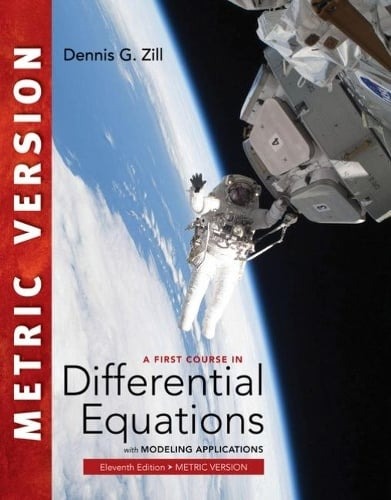
A first course in differential equations with modeling applications
A comprehensive treatment of ordinary differential equations, concisely presenting basic and essential results in a rigorous manner. Including various examples from physics, mechanics, natural sciences, engineering and automatic theory, Differential Equations is a bridge between the abstract theory of differential equations and applied systems theory.
