



الصفحة 2
الصفحة 2

Numerical Analysis and Its Applications ; 3rd International Conference, NAA 2004, Rousse, Bulgaria, June 29 - July 3, 2004, Revised Selected Papers
Constitutes the refereed post-proceedings of the Third International Conference on Numerical Analysis and Its Applications, held in Bulgaria in June/July 2004. This book addresses various aspects of numerical analysis. It covers the application fields such as computational sciences and engineering, chemistry, physics, economics, and simulation.

Nonlinear Speech Modeling and Applications : Advanced Lectures and Revised Selected Papers
Presents the revised tutorial lectures given at the International Summer School on Nonlinear Speech Processing-Algorithms and Analysis held in Vietri sul Mare, Salerno, Italy in September 2004. The 14 revised tutorial lectures by leading international researchers are organized in topical sections on dealing with nonlinearities in speech signals, acoustic-to-articulatory modeling of speech phenomena, data driven and speech processing algorithms, and algorithms and models based on speech perception mechanisms. Besides the tutorial lectures, 15 revised reviewed papers are included presenting original research results on task oriented speech applications.

Nonlinear dynamics of a wheeled vehicle
This book provides an overview of the theory of stability analysis and its applications. It is focused on various methods devoted to analyzing wheeled vehicle behavior. The authors provide both basic and advanced knowledge of the subject.

Nonlinear Dimensionality Reduction
This book describes existing and advanced methods to reduce the dimensionality of numerical databases. For each method, the description starts from intuitive ideas, develops the necessary mathematical details, and ends by outlining the algorithmic implementation. Methods are compared with each other with the help of different illustrative examples. The purpose of the book is to summarize clear facts and ideas about well-known methods as well as recent developments in the topic of nonlinear dimensionality reduction. With this goal in mind, methods are all described from a unifying point of view, in order to highlight their respective strengths and shortcomings.

Nonblocking Supervisory Control of State Tree Structures
This monograph proposes how to manage complexity by organizing the system as a State Tree Structure (STS). an efficient recursive symbolic algorithm is presented that can perform nonblocking supervisory control design in reasonable time and memory for complex systems.

Nonblocking Electronic and Photonic Switching Fabrics
This state-of-the-art survey of switching fabric architectures gives special attention to combinatorial properties of switching fabrics – nonblockingness and rearrangeability. Also describing control algorithms proposed to control different architectures.

Next Generation Transport Networks : Data, Management, and Control Planes
Next Generation Transport Networks: Data, Management, and Control Planes provides a tutorial and reference information for next generation telecommunication network technologies. This insightful and accessible overview includes key technologies that comprise the backbone of the networking infrastructure.

Next Generation Teletraffic and Wired/Wireless Advanced Networking ; 8th International Conference, NEW2AN and 1st Russian Conference on Smart Spaces, ruSMART 2008 St. Petersburg, Russia, September 3-5, 2008. Proceedings
This book constitutes the refereed proceedings of the 8th International Conference on Next Generation Teletraffic and Wired/Wireless Advanced Networking, NEW2AN 2008, held in St. Petersburg, Russia in September 3-5, 2008 in conjunction with the First ruSMART 2008.The 21 revised full papers presented were carefully reviewed and selected from a total of 60 submissions. The NEW2AN papers are organized in topical sections on wireless networks, multi-hop wireless networks, cross-layer design, teletraffic theory, multimedia communications, heterogeneous networks, network security. The ruSMART papers start with three keynote talks followed by seven articles on Smart Spaces.
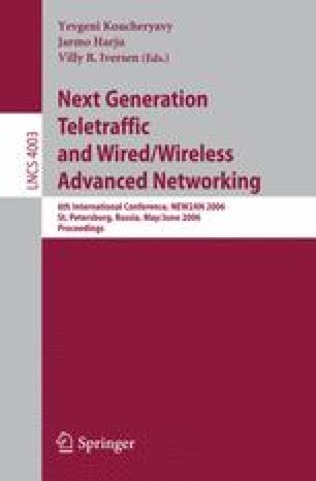
Next Generation Teletraffic and Wired ; 6th International Conference, NEW2AN 2006, St. Petersburg, Russia, May 29-June 2, 2006, Proceedings
This book constitutes the refereed proceedings of the 6th International Conference on Next Generation Teletraffic and Wired/Wireless Advanced Networking, NEW2AN 2006, held in St. Petersburg, Russia in May/June 2006. The book includes 49 revised full papers presented together with 2 keynote talks. The papers are organized in topical sections on teletraffic, traffic characterization and modeling, 3G/UMTS, sensor networks, WLAN, QoS, MANETs, lower layer techniques, PAN technologies, and TCP.

Next generation information technologies and systems ; 6th International Conference, NGITS 2006, Kebbutz Sehfayim, Israel, July 4-6, 2006, Proceedings
The selected papers may be classified roughly in ten broad areas: ? Information systems development ? Distributed systems ? Semi-structured data ? Data mining and agent-oriented computing ? User-oriented design ? Frameworks, models and taxonomies ? Simulation and incremental computing ? Information integration ? Security and privacy ? Next-generation applications This event is the culmination of efforts by many talented and dedicated individuals.

Newton-Euler Dynamics
Most books on "intermediate dynamics" covering advanced Newtonian and introductory Lagrangian methods.This material cannot be covered adequately in one course if it is to be shared with an introduction to Langrangian methods. This text is devoted to application of Newton-Euler methods to complex, real-life 3-D dynamics problems.
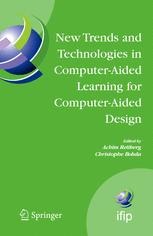
New Trends and Technologies in Computer-Aided Learning for Computer-Aided Design ; IFIP International Working Conference: EduTech 2005, Perth, Australia, October 20-21, 2005
Computation and communication technologies underpin work and development in many different areas. Among them, Computer-Aided Design of electronic systems and E-Learning technologies are two areas which are different but share many concerns. The design of CAD and E-Learning systems already touches on a number of parallels, such as system interoperability, user interfaces, standardization, EML-based formats, reusability aspects (of content or designs), and intellectual property rights. Furthermore, the teaching of Design Automation tools and methods is particularly amenable to a distant or blended learning setting, and implies the interconnection of typical CAD tools, such as simulators or synthesis tools, with e-learning tools. There are many other aspects in which synergy can be found when using E-Learning technology for teaching and learning technology. This workshop, sponsored by IFIP WG 10.5 Design and Engineering of Electronic Systems in cooperation with IFIP WG 3.6 Distance Education, will explore the interrelationship between these two subjects, where Computer-Aided Design meets Computer-Aided Learning. New Trends and Technologies in Computer-Aided Learning for Computer-Aided Design documents recent approaches and results presented at the EduTech 2005 Workshop, which was held in October 2005 in Perth, Australia and sponsored by the International Federation for Information Processing (IFIP). The topics chosen for this working conference are very timely: learning environments, tools and applications for education, education technologies and trends, and teaching in the hardware design area.

New Stream Cipher Designs : The eSTREAM Finalists
The goal of eSTREAM was to promote the design of new stream ciphers with a particular emphasis on algorithms that would be either very fast in software or very resource-efficient in hardware. Algorithm designers were invited to submit new stream cipher proposals to eSTREAM, and 34 candidates were proposed from around the world. Over the following years the submissions were assessed with regard to both security and practicality by the cryptographic community, and the results were presented at major conferences and specialized workshops dedicated to the state of the art of stream ciphers.

New horizons for a data-driven economy : A roadmap for usage and exploitation of big data in Europe
The book is structured in four parts: Part I “The Big Data Opportunity” explores the value potential of big data with a particular focus on the European context. It also describes the legal, business and social dimensions that need to be addressed, and briefly introduces the European Commission’s BIG project. Part II “The Big Data Value Chain” details the complete big data lifecycle from a technical point of view, ranging from data acquisition, analysis, curation and storage, to data usage and exploitation. Next, Part III “Usage and Exploitation of Big Data” illustrates the value creation possibilities of big data applications in various sectors, including industry, healthcare, finance, energy, media and public services. Finally, Part IV “A Roadmap for Big Data Research” identifies and prioritizes the cross-sectorial requirements for big data research, and outlines the most urgent and challenging technological, economic, political and societal issues for big data in Europe.
New Frontiers in Applied Artificial Intelligence ; 21st International Conference on Industrial, Engineering and Other Applications of Applied Intelligent Systems, IEA/AIE 2008 Wrocław, Poland, June 18-20, 2008 Proceedings
The 75 revised full papers presented were carefully reviewed and selected from 302 submissions. The papers are organized in topical sections on computer vision, fuzzy system applications, robot and manufacturing, data mining and KDS, neural networks, machine learning, natural language processing, internet application and education, heuristic search, application systems, agent-based system, evolutionary and genetic algorithms, knowledge management, and other applications. The book concludes with 15 contributions from the following special sessions: knowledge driven manufacturing systems, joint session on adaptive networked systems and fuzzy knowledge bases, and software agents and multi-agent systems.

New Frontiers for Entertainment Computing ; IFIP 20th World Computer Congress, First IFIP Entertainment Computing Symposium (ECS 2008), September 7-10, 2008, Milano, Italy
The IFIP series publishes state-of-the-art results in the sciences and technologies of information and communication. The scope of the series includes: foundations of computer science; software theory and practice; education; computer applications in technology; communication systems; systems modeling and optimization; information systems; computers and society; computer systems technology; security and protection in information processing systems; artificial intelligence; and human-computer interaction. Proceedings and post-proceedings of refereed international conferences in computer science and interdisciplinary fields are featured. These results often precede journal publication and represent the most current research.
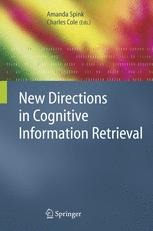
New Directions in Cognitive Information Retrieval
New Directions in Cognitive Information Retrieval presents an exciting new direction for research into cognitive oriented information retrieval (IR) research, a direction based on an analysis of the user’s problem situation and cognitive behavior when using the IR system. This contrasts with the current dominant IR research paradigm which concentrates on improving IR system matching performance. The chapters describe the leading edge concepts and models of cognitive IR that explore the nexus between human cognition, information and the social conditions that drive humans to seek information using IR systems. Chapter topics include: Polyrepresentation, cognitive overlap and the boomerang effect, Multitasking while conducting the search, Knowledge Diagram Visualizations of the topic space to facilitate user assimilation of information, Task, relevance, selection state, knowledge need and knowledge behavior, search training built into the search, children’s collaboration for school projects, and other cognitive perspectives on IR concepts and issues.
New Developments in Parsing Technology
Parsing can be defined as the decomposition of complex structures into their constituent parts, and parsing technology as the methods, the tools, and the software to parse automatically. Parsing is a central area of research in the automatic processing of human language. Parsers are being used in many application areas, for example question answering, extraction of information from text, speech recognition and understanding, and machine translation. New developments in parsing technology are thus widely applicable. This book contains contributions from many of today's leading researchers in the area of natural language parsing technology. The contributors describe their most recent work and a diverse range of techniques and results. This collection provides an excellent picture of the current state of affairs in this area. This volume is the third in a series of such collections, and its breadth of coverage should make it suitable both as an overview of the current state of the field for graduate students, and as a reference for established researchers.

New Algorithms, Architectures and Applications for Reconfigurable Computing
New Algorithms, Architectures and Applications for Reconfigurable Computing consists of a collection of contributions from the authors of some of the best papers from the Field Programmable Logic conference (FPL’03) and the Design and Test Europe conference (DATE’03).

Neuroscribe = نيوروسكرايب
Neuroscribe is a cutting-edge deep learning framework designed to address the complexities and inefficiencies encountered in existing frameworks like PyTorch and TensorFlow. Aimed at streamlining model development and enhancing performance across diverse hardware environments, NeuroScribe offers a lightweight and flexible solution. The framework features a robust tensor library, an auto-differentiation engine, a comprehensive neural network module, and advanced optimization algorithms. With built-in visualization tools and a user-friendly interface, NeuroScribe simplifies both beginner and advanced workflows. Its cross-platform compatibility, supported by CUDA and Metal Performance Shaders (MPS), ensures optimal performance, and in some scenarios, NeuroScribe demonstrates superior speed compared to leading frameworks. Additionally, NeuroScribe introduces unique libraries and features not found in other frameworks, further enhancing its versatility and appeal. The modular architecture and automatic system detection further enhance its adaptability, making NeuroScribe a versatile and powerful tool for deep learning practitioners.
