



الصفحة 18
الصفحة 18
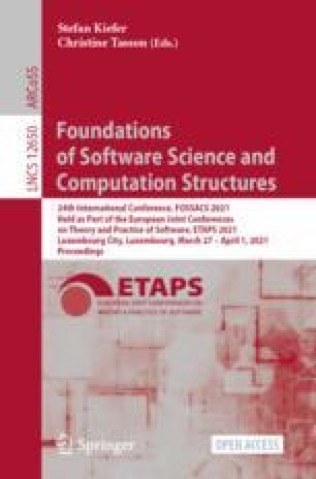
Foundations of software science and computation structures ; 24th International conference, FOSSACS 2021, Held as Part of the European joint conferences on theory and practice of software, ETAPS 2021, Luxembourg City, Luxembourg, March 27 – April 1, 2021, proceedings
This book constitutes the proceedings of the 24th International Conference on Foundations of Software Science and Computational Structures, FOSSACS 2021, which was held during March 27 until April 1, 2021, as part of the European Joint Conferences on Theory and Practice of Software, ETAPS 2021. The conference was planned to take place in Luxembourg and changed to an online format due to the COVID-19 pandemic.

Foundations of software science and computation structures ; 23rd International conference, FOSSACS 2020, Held as part of the European joint conferences on theory and practice of software, ETAPS 2020, Dublin, Ireland, April 25–30, 2020, proceedings
This book constitutes the proceedings of the 23rd International Conference on Foundations of Software Science and Computational Structures, FOSSACS 2020, which took place in Dublin, Ireland, in April 2020, and was held as Part of the European Joint Conferences on Theory and Practice of Software, ETAPS 2020.

Foundations of security analysis and design III : FOSAD 2004/2005 tutorial lectures
The increasing relevance of security to real-life applications, such as electronic commerce and Internet banking, is attested by the fast-growing number of - search groups, events, conferences, and summer schools that address the study of foundations for the analysis and the design of security aspects. The “Int- national School on Foundations of Security Analysis and Design” (FOSAD, see http://www.sti.uniurb.it/events/fosad/)has been one of the foremost events - tablishedwiththegoalofdisseminatingknowledgeinthiscriticalarea,especially for young researchers approaching the ?eld and graduate students coming from less-favoured and non-leading countries. The FOSAD school is held annually at the Residential Centre of Bertinoro (http://www.ceub.it/), in the fascinating setting of a former convent and ep- copal fortress that has been transformed into a modern conference facility with computing services and Internet access. Since the ?rst school, in 2000, FOSAD hasattractedmorethan250participantsand50lecturersfromallovertheworld.

Foundations of Security : What Every Programmer Needs to Know
Foundations of Security: What Every Programmer Needs to Know teaches new and current software professionals state-of-the-art software security design principles, methodology, and concrete programming techniques they need to build secure software systems.

Foundations of Microsoft® Expression Web : The Basics and Beyond
Expression Web, one of the excellent programs within the suite, is a powerful web site creation tool that allows you to rapidly build up standards-compliant web pages, style them with CSS, add dynamic ASP.NET functionality to them, and publish them to the weball from the comfort of one program, and "Foundations of Microsoft Expression Web: The Basics and Beyond" is one of the first books available on the program.

Foundations of GTK+ Development
GTK+ is one of the most influential graphical toolkits for the Linux operating system. It is the technology upon which the GNOME and XFCE desktop environments are based, and its crucial to have clear understanding of its complexities to build even a simple Linux desktop application. Foundations of GTK+ Development guides you through these complexities, laying the foundation that will allow you to cross from novice to professional.

Foundations of genetic algorithms ; 8th International Workshop, FOGA 2005, Aizu-Wakamatsu City, Japan, January 5-9, 2005, Revised Selected Papers
The8thWorkshopontheFoundationsofGeneticAlgorithms,FOGA-8,washeld at the University of Aizu in Aizu-Wakamatsu City, Japan, January 5–9, 2005. This series of workshops was initiated in 1990 to encourage further research on the theoretical aspects of genetic algorithms, and the workshops have been held biennially ever since. The papers presented at these workshops are revised, edited and published as volumes during the year following each workshop. This series of (now eight) volumes provides an outstanding source of reference for the theoretical work in this ?eld. At the same time this series of volumes provides a clear picture of how the theoretical research has grown and matured along with the ?eld to encompass many evolutionary computation paradigms including evolution strategies (ES), evolutionary programming (EP), and genetic programming (GP), as well as the continuing growthininteractionswith other ?elds suchas mathematics,physics, and biology.

Foundations of fuzzy logic and soft computing ; 12th International Fuzzy Systems Association World Congress, IFSA 2007, Cancun, Mexico, Junw 18-21, 2007, Proceedings
This book comprises a selection of papers from IFSA 2007 on new methods and theories that contribute to the foundations of fuzzy logic and soft computing. methodologies. Soft computing consists of several computing paradigms which can be used to produce powerful intelligent systems for solving real-world problems.

Foundations of Data Mining and Knowledge Discovery
This volume presents the results of investigations into the foundations of the discipline, and represents the state-of-the-art for much of the current research. This book will prove extremely valuable and fruitful for data mining researchers, no matter whether they would like to uncover the fundamental principles behind data mining, or apply the theories to practical applications.

Foundations of C++/CLI : The Visual C++ Language for .NET 3.5
Foundations of C++/CLI: The Visual C++ Language for .NET 3.5 introduces C++/CLI, Microsoft's extensions to the C++ syntax that allow you to target the common language runtime, the key to the heart of the .NET Framework 3.5. This book gives you a small, fast–paced primer that will kick–start your journey into the world of C++/CLI. In 13 no–fluff chapters, Microsoft insiders take readers into the core of the C++/CLI language and explain both how the language elements work and how Microsoft intends them to be used. This book is a beginner's guide, but it assumes a familiarity with programming basics. And it concentrates on explaining the aspects of C++/CLI that make it the most powerful and fun language of the .NET Framework. As such, this book is ideal if you're thinking of migrating to C++/CLI from another language.

Foundations of Atlas : Rapid Ajax Development with ASP.NET 2.0
This book introduces a fast-track path to understanding Atlas, and how this technology can increase the power and functionality of your code while conserving time and effort. The book begins with a bare-bones introduction that explains how Atlas relates to Ajax. Microsoft Atlas is a web-client framework that makes building Ajax-style applications easier. It provides a prewritten framework that gives you a structured environment in which to work. Atlas also provides you with an object model and standardized debugging to make development faster and simpler. Ajax is a way of combining a number of Web technologies including JavaScript, dynamic HTML, and a feature known as XMLHttp (which reduces the need for client browsers to constantly reconnect to the server every time new information is downloaded). But at the moment, people developing with Ajax have to write their code from the ground up, which is complex and time consuming.

Foundations of Ajax
Ajax burst onto the Web development scene by offering highly interactive, desktop-like Web applications that can be deployed through any modern Web browser without the need for special plug-ins. Ajax is built on existing Web technologies such as JavaScript, HTML, and CSS, and it is used in conjunction with your favorite server-side language. Foundations of Ajax explains how to combine these technologies effectively to implement Ajax into your new or existing Web applications. Like you, we are developers who are in the trenches, tasked with building Web-enabled applications that provide real value to our customers. As the Web continues to grow, the demand for more expressive and engaging interfaces will continue to increase.

Foundations of Agile Python Development
You've long been enamored with the Python language, and have mastered its many nuances. Yet something seems to be missing—a productivity boost that you know is possible but you're not sure how to go about it. This was the sentiment of so many developers before discovering Agile programming paradigm, which embraces concepts such as automation, effective code management, and test–driven development. Foundations of Agile Python Development is the first book to apply these sought–after principles to Python developers, introducing both the tools and techniques built and supported by the Python community. Authored by Jeff Younker, a well–known member of Python's agile community who is perhaps best known for his creation of a popular Python testing framework

Foundation XML for Flash
XML is a completely platform-agnostic data medium. Flash is able to make use of XML data, which is very useful when creating rich Internet applications. It allows you to populate Flash web interfaces with data from almost any source that supports XML as a data medium, be it databases, raw XML files, or more excitingly, .NET applications, Web Services, and even Microsoft Office applications like Excel and Word! In this book, Sas Jacobs first introduces XML itself—what it is, its syntax, its associated technologies (such as CSS and XSLT,) and how to get XML out of your applications in a format Flash can use. Then, she shows how to use the XML object to stream XML data into Flash, and how to use the XMLConnector component and XML Sockets to build advanced Flash/XML applications.

Foundation Website Creation with CSS, XHTML, and JavaScript
Foundation Website Creation with CSS, XHTML, and JavaScript covers the entire process of building a website. This process involves much more than just technical knowledge, and this book provides you with all the information you'll need to understand the concepts behind designing and developing for the Web, as well as the best means to deliver professional, best-practice-based results. There is far more to building a successful website than knowing a little Hypertext Markup Language (HTML). The process starts long before any coding takes place, and this book introduces you to the agile development process, explaining why this method makes so much sense for web projects and how best to implement it. Planning is vital, so you'll also learn how to use techniques such as brainstorming, wireframes, mockups, and prototypes to get your project off to the best possible start and help ensure smooth progress as it develops.

Foundation Web Design with Dreamweaver 8
Dreamweaver is Macromedia's bestselling web design/development environment. Dreamweaver has the capability to generate dynamic website code using server-side languages like ASP, PHP, and ASP.NET. We know that you don't always require a full database-driven site though, so this book focuses on using version 8 of Dreamweaver to design and create usable, standards-compliant websites using XHTML and CSS. One of the highlights of this version is much closer, tighter CSS/XHTML. This book will show you how to make the most of that feature. After a brief introduction to the latest version of Dreamweaver, and how CSS and XHTML fit into it, Craig Grannell looks at using the software for your web design projects in a hands-on, task based manner.

Foundation PHP5 for Flash
This latest, completely rewritten, edition again brings together three of the web's hottest technologies—Flash, the server-side language PHP, and the MySQL database system. We've brought things back up to date, using ActionScript 2.0, PHP 5.0, and MySQL 4.1, the book has been designed to be version-neutral. In other words, you can be confident that you're working with the latest standards, but that your applications won't break if deployed on an older server. The book also provides a brief introduction to an alternative database system, SQLite, which is now automatically bundled with PHP 5 and requires no installation.

Foundation PHP for Dreamweaver 8
In this book, we look specifically at using Dreamweaver's built-in server behaviors to build dynamic web sites using PHP and MySQL, the world's most popular open source server-side language and database server combination, which are both reliable, powerful, and open source (and therefore free to use). This version of Dreamweaver includes more powerful support for PHP and MySQL than ever before, and we'll show you how to make this work for you. No previous experience of PHP or MySQL is necessary to use this book. Examples built throughout the book include a content management system, and an online image gallery. All examples are designed to meet modern usability requirements and be web standards-compliant.

Foundation models for natural language processing : pre-trained language models integrating media
Covers basic natural language processing models, pre-trained language models BERT, GPT, and sequence-to-sequence converters, as well as the concepts of self-attention and context-sensitive embedding. Various approaches to improving these models are then discussed, such as expanding the pre-training parameters, increasing the length of input texts, or incorporating additional knowledge. An overview of the best performing models is then provided for about twenty application areas, e.g., question answering, translation, story generation, dialogue systems, image generation from text, etc. For each application area, the strengths and weaknesses of existing models are discussed, and an overview of further developments is provided. In addition, links to freely available code are provided. The concluding chapter summarizes the economic opportunities, risk mitigation, and potential developments of AI.

Foundation Form Creation with Adobe LiveCycle Designer ES
Form creation is key to information processing and forms workflow is a key concept within Adobe LiveCycle Enterprise Suite. Adobe LiveCycle Forms ES is a stand-alone product that also comes bundled with Adobe LiveCycle Enterprise Suite. This is the first and only book about this new product specifically created for the design, creation, and processing of dynamically interactive forms. Foundation Form Creation with Adobe LiveCycle Designer ES is written for users of all abilities, with introductory material for beginners and advanced techniques for more experienced users. It discusses both the best-practices of designing forms that work and the specifics of implementing them efficiently for data collection—the full life cycle of working with forms.
