



الصفحة 17
الصفحة 17

Informatics in the Future ; Proceedings of the 11th European Computer Science Summit (ECSS 2015), Vienna, October 2015
This volume discusses the prospects and evolution of informatics (or computer science), which has become the operating system of our world, and is today seen as the science of the information society. Its artifacts change the world and its methods have an impact on how we think about and perceive the world. Classical computer science is built on the notion of an “abstract” machine, which can be instantiated by software to any concrete problem-solving machine, changing its behavior in response to external and internal states, allowing for self-reflective and “intelligent” behavior. However, current phenomena such as the Web, cyber physical systems or the Internet of Things show us that we might already have gone beyond this idea, exemplifying a metamorphosis from a stand-alone calculator to the global operating system of our society.

Informatics in Control, Automation and Robotics II
Informatics in Control, Automation and Robotics II is a collection of the best papers presented at the 2nd International Conference on Informatics in Control, Automation and Robotics (ICINCO). The purpose of ICINCO was to bring together researchers, engineers and practitioners interested in the application of informatics to Control, Automation and Robotics.

Industrial applications of semantic web ; Proceedings of the 1st International IFIP/WG12.5 Working Conference on Industrial Applications of Semantic Web, August 25-27, 2005 Jyvaskyla, Finland
The IFIP series publishes state-of-the-art results in the sciences and technologies of information and communication. The scope of the series includes: foundations of computer science; software theory and practice; education; computer applications in technology; communication systems; systems modeling and optimization; information systems; computers and society; computer systems technology; security and protection in information processing systems; artificial intelligence; and human-computer interaction. Proceedings and post-proceedings of referred international conferences in computer science and interdisciplinary fields are featured. These results often precede journal publication and represent the most current research. The principal aim of the IFIP series is to encourage education and the dissemination and exchange of information about all aspects of computing.

Inductive logic programming ; 17th International Conference, ILP 2007, Corvallis, OR, USA, June 19-21, 2007, Revised Selected Papers
The 18th International Conference on Inductive Logic Programming was held in Prague, September 10–12, 2008. ILP returned to Prague after 11 years, and it is tempting to look at how the topics of interest have evolved during that time. The ILP community clearly continues to cherish its beloved ?rst-order logic representation framework. This is legitimate, as the work presented at ILP 2008 demonstrated that there is still room for both extending established ILP approaches (such as inverse entailment) and exploring novel logic induction frameworks (such as brave induction). Besides the topics lending ILP research its unique focus.

Independent Component Analysis and Blind Signal Separation ; 6th International Conference, ICA 2006, Charleston, SC, USA, March 5-8, 2006, Proceedings
This book constitutes the refereed proceedings of the 6th International Conference on Independent Component Analysis and Blind Source Separation, ICA 2006, held in Charleston, SC, USA, in March 2006. The 120 revised papers presented were carefully reviewed and selected from 183 submissions. The papers are organized in topical sections on algorithms and architectures, applications, medical applications, speech and signal processing, theory, and visual and sensory processing.

Inclusive radio communications for 5G and beyond
Based on the COST IRACON project that consists of 500 researchers from academia and industry, with 120 institutions from Europe, US and the Far East involved. The book presents state-of-the-art design and analysis methods for 5G (and beyond) radio communication networks, along with key challenges and issues related to the development of 5G networks.

Improvements in System Safety ; Proceedings of the Sixteenth Safety-critical Systems Symposium, Bristol, UK, 5-7 February 2008
Improvements in System Safety contains the full complement of papers presented at the sixteenth annual Safety-critical Systems Symposium, held at Bristol, UK, in February 2008.The Symposium is for engineers, managers and academics in the field of safety, across all industry sectors, and so the papers included in this volume offer a wide-ranging coverage of major safety issues as well as a good blend of academic research and industrial experience. They include discussions of some of the most recent developments in the field.

IMPROVE - Innovative modelling approaches for production systems to raise validatable efficiency : Intelligent methods for the factory of the future
This open access work presents selected results from the European research and innovation project IMPROVE which yielded novel data-based solutions to enhance machine reliability and efficiency in the fields of simulation and optimization, condition monitoring, alarm management, and quality prediction.

Implementing semantic web services : The SESA framework
Service-oriented computing has become one of the predominant factors in IT research and development efforts over the last few years. In spite of several standardization efforts that advanced from research labs into industrial-strength technologies and tools, there is still much human effort required in the process of finding and executing Web services.
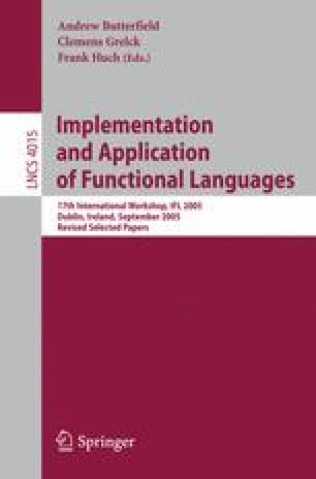
Implementation and Application of Functional Languages ; Vol. 4015 ; 17th International Workshop, IFL 2005, Dublin, Ireland, September 19-21, 2005, Revised Selected Papers
The 17th International Workshop on Implementation and Application of Functional Languages (IFL 2005) was held in Dublin, Ireland, September 19–21, 2005. It was organized by the Department of Computer Science at Trinity College, University of Dublin. IFL 2005 was the 17th event in the annual series of IFL workshops. The aim of the workshop series is to bring together researchers actively engaged in the implementation and application of functional and function-based programming languages. It provides an open forum for researchers who wish to present and discuss new ideas and concepts, work in progress, preliminary results, etc., related primarily, but not exclusively, to the implementation and application of functional languages. Topics of interest cover a wide range from theoretical aspects over language design and implementation towards applications and tool support.
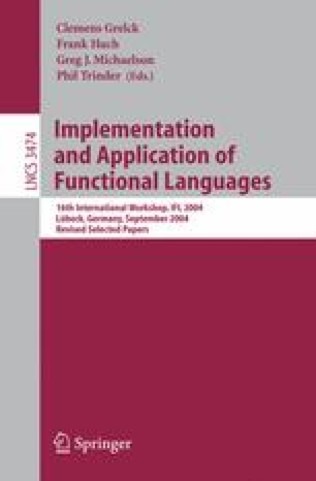
Implementation and application of functional languages ; Vol. 3474 ; 16th International Workshop, IFL 2004, Lübeck, Germany, September 8-10, 2004, Revised Selected Papers
The 16th International Workshop on Implementation and Application of Fu- tional Languages (IFL 2004) was held in Lub ¨ eck, Germany, September 8–10, 2004. It was jointly organized by the Institute of Computer Science and Applied Mathematics of the University of Kiel and the Institute of Software Technology and Programming Languages of the University of Lub ¨ eck. IFL 2004 was the sixteenth event in the annual series of IFL workshops. The aim of the workshop series is to bring together researchers actively engaged in the implementation and application of functional and function-based progr- ming languages. It provides an open forum for researchers who wish to present and discuss new ideas and concepts, work in progress, preliminary results, etc., related primarily, but not exclusively, to the implementation and application of functional languages. Topics of interest cover a wide range from theoretical - pects over language design and implementation towards applications and tool support.

Impacts and Risk Assessment of Technology for Internet Security : Enabled Information Small-Medium Enterprises (TEISMES)
This emerging economy is bringing with it new forms of TEI intermediation, online businesses, virtual supply chains, rapidly changing internet-electronic commerce technologies, increasing knowledge intensity, and unprecedented sensitivity of the time-to-market by customers. Impacts and Risk Assessment of Technology for Internet Security Enabled Information Small-Medium Enterprises (TEISMES) also identifies ways of minimizing risk liability of TEISME business operations as a result of their dependence on TEI (Internet-eC). The rapid evolution and spread of information technology (IT) during the last few years is challenging SMEs, governments and internet security professionals to rethink the very nature of risk exposure. Impacts and Risk Assessment of Technology for Internet Security Enabled Information Small-Medium Enterprises (TEISMES) is designed for a professional audience of researchers and practitioners in industry. This book is also suitable for graduate-level students in computer science.
Imaging Beyond the Pinhole Camera
The world's first photograph was taken in 1826 using a pinhole camera called camera obscura. Cameras used since then are basically following the pinhole camera principle. This book looks at the development as well as the applications of alternative camera architectures.

Image recognition : progress, trends and challenges
Focuses on research trends in image processing and recognition and corresponding developments. Among them, the book focuses on recent research, especially in the field of advanced human-computer interaction and intelligent computing. Given the existing interaction and recognition of the station, some novel topics are proposed, including how to establish a cognitive model in human-computer interaction and how to express and transfer human knowledge into human-machine image recognition. In an interactive implementation, how to implement user experience through image recognition during machine interaction

Image processing based on partial differential equations ; Proceedings of the International Conference on PDE-Based Image Processing and Related Inverse Problems, CMA, Oslo, August 8-12, 2005
The book contains twenty-two original scienti?c research articles that address the state-of-the-art in using partial di?erential equations for image and signal processing. The articles arose from presentations given at the inter- tional conference on PDE-Based Image Processing and Related Inverse Pr- lems, held at the Centre of Mathematics for Applications, University of Oslo, Norway, August 8-12, 2005.

Image and video retrieval ; Vol. 3568 ; 4th International conference, CIVR 2005, Singapore, July 20-22, 2005, Proceedings
It was our great pleasure to host the 4th International Conference on Image and Video Retrieval (CIVR) at the National University of Singapore on 20–22 July 2005. CIVR aims to provide an international forum for the discussion of research challenges and exchange of ideas among researchers and practitioners in image/video retrieval technologies. It addresses innovative research in the broad ?eld of image and video retrieval. A unique feature of this conference is the high level of participation by researchers from both academia and industry. Another unique feature of CIVR this year was in its format – it o?ered both the traditional oral presentation sessions, as well as the short presentation cum poster sessions. The latter provided an informal alternative forum for animated discussions and exchanges of ideas among the participants.After a rigorous review process, 20 papers were accepted for oral presentations, and 42 papers were accepted for poster presentations. In addition to the accepted submitted papers, the program also included 4 invited papers, 1 keynote industrial paper, and 4 invited industrial papers. Altogether, we o?ered a diverse and interesting program, addressing the current interests and future trends in this area.

Image and video retrieval ; Vol. 4071 ; 5th Internatinoal Conference, CIVR 2006, Tempe, AZ, USA, July 13-15, 2006, Proceedings
This volume contains the proceeding of the 5th International Conference on - age and Video Retrieval (CIVR), July 13–15, 2006, Arizona State University, Tempe, AZ, USA: http://www. civr2006. org. Image and video retrieval cont- ues to be one of the most exciting and fast-growing research areas in the ?eld of multimedia technology. However, opportunities for exchanging ideas between researchers and users of image and video retrieval systems are still limited.

Image and video encryption : From digital rights management to secured personal communication
Image and Video Encryption provides a unified overview of techniques for encryption of images and video data. This ranges from commercial applications like DVD or DVB to more research oriented topics and recently published material. This volume introduces different techniques from unified viewpoint, then evaluates these techniques with respect to their respective properties (e.g., security, speed.....). Encryption of visual data is an important topic in the area of mutimedia security, applications range from digital rights management (DVD, DVB) ) to secure personal communications. Within this topic area, we face several aims which contradict each other. What we thrive on is good compression, fast compression, high security, fast encryption, bitstream compliance, little power consumption and little memory requirements. The authors experimentally compare different approaches proposed in the literature and include an extensive bibliography of corresponding published material. Image and Video Encryption is designed for a professional audience composed of researchers and practitioners in industry. The book is also suitable for graduate-level students in computer science and electrical engineering.

Image Analysis and Recognition ; Vol. 4142 ; 3rd International Conference, ICIAR 2006, Póvoa de Varzim, Portugal, September 18-20, 2006, Proceedings, Part II
ICIAR 2006, the International Conference on Image Analysis and Recognition, was the third ICIAR conference, and was held in P´ ovoa de Varzim, Portugal. ICIARisorganizedannually,andalternatesbetweenEuropeandNorthAmerica. ICIAR 2004 was held in Porto, Portugal and ICIAR 2005 in Toronto, Canada. The idea of o?ering these conferences came as a result of discussion between researchers in Portugal and Canada to encourage collaboration and exchange, mainlybetweenthesetwocountries,butalsowiththeopenparticipationofother countries, addressing recent advances in theory, methodology and applications. The response to the call for papers for ICIAR 2006 was higher than the two previous editions. From 389 full papers submitted, 163 were ?nally accepted (71 oral presentations, and 92 posters). The review process was carried out by the Program Committee members and other reviewers; all are experts in various image analysis and recognition areas. Each paper was reviewed by at least two reviewers, and also checked by the conference Co-chairs. The high quality of the papers in these proceedings is attributed ?rst to the authors, and second to the quality of the reviews provided by the experts.

Image Analysis and Recognition ; Vol. 4141 ; 3rd International Conference, ICIAR 2006, Póvoa de Varzim, Portugal, September 18-20, 2006, Proceedings, Part I
ICIAR 2006, the International Conference on Image Analysis and Recognition, was the third ICIAR conference, and was held in P´ ovoa de Varzim, Portugal. ICIARisorganizedannually,andalternatesbetweenEuropeandNorthAmerica. ICIAR 2004 was held in Porto, Portugal and ICIAR 2005 in Toronto, Canada. The idea of o?ering these conferences came as a result of discussion between researchers in Portugal and Canada to encourage collaboration and exchange, mainlybetweenthesetwocountries,butalsowiththeopenparticipationofother countries, addressing recent advances in theory, methodology and applications. The response to the call for papers for ICIAR 2006 was higher than the two previous editions. From 389 full papers submitted, 163 were ?nally accepted (71 oral presentations, and 92 posters). The review process was carried out by the Program Committee members and other reviewers; all are experts in various image analysis and recognition areas. Each paper was reviewed by at least two reviewers, and also checked by the conference Co-chairs. .
