



الصفحة 16
الصفحة 16
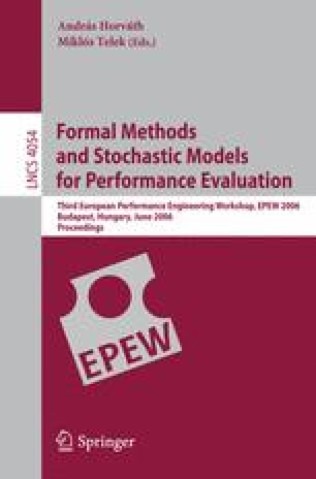
Formal Methods and Stochastic Models for Performance Evaluation ; 3rd European Performance Engineering Workshop, EPEW 2006, Budapest, Hungary, June 21-22, 2006, Proceedings
This volume contains the proceedings of the third EPEW workshop held at the Technical University of Budapest, Budapest, Hungary, June 21-22, 2006. These proceedings comprise the 16 accepted contributed papers of EPEW 2006.Toensurethehigh-qualityevaluationofthesubmittedpapersweextended the ProgramCommittee of EPEW 2006 with international experts from all over the world. The ?nal workshop program, as well as this volume, are made up of ?ve thematic sessions: – Stochastic process algebra – Workloads and benchmarks – Theory of stochastic processes – Formal dependability and performance evaluation – Queues, theory and practice These sessions cover a wide range of performance evaluation methods and c- pose an overview of the current research directions in performance evaluation.

Formal Methods and Software Engineering; 9th International Conference on Formal Engineering Methods, ICFEM 2007, Boca Raton, Florida, USA, November 14-15, 2007, Proceedings
This book constitutes the refereed proceedings of the 9th International Conference on Formal Engineering Methods, ICFEM 2007, held in Boca Raton, Florida, USA, November 14-15, 2007. The papers address all current issues in formal methods and their applications in software engineering.
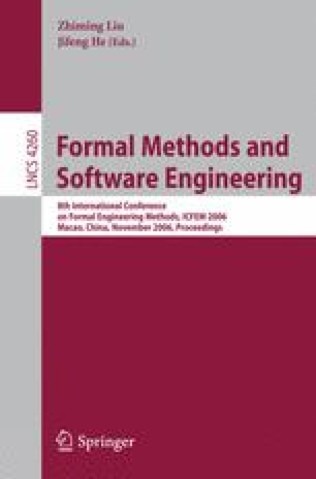
Formal Methods and Software Engineering ; Vol. 4260 ; 8th International Conference on Formal Engineering Methods, ICFEM 2006, Macao, China, November 1-3, 2006, Proceedings
This book constitutes the refereed proceedings of the 8th International Conference on Formal Engineering Methods, ICFEM 2006, held in Macao, China, in November 2006. The papers address all current issues in formal methods and their applications in software engineering.

Formal Methods and Software Engineering ; Vol. 3785 ; 7th International Conference on Formal Engineering Methods, ICFEM 2005, Manchester, UK, November 1-4, 2005, Proceedings
This volume contains papers presented at the 7th International Conference on Formal Engineering Methods (ICFEM 2005), 1-4 November 2005, Manchester, UK. Formal engineering methods are changing the way that systems are dev- oped. With language and tool support, these methods are being used for se- automatic code generation, and for the automatic abstraction and checking of implementations. In the future, they will be used at every stage of development: requirements, speci?cation, design, implementation, testing, anddocumentation. The aim of ICFEM 2005 was to bring together those interested in the - plication of formal engineering methods to computer systems. Researchers and practitioners, from industry, academia, and government, were encouraged to - tend, and to help advance the state of the art. The conference was supported by sponsorships from Microsoft Research, USA, the Software Engineers Association of Japan, the University of Man- ester, Manchester City Council, FormalMethods Europe (FME) and the British Computer Society FormalAspects ofComputing Specialist Group(BCS-FACS). We wish to thank these sponsors for their generosity. The ?nal programme consisted of 3 invited talks and 30 technical papers selected from a total of 74 submissions. The invited speakers were: Anthony Hall, independent consultant, UK; Egon B] orger, University of Pisa, Italy; John Rushby, SRI, USA. Their talks were sponsored by BCS-FACS, Microsoft - search and FME respectively. We wish to thank the invited speakers for their inspiring talks.

Formal Methods and Hybrid Real-Time Systems : Essays in Honour of Dines Bjorner and Zhou Chaochen on the Occasion of Their 70th Birthdays
This paper presents a few of these, including a distributed garbage collection problem, distributed consensus problems for reconciling tree-like data structures, using model-based test case generation, and the use of software model checking in design and development process.

Formal aspects in security and trust ; Vol. 173 ; IFIP TC1 WG1.7 Workshop on Formal Aspects in Security and Trust (FAST), World Computer Congress, August 22-27, 2004, Toulouse, France
The IFIP series publishes state-of-the-art results in the sciences and technologies of information and communication. The scope of the series includes: foundations of computer science; software theory and practice; education; computer applications in technology; communication systems; systems modeling and optimization; information systems; computers and society; computer systems technology; security and protection in information processing systems; artificial intelligence; and human-computer interaction. Proceedings and post-proceedings of referred international conferences in computer science and interdisciplinary fields are featured. These results often precede journal publication and represent the most current research. The principal aim of the IFIP series is to encourage education and the dissemination and exchange of information about all aspects of computing.

Forecasting Oracle Performance
Forecasting Oracle Performance is the first book to focus squarely on the problem of forecasting the future performance of an Oracle database. Other Oracle performance books are good for putting out fires; Craig's book helps you avoid all the heat in the first place.

FM 2006: Formal Methods ; 14th International Symposium on Formal Methods, Hamilton, Canada, August 21-27, 2006, Proceedings
This book presents the refereed proceedings of the 14th International Symposium on Formal Methods, FM 2006, held in Hamilton, Canada, August 2006. The book presents 36 revised full papers together with 2 invited contributions and extended abstracts of 7 invited industrial presentations, organized in topical sections on interactive verification, formal modelling of systems, real time, industrial experience, specification and refinement, programming languages, algebra, formal modelling of systems, and more.

FM 2005: Formal Methods ; International Symposium of Formal Methods Europe, Newcastle, UK, July 18-22, 2005, Proceedings
This volume contains the proceedings of Formal Methods 2005, the 13th InternationalSymposiumonFormalMethodsheldinNewcastleuponTyne,UK, during July 18–22, 2005. Formal Methods Europe (FME, www.fmeurope.org) is an independent association which aims to stimulate the use of, and research on, formal methods for system development. FME conferences began with a VDM Europe symposium in 1987. Since then, the meetings have grown and have been held about once every 18 months. Throughout the years the symposia have been notablysuccessfulinbringingtogetherresearchers,tooldevelopers,vendors,and users, both from academia and from industry. Formal Methods 2005 con?rms this success. We received 130 submissions to the main conference, from all over the world. Each submission was carefully refereed by at least three reviewers. Then, after an intensive, in-depth discussion, the Program Committee selected 31 papers for presentation at the conference. They form the bulk of this volume.

Flexible Query Answering Systems ; 7th International Conference, FQAS 2006, Milan, Italy, June 7-10, 2006
This book constitutes the refereed proceeding of the 7th International Conference on Flexible Query Answering Systems, FQAS 2006, held in Milan, Italy in June 2006. The 60 revised full papers presented were carefully reviewed and selected from numerous submissions. The papers are organized in topical sections on flexibility in database management and quering, vagueness and uncertainty in XML quering and retrieval, information retrieval and filtering, multimedia information access, user modeling and personalization, knowledge and data extraction, intelligent information extraction from text, and knowledge representation and reasoning.
Finite-state methods and natural language processing ; 5th International Workshop, FSMNLP 2005, Helsinki, Finland, September 1-2, 2005, Revised Papers
This book constitutes the thoroughly refereed post-proceedings of the 5th International Workshop on Finite-State Methods in Natural Language Processing, FSMNLP 2005, held in Helsinki, Finland, September 2005. The book presents 24 revised full papers and seven revised poster papers together with two invited contributions and abstracts of six software demos. Topics include morphology, optimality theory, some special FSM families, weighted FSM algorithms, FSM representations, exploration, ordered structures, and surface parsing.

Fifth World Conference on Information Security Education ; Proceedings of the IFIP TC 11 WG 11.8, WISE 5, 19 to 21 June 2007, United States Military Academy, West Point, NY, USA
The scope of This book includes: foundations of computer science; software theory and practice; education; computer applications in technology; communication systems; systems modeling and optimization; information systems; computers and society; computer systems technology; security and protection in information processing systems; artificial intelligence; and human-computer interaction. Proceedings and post-proceedings of referred international conferences in computer science and interdisciplinary fields are featured. These results often precede journal publication and represent the most current research.
Fifth IFIP International Conference On Theoretical Computer Science - Tcs 2008 ; IFIP 20th World Computer Congress, TC 1, Foundations of Computer Science, September 7-10, 2008, Milano, Italy
Includes: foundations of computer science; software theory and practice; education; computer applications in technology; communication systems; systems modeling and optimization; information systems; computers and society; computer systems technology; security and protection in information processing systems; artificial intelligence; and human-computer interaction. Proceedings and post-proceedings of refereed international conferences in computer science and interdisciplinary fields are featured. These results often precede journal publication and represent the most current research. The principal aim of the IFIP series is to encourage education and the dissemination and exchange of information about all aspects of computing.

Field-Based Coordination for Pervasive Multiagent Systems
Software systems involve autonomous and distributed software components that have to execute and interact in open and dynamic environments, such as in pervasive, autonomous, and mobile applications. The requirements with respect to dynamics, openness, scalability, and decentralization call for new approaches to software design and development, capable of supporting spontaneous configuration, tolerating partial failures, or arranging adaptive reorganization of the whole system.

Explosively Driven Pulsed Power : Helical Magnetic Flux Compression Generators
While the basic operating principles of Helical Magnetic Flux Compression Generators are easy to understand, the details of their construction and performance limits have been described only in government reports, many of them classified. Conferences in the field of flux compression are also dominated by contributions from government (US and foreign) laboratories. And the government-sponsored research has usually been concerned with very large generators with explosive charges that require elaborate facilities and safety arrangements. This book emphasizes research into small generators (less than 500 grams of high explosives) and explains in detail the physical fundamentals, construction details, and parameter-variation effects related to them.

Expert Oracle Database 10g Administration
This book covers the new 10g management and performance tools and provides essential primers on Unix, Linux and Windows NT administration and on core SQL and PL/SQL programming techniques. And it provides everything the new and aspring Oracle database administrator needs to build and administer complex Oracle 10g databases.

Evolving Connectionist Systems : The Knowledge Engineering Approach
Evolving Connectionist Systems is aimed at all those interested in developing and using intelligent computational models and systems to solve challenging real world problems in computer science, engineering, bioinformatics and neuroinformatics. The book challenges scientists and practitioners with open questions about future creation of new information models inspired by Nature. This edition includes new methods for adaptive, knowledge-based learning, such as online incremental feature selection, spiking neural networks, transductive neuro-fuzzy inference, adaptive data and model integration, cellular automata and artificial life systems, particle swarm optimisation, ensembles of evolving systems, and quantum inspired neural networks. New applications to gene and protein interaction modelling, brain data analysis and brain model creation, computational neuro-genetic modelling, adaptive speech, image and multimodal recognition, language modelling, adaptive robotics, modelling dynamic financial and socio-economic systems, and ecological modelling, are covered. An important new feature of the book is the attempt to connect different structural and functional levels of a complex, intelligent system, looking for inspiration from functional relationships in natural systems, such as the genetic and the brain activity.
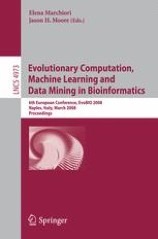
Evolutionary computation, machine learning and data mining in bioinformatics ; 6th European Conference, EvoBIO 2008, Naples, Italy, March 26-28, 2008. Proceedings
The feld of bioinformatics has two main objectives: the creation and main- nance of biological databases, and the discovery of knowledge from life sciences data in order to unravel the mysteries of biological function, leading to new drugs and therapies for human disease. Life sciences data come in the form of biological sequences, structures, pathways, or literature. One major aspect of discovering biological knowledge is to search, predict, or model specifc infortioninagivendatasetinorderto generate new in teresting knowledge.Computer science methods such as evolutionary computation, machine learning, and data mining all have a great deal to ofer the feld of bioinformatics.

Evolutionary computation, machine learning and data mining in bioinformatics ; 5th European Conference, EvoBIO 2007, Valencia, Spain, April 11-13, 2007, Proceedings
This book Covers brings together experts in computer science with experts in bioinformatics and the biological sciences. It presents contributions on fundamental and theoretical issues along with papers dealing with different applications areas.

Euro-Par 2020 : Parallel Processing ; 26th International Conference on Parallel and Distributed Computing, Warsaw, Poland, August 24–28, 2020, Proceedings
This book constitutes the proceedings of the 26th International Conference on Parallel and Distributed Computing, Euro-Par 2020, held in Warsaw, Poland, in August 2020. The conference was held virtually due to the coronavirus pandemic. The 39 full papers presented in this volume were carefully reviewed and selected from 158 submissions. They deal with parallel and distributed computing in general, focusing on support tools and environments; performance and power modeling, prediction and evaluation; scheduling and load balancing; high performance architectures and compilers; data management, analytics and machine learning; cluster, cloud and edge computing; theory and algorithms for parallel and distributed processing; parallel and distributed programming, interfaces, and languages; multicore and manycore parallelism; parallel numerical methods and applications; and accelerator computing.
