



الصفحة 16
الصفحة 16
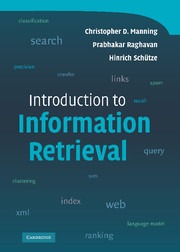
Introduction to information retrieval
Teaches classical and web information retrieval, including web search and the related areas of text classification and text clustering from basic concepts. It gives an up-to-date treatment of all aspects of the design and implementation of systems for gathering, indexing, and searching documents; methods for evaluating systems; and an introduction to the use of machine learning methods on text collections. All the important ideas are explained using examples and figures, making it perfect for introductory courses in information retrieval for advanced undergraduates and graduate students in computer science.
Introduction to Geometric Computing
The geometric ideas in computer science, mathematics, engineering, and physics have considerable overlap and students in each of these disciplines will eventually encounter geometric computing problems. The topic is traditionally taught in mathematics departments via geometry courses, and in computer science through computer graphics modules. This text isolates the fundamental topics affecting these disciplines and lies at the intersection of classical geometry and modern computing.

Introduction to development engineering
Introduces the emerging field of development engineering and its constituent theories, methods, and applications. It is both an instructional text for students and a resource for researchers and practitioners involved in the design and scaling of technologies for low-resource communities. The scope is broad, ranging from the development of mobile applications for low-literacy users to hardware and software solutions for providing electricity and water in remote environments. It is also highly interdisciplinary, drawing on methods and theories from the social sciences as well as engineering and the natural sciences.

Introduction to Cryptography : Principles and Applications
In the first part, this book covers the key concepts of cryptography on an undergraduate level, from encryption and digital signatures to cryptographic protocols. In the second part, more advanced topics are addressed, such as the bit security of one-way functions and computationally perfect pseudorandom bit generators.

Introduction to Computer Graphics : Using Java 2D and 3D
This book introduces the most important basic concepts of computer graphics, coupling the technical background and theory with practical examples and applications throughout. Its user-friendly approach enables the reader to gain understanding through the theory at work, via the many example programs provided. With only elementary knowledge of the programming language Java, the reader will be able to create their own images and animations immediately, using Java 2D and/or Java 3D.

Introduction to C++ : 500+ Difficulty-Scaled Solved Programming Exercises
Includes more than 500 exercises and examples of progressive difficulty to aid the reader in understanding the C++ principles and to see how concepts can materialize in code. The examples are designed to be short, concrete, and substantial, quickly giving the reader the ability to understand how to apply correctly and efficiently the features of the C++ language and to get a solid programming know-how. Rest assured that if you are able to understand this book's examples and solve the exercises, you can safely go on to edit larger programs, you will be able to develop your own applications, and you will have certainly established a solid fundamental conceptual and practical background to expand your knowledge and skills

Introduction to Algorithms
Combines rigor and comprehensiveness. It covers a broad range of algorithms in depth, yet makes their design and analysis accessible to all levels of readers, with self-contained chapters and algorithms in pseudocode. Since the publication of the first edition, Introduction to Algorithms has become the leading algorithms text in universities worldwide as well as the standard reference for professionals. This fourth edition has been updated throughout.

Introduction to Advanced System-on-Chip Test Design and Optimization
SOC test design and its optimization is the topic of Introduction to Advanced System-on-Chip Test Design and Optimization. It gives an introduction to testing, describes the problems related to SOC testing, discusses the modeling granularity and the implementation into EDA (electronic design automation) tools. The book is divided into three sections: i) test concepts, ii) SOC design for test, and iii) SOC test applications.

Introduction pratique aux bases de données relationnelles = A practical introduction to relational databases
Cet ouvrage introduit le lecteur dans le domaine des bases de données relationnelles en présentant une vaste sélection de sujets portant sur la modélisation des données, les langages de base de données, l'architecture des systèmes et l'évolution post-relationnelle. - Notions fondamentales: le modèle relationnel, les composants d’un système de gestion de bases de données, l’organisation de la mise en œuvre d’une base de données, les tâches de gestion des données. - De l'analyse à la base de données : le modèle entité association, la généralisation et l’agrégation, les dépendances et les formes normales,les contraintes d’intégrité. - Aperçu des langages de requête et de manipulation des données: l’algèbre relationnelle, le calcul des prédicats, SQL, QUEL, QBE, le traitement des valeurs nulles, la protection des données. - Les composants de l'architecture d'un système de bases de données : la compilation, l’interprétation et l’optimisation des requêtes, l’environnement multiutilisateur, le concept de transaction et la sérialisation, les méthodes optimiste et pessimiste, les structures de stockage et les méthodes d’accès. L’intégration et la migration des bases de données: l’exploitation des bases de données hétérogènes, les bases de données sur le Web, les règles de conversion pour effectuer l’intégration et la migration, les variantes de migration des bases de données hétérogènes, la planification de l’intégration et de la migration.

Introducing Blockchain Applications : Understand and Develop Blockchain Applications Through Distributed Systems
Deepen your understanding of blockchain technology and develop your own blockchain applications. This book provides a thorough review of distribution-based systems on blockchain technology, starting from the fundamental concepts that underlie it, all the way through the implementation of a blockchain network for business purposes. ou will: Learn the concept of blockchains by way of a practical example Grasp the connection between distributed systems and blockchain technology Learn the design of blockchain with hyperledger fabric Learn the design of cyber-physical systems in a distributed environment

Internet of things. information processing in an increasingly connected world ; First IFIP International Cross-Domain Conference, IFIPIoT 2018, Held at the 24th IFIP World Computer Congress, WCC 2018, Poznan, Poland, September 18-19, 2018, Revised Selected Papers
This book cover a wide range of topics from a technology to a business perspective and include among others hardware, software and management aspects, process innovation, privacy, power consumption, architecture, applications.

Internet of things, artificial intelligence and blockchain technology
Explores the concepts and techniques of IoT, AI, and blockchain. Also discussed is the possibility of applying blockchain for providing security in various domains. The specific highlight of this book is focused on the application of integrated technologies in enhancing data models, better insights and discovery, intelligent predictions, smarter finance, smart retail, global verification, transparent governance, and innovative audit systems. Explains how blockchain can significantly increase data privacy and security while boosting accuracy and integrity in IoT generated data and AI processed information; Gives insight into blockchain’s numerous potential applications, starting with recent technologies that give users control over sharing and privacy; Shows readers how to employ blockchain in IoT and AI, helping them to understand what they can and cannot do with blockchain.

Internet of things from hype to reality : The road to digitization
Presents updated material on its core content: an end-to-end IoT architecture that is comprised of devices, network, compute, storage, platform, applications along with management and security components. As with the second edition, it is organized into six main parts: an IoT reference model; fog computing and the drivers; IoT management and applications; smart services in IoT; IoT standards; and case studies. This edition’s features include overhaul of the IoT Protocols (Chapter 5) to include an expanded treatment of low-power wide area networks including narrow band IoT (NB-IoT) protocol, updated IoT platforms and capabilities (Chapter 7) to include comparison of commercially available platforms (e.g. AWS IoT Platform, Google Cloud IoT Platform, Microsoft Azure IoT Platform, and PTC ThinkWorx), updated security (Chapter 8) to include approaches for securing IoT devices with examples of IoT devices used in security attacks and associated solutions including MUD and DICE, and finally new Appendix B to include six IoT project detailed for students.

Internet and Network Economics ; Vol. 4286 ; 2nd International Workshop, WINE 2006, Patras, Greece, December 15-17, 2006, Proceedings
Constitutes the refereed proceedings of the Second International Workshop on Internet and Network Economics, WINE 2006, held in Patras, Greece in December 2006. The 32 revised full papers presented together with 3 invited talks were carefully reviewed and selected from 79 submissions. The papers contain foundational and mathematical work from theories, methodologies, and applications in computer science, economics, mathematics, and management sciences for solving problems arisen in internet technologies, grid computing, network communication protocols, as well as social economic issues in virtual communities enabled through the World Wide Web.

Internet and network economics ; 4th International Workshop, WINE 2008, Shanghai, China, December 17-20, 2008. Proceedings
This book constitutes the refereed proceedings of the 4th International Workshop on Internet and Network Economics, WINE 2008, held in Shanghai, China, in December 2008.The 68 revised full papers presented together with 10 invited talks were carefully reviewed and selected from 126 submissions. The papers are organized in topical sections on market equilibrium, congestion games, information markets, nash equilibrium, network games, solution concepts, algorithms and optimization, mechanism design, equilibrium, online advertisement, sponsored search auctions, and voting problems.

International Symposium on Fundamentals of Software Engineering ; International Symposium, FSEN 2007, Tehran, Iran, April 17-19, 2007, Proceedings
The present volume contains the post-proceedings of the second IPM Inter- tional Symposium on Fundamentals of Software Engineering (FSEN), Tehran, Iran, April 17–19, 2007. Thissymposium brought together researchers and practitioners working on di?erent aspects of formal methods in software engineering.

Inter-Domain Management ; 1st International conference on autonomous infrastructure, management and security, AIMS 2007, Oslo, Norway, June 21-22, 2007, Proceedings
Therearealreadymanyexcellentconferencesinthe?eldofNetworkofSystem Management : LISA, IM, NOMS, DSOM, Policy Workshop, etc. Although there is an overlap, both in attendance and ideas, AIMS does not compete with any of these. Rather we have sought a strong cross-disciplinary forum, in which novelty and discussion are made paramount. An additional objective of AIMS is to provide a forum for doctoral students, the future leaders of our research, to discuss their research with a wider audience and receive training to help make their research careers successful.
Interdisciplinary Insights for Digital Touch Communication
The book concludes with a discussion of the significance of social understanding and methods in the context of Interdisciplinary collaborations to explore touch, towards the design of digital touch communication, ‘ways of feeling’, that are useable, appropriate, ethical and socially aware.

Intercultural Collaboration ; 1st International Workshop, IWIC 2007 Kyoto, Japan, January 25-26, 2007 Invited and Selected Papers
This book presents 29 revised invited and selected lectures given by top-researchers at the First International Workshop on Intercultural Collaboration, IWIC 2007, held in Kyoto, Japan in January 2007.

Interconnect-Centric Design for Advanced SoC and NoC
In Interconnect-centric Design for Advanced SoC and NoC, we have tried to create a comprehensive understanding about on-chip interconnect characteristics, design methodologies, layered views on different abstraction levels and finally about applying the interconnect-centric design in system-on-chip design.
