



الصفحة 15
الصفحة 15

Android programming : The big Nerd Ranch guide (Big Nerd Ranch Guides)
For programmers with Kotlin experience. Based on Big Nerd Ranch's popular Android Bootcamp, this guide will lead you through the wilderness using hands-on example apps combined with clear explanations of key concepts and APIs. This book focuses on practical techniques for developing apps in Kotlin compatible with Android 7.0 (Nougat) through Android 12 and beyond. Write and run code every step of the way, using Android Studio to create apps that integrate with other apps, download and display pictures from the web, store data in databases, and more. Learn about the latest patterns and techniques, including Kotlin coroutines and Jetpack Compose, a new way to build Android UIs.

Android Programming : The Big Nerd Ranch Guide
An introductory Android book for programmers with Java experience. Based on Big Nerd Ranch’s popular Android Bootcamp course, this guide will lead you through the wilderness using hands-on example apps combined with clear explanations of key concepts and APIs. This book focuses on practical techniques for developing apps compatible with all versions of Android widely used today (Android 2.2 - 4.2). Write and run code every step of the way – creating apps that catalog crime scenes, browse photos, track your jogging route, and more.
Anaphora : Analysis, Algorithms and Applications ; 6th Discourse Anaphora and Anaphor Resolution Colloquium, DAARC 2007, Lagos Portugal, March 29-30, 2007, Selected Papers
This book presented sections on human processing and performance, language analysis and representation, resolution methodology and algorithms, as well as computational systems and applications.
An Introduction to Language Processing with Perl and Prolog : An Outline of Theories, Implementation, and Application with Special Consideration of English, French, and German
This book teaches the principles of natural language processing, first covering linguistics issues such as encoding, entropy, and annotation schemes; defining words, tokens and parts of speech; and morphology. It then details the language-processing functions involved, including part-of-speech tagging using rules and stochastic techniques; using Prolog to write phase-structure grammars; parsing techniques and syntactic formalisms; semantics, predicate logic and lexical semantics; and analysis of discourse, and applications in dialog systems. The key feature of the book is the author's hands-on approach throughout, with extensive exercises, sample code in Prolog and Perl, and a detailed introduction to Prolog. The reader is supported with a companion website that contains teaching slides, programs, and additional material.
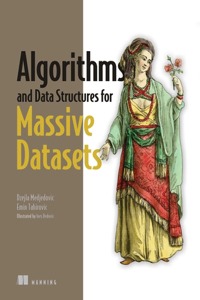
Algorithms and data structures for massive datasets
Learn: Probabilistic sketching data structures for practical problems Choosing the right database engine for your application Evaluating and designing efficient on-disk data structures and algorithms Understanding the algorithmic trade-offs involved in massive-scale systems Deriving basic statistics from streaming data Correctly sampling streaming data Computing percentiles with limited space resources Algorithms and Data Structures for Massive Datasets reveals a toolbox of new methods that are perfect for handling modern big data applications. You'll explore the novel data structures and algorithms that underpin Google, Facebook, and other enterprise applications that work with truly massive amounts of data. These effective techniques can be applied to any discipline, from finance to text analysis. Graphics, illustrations, and hands-on industry examples make complex ideas practical to implement in your projects--and there's no mathematical proofs to puzzle over. Work through this one-of-a-kind guide, and you'll find the sweet spot of saving space without sacrificing your data's accuracy. About the Technology Standard algorithms and data structures may become slow--or fail altogether--when applied to large distributed datasets. Choosing algorithms designed for big data saves time, increases accuracy, and reduces processing cost.
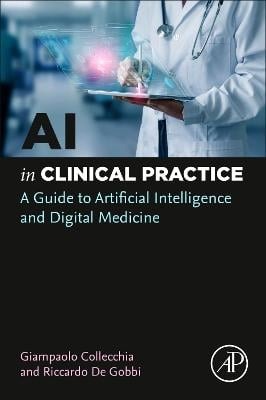
AI in clinical practice : A guide to artificial intelligence and digital medicine
Explains how artificial intelligence is applied to medicine, illustrating not only its enormous potential but also ancillary issues and the limits and risks inherent in its use on a large scale. The book focuses on the intersection between medicine and AI and its implications on the impact of human health care delivery. Topics discussed include wearable devices, health data, Internet of Things, virtual reality, robotic assistance system, and digital intelligence in the health sector. Additionally, sections discuss diagnostics and decision-making systems and machine/deep learning in clinical setting.
AI in banking : Practical applications and case studies
Delves into the application of AI from theory to practice, offering detailed insights into AI project design and code implementation across eleven business scenarios in four major sectors: retail banking, e-banking, bank credit, and tech operations. it provides hands-on examples of various technologies, including automatic machine learning, integrated learning, graph computation, recommendation systems, causal inference, generative adversarial networks, supervised learning, unsupervised learning, computer vision, reinforcement learning, fuzzy control, automatic control, speech recognition, semantic understanding, bayesian networks, edge computing, and more. this book stands as a rare and practical guide to AI projects in the banking industry.

Agile processes in software engineering and extreme programming ; 19th International Conference, XP 2018, Porto, Portugal, May 21–25, 2018, Proceedings
This open access book constitutes the proceedings of the 19th International Conference on Agile Software Development, XP 2018, held in Porto, Portugal, in May 2018. XP is the premier agile software development conference combining research and practice, and XP 2018 provided a playful and informal environment to learn and trigger discussions around its main theme – make, inspect, adapt. The 21 papers presented in this volume were carefully reviewed and selected from 62 submissions. They were organized in topical sections named: agile requirements; agile testing; agile transformation; scaling agile; human-centric agile; and continuous experimentation.
Agent-mediated electronic commerce VI ; Theories for and engineering of distributed mechanisms and systems, AAMAS 2004 Workshop, Amec 2004, New York, NY, USA, July 19, 2004, revised selected papers
The design of intelligent trading agents, mechanisms, and systems has receivedgrowing atttention in the agents and multiagent systems communities in aneffort to address the increasing costs of search, transaction, and coordinationwhich follows from the increasing number of Internet-enabled distibuted elec-tronic markets. Furthermore, new technologies and supporting business modelsare resulting in a growing volume of open and horizontally integrated markets fortrading of an increasingly diverse set of goods and services. However, growth oftechnologies for such markets requires innovative solutions to a diverse set of ex-isting and novel technical problems which we are only beginning to understand.Specifically, distributed markets present not only traditional

Agent Computing and Multi-Agent Systems ; 9th Pacific Rim International Workshop on Multi-Agents, PRIMA 2006, Guilin, China, August 7-8, 2006, Proceedings
PRIMA is a series of workshops on agent computing and multi-agent systems, integrating the activities in Asia and Pacific Rim countries. Agent computing and multi-agent systems are computational systems in which several autonomous or se- autonomous agents interact with each other or work together to perform some set of tasks or satisfy some set of goals. These systems may involve computational agents that are homogeneous or heterogeneous, they may involve activities on the part of agents having common or distinct goals, and they may involve participation on the part of humans and intelligent agents. The aim of PRIMA 2006 was to bring together Asian and Pacific Rim researchers and developers from academia and industry to report on the latest technical advances or domain applications and to discuss and explore scientific and practical problems as raised by the participants. PRIMA 2006 received 203 submitted papers.

Advances in neural networks - ISNN 2006 ; Vol.3973 : 3rd International symposium on Neural Networks, ISNN 2006, Chengdu, China, May 28 - June 1, 2006, Proceedings, Part III
Constitute the Proceedings of the Third International Symposium on Neural Networks (ISNN 2006) held in Chengdu in southwestern China during May 28–31, 2006. After a successful ISNN 2004 in Dalian and ISNN 2005 in Chongqing, ISNN became a well-established series of conferences on neural computation in the region with growing popularity and improving quality. ISNN 2006 received 2472 submissions from authors in 43 countries and regions,Based on rigorous reviews, 616 high-quality papers were selected for publication in the proceedings with the acceptance rate being less than 25%. The papers are organized in 27 cohesive sections covering all major topics of neural network research and development. In addition to the numerous contributed papers, ten distinguished scholars gave plenary speeches .

Advances in neural networks - ISNN 2006 ; Vol. 3972 : 3rd International symposium on neural networks, ISNN 2006, Chengdu, China, May 28 - June 1, 2006, Proceedings, Part II
Constitute the Proceedings of the Third International Symposium on Neural Networks (ISNN 2006) held in Chengdu in southwestern China during May 28–31, 2006. After a successful ISNN 2004 in Dalian and ISNN 2005 in Chongqing, ISNN became a well-established series of conferences on neural computation in the region with growing popularity and improving quality. ISNN 2006 received 2472 submissions from authors in 43 countries and regions,Based on rigorous reviews, 616 high-quality papers were selected for publication in the proceedings with the acceptance rate being less than 25%. The papers are organized in 27 cohesive sections covering all major topics of neural network research and development. In addition to the numerous contributed papers, ten distinguished scholars gave plenary speeches .

Advances in neural networks - ISNN 2006 ; Vol. 3971 : 3rd International symposium on neural networks, ISNN 2006, Chengdu, China, May 28 - June 1, 2006, Proceedings, Part I
This book and its sister volumes constitute the Proceedings of the Third International Symposium on Neural Networks (ISNN 2006) held in Chengdu in southwestern China during May 28–31, 2006. After a successful ISNN 2004 in Dalian and ISNN 2005 in Chongqing, ISNN became a well-established series of conferences on neural computation in the region with growing popularity and improving quality. ISNN 2006 received 2472 submissions from authors in 43 countries and regions,Based on rigorous reviews, 616 high-quality papers were selected for publication in the proceedings with the acceptance rate being less than 25%. The papers are organized in 27 cohesive sections covering all major topics of neural network research and development. In addition to the numerous contributed papers, ten distinguished scholars gave plenary speeches .

Advances in natural language processing ; 6th International Conference, GoTAL 2008 Gothenburg, Sweden, August 25-27, 2008 Proceedings
This book constitutes the refereed proceedings of the 6th International Conference on Natural Language Processing, GoTAL 2008, Gothenburg, Sweden, August 2008.
Advances in natural language processing ; 5th International Conference ; 1TAL 2006 Turku, Finland, August 23-25, 2006 Proceedings
This book constitutes the refereed proceedings of the 5th International Conference on Natural Language Processing, FinTAL 2006, held in Turku, Finland in August 2006. The book presents 72 revised full papers together with 1 invited talk and the extended abstracts of 2 invited keynote addresses. The papers address all current issues in computational linguistics and monolingual and multilingual intelligent language processing - theory, methods and applications.
Advances in Multilingual and Multimodal Information Retrieval ; 8th Workshop of the Cross-Language Evaluation Forum, CLEF 2007, Budapest, Hungary, September 19-21, 2007, Revised Selected Papers
This book constitutes the thoroughly refereed proceedings of the 8th Workshop of the Cross-Language Evaluation Forum, CLEF 2007, held in Budapest, Hungary, September 2007.
Advances in Knowledge Acquisition and Management ; Pacific Rim Knowledge Acquisition Workshop, PKAW 2006, Guilin, China, August 7-8, 2006 : Revised Selected Papers
In recent years, a significant interest developed regarding the problem of constructing ontologies. Of particular interest have been ontologies that could be re-used in a number of ways and could possibly be shared across diff- ent users as well as domains. The Pacific Knowledge Acquisition Workshops (PKAW) have a long tradition in providing a forum for researchers to exchange the latest ideas on the topic. Parti- pants come from all over the world but with a focus on the Pacific Rim region. PKAW is one of three international knowledge acquisition workshop series held in the Pacific-Rim, Canada and Europe over the last two decades. The previous Pacific Knowledge Acquisition Workshop, PKAW 2004, had a strong emphasis on inc- mental knowledge acquisition, machine learning, neural networks and data mining.

Advances in computer science - ASIAN 2004 : Higher level decision making ; 9th Asian computing ccience conference ; Dedicated to Jean-Louis Lassez on the occasion of his 5th cycle birthday, Chiang Mai, Thailand, December 8-10, 2004
Constitutes the proceedings of the 9th Asian Computing Science Conference was held in Chiang Mai in Decem-ber 2004. This volume contains papers that were presented at that conference. Its theme was “higher-level decision-making”.Philippe Flajolet was invited to give the opening keynote address, whileYuzuru Tanaka and Phillip Rogaway werealso keynote speakers. In additionto the keynote speakers, distinguished colleagues of Jean-Louis Lassez were in-vited to present talks in his honour. Many of those talks are represented bypapers in this volume, this book Include Topics : Theory of Computation / Artificial Intelligence / Software Engineering / Programming and Operating Systems / Cryptology / Discrete Mathematics in Computer Science / Information Systems Applications (incl. Internet)
Advances in Computational Collective Intelligence ; 12th International Conference, ICCCI 2020, Da Nang, Vietnam, November 30 – December 3, 2020, Proceedings
Constitutes refereed proceedings of the 12th International Conference on International Conference on Computational Collective Intelligence, ICCCI 2020, held in Da Nang, Vietnam, in November – December 2020. Due to the the COVID-19 pandemic the conference was held online. The 68 papers were thoroughly reviewed and selected from 314 submissions. The papers are organized according to the following topical sections: data mining and machine learning; deep learning and applications for industry 4.0; recommender systems; computer vision techniques; decision support and control systems; intelligent management information systems; innovations in intelligent systems; intelligent modeling and simulation approaches for games and real world systems; experience enhanced intelligence to IoT; data driven IoT for smart society; applications of collective intelligence; natural language processing; low resource languages processing; computational collective intelligence and natural language processing.
Advanced functional programming ; 5th International School, AFP 2004, Tartu, Estonia, August 14-21, 2004, Revised Lectures
Contains the revised lecture notes corresponding to nine of thelecture courses presented at the 5th International School on Advanced Functional Programming, AFP 2004, held in Tartu, Estonia, August 14–21, 2004. The goal of the AFP schools is to inform the wide international communitiesof computer science students and software production professionals about thenew and important developments in the area of functional programming. The schools put a special emphasis on practical applications of advanced techniques.
