



الصفحة 14
الصفحة 14

Machine Learning Techniques for Multimedia : Case Studies on Organization and Retrieval
This book provides a comprehensive coverage of the most important machine learning techniques used and their application in this domain. Arising from the EU MUSCLE network, a program that drew together multidisciplinary teams with expertise in machine learning, pattern recognition, artificial intelligence, and image, video, text and crossmedia processing, the book first introduces the machine learning principles and techniques that are applied in multimedia data processing and analysis. The second part focuses on multimedia data processing applications, with chapters examining specific machine learning issues in domains .

Machine Learning Techniques and Analytics for Cloud Security
covers new methods, surveys, case studies, and policy with almost all machine learning techniques and analytics for cloud security solutions

Machine Learning for Multimedia Content Analysis
Challenges in complexity and variability of multimedia data have led to revolutions in machine learning techniques. Multimedia data, such as digital images, audio streams and motion video programs, exhibit richer structures than simple, isolated data items. A number of pixels in a digital image collectively conveys certain visual content to viewers. A TV video program consists of both audio and image streams that unfold the underlying story. To recognize the visual content of a digital image, or to understand the underlying story of a video program, we may need to label sets of pixels or groups of image and audio frames jointly.
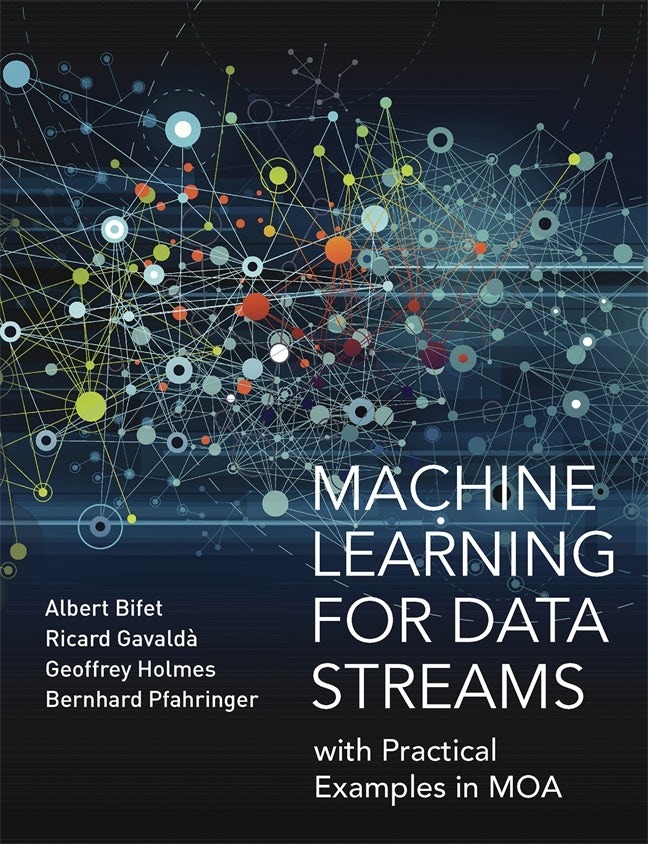
Machine learning for data streams : With practical examples in MOA
The book first offers a brief introduction to the topic, covering big data mining, basic methodologies for mining data streams, and a simple example of MOA. More detailed discussions follow, with chapters on sketching techniques, change, classification, ensemble methods, regression, clustering, and frequent pattern mining. Most of these chapters include exercises, an MOA-based lab session, or both. Finally, the book discusses the MOA software, covering the MOA graphical user interface, the command line, use of its API, and the development of new methods within MOA.

Machine learning for cyber security ; 3rd International Conference, ML4CS 2020, Guangzhou, China, October 8–10, 2020, Proceedings, Part III
Constitutes the proceedings of the Third International Conference on Machine Learning for Cyber Security, ML4CS 2020, held in Xi’an, China in October 2020. The 118 full papers and 40 short papers presented were carefully reviewed and selected from 360 submissions. The papers offer a wide range of the following subjects: Machine learning, security, privacy-preserving, cyber security, Adversarial machine Learning, Malware detection and analysis, Data mining, and Artificial Intelligence.

Machine Learning for Cyber Security ; 3rd International Conference, ML4CS 2020, Guangzhou, China, October 8–10, 2020, Proceedings, Part II
Constitutes the proceedings of the Third International Conference on Machine Learning for Cyber Security, ML4CS 2020, held in Xi’an, China in October 2020. The 118 full papers and 40 short papers presented were carefully reviewed and selected from 360 submissions. The papers offer a wide range of the following subjects: Machine learning, security, privacy-preserving, cyber security, Adversarial machine Learning, Malware detection and analysis, Data mining, and Artificial Intelligence.

Machine Learning for Cyber Security ; 3rd International Conference, ML4CS 2020, Guangzhou, China, October 8–10, 2020, Proceedings, Part I
Constitutes the proceedings of the Third International Conference on Machine Learning for Cyber Security, ML4CS 2020, held in Xi’an, China in October 2020. The 118 full papers and 40 short papers presented were carefully reviewed and selected from 360 submissions. The papers offer a wide range of the following subjects: Machine learning, security, privacy-preserving, cyber security, Adversarial machine Learning, Malware detection and analysis, Data mining, and Artificial Intelligence.

Machine Learning and Knowledge Extraction ; 5th IFIP TC 5, TC 12, WG 8.4, WG 8.9, WG 12.9 International Cross-Domain Conference, CD-MAKE 2021, Virtual Event, August 17–20, 2021, Proceedings
Constitutes the refereed proceedings of the 5th IFIP TC 5, TC 12, WG 8.4, WG 8.9, WG 12.9 International Cross-Domain Conference, CD-MAKE 2021, held in virtually in August 2021. The 20 full papers and 2 short papers presented were carefully reviewed and selected from 48 submissions. The cross-domain integration and appraisal of different fields provides an atmosphere to foster different perspectives and opinions; it will offer a platform for novel ideas and a fresh look on the methodologies to put these ideas into business for the benefit of humanity.

Machine Learning and Knowledge Discovery in Databases ; European Conference, ECML PKDD 2008, Antwerp, Belgium, September 15-19, 2008, Proceedings, Part II
Constitutes the refereed proceedings of the joint conference on Machine Learning and Knowledge Discovery in Databases: ECML PKDD 2008, held in Antwerp, Belgium, in September 2008.The 100 papers presented in two volumes, together with 5 invited talks, were carefully reviewed and selected from 521 submissions. In addition to the regular papers the volume contains 14 abstracts of papers appearing in full version in the Machine Learning Journal and the Knowledge Discovery and Databases Journal of Springer.

Machine Learning and Knowledge Discovery in Databases ; European Conference, ECML PKDD 2008, Antwerp, Belgium, September 15-19, 2008, Proceedings, Part I
Constitutes the refereed proceedings of the joint conference on Machine Learning and Knowledge Discovery in Databases: ECML PKDD 2008, held in Antwerp, Belgium, in September 2008.The 100 papers presented in two volumes, together with 5 invited talks, were carefully reviewed and selected from 521 submissions. In addition to the regular papers the volume contains 14 abstracts of papers appearing in full version in the Machine Learning Journal and the Knowledge Discovery and Databases Journal of Springer.

Machine learning and data mining for sports analytics ; 7th international workshop, MLSA 2020, Co-located with ECML/PKDD 2020, Ghent, Belgium, September 14–18, 2020, Proceedings
Constitutes the refereed post-conference proceedings of the 7th International Workshop on Machine Learning and Data Mining for Sports Analytics, MLSA 2020, colocated with ECML/PKDD 2020, in Ghent, Belgium, in September 2020. The 11 papers presented were carefully reviewed and selected from 22 submissions. The papers present a variety of topics within the area of sports analytics, including tactical analysis, outcome predictions, data acquisition, performance optimization, and player evaluation.

Machine Learning : ECML 2005 ; 16th European Conference on Machine Learning, Porto, Portugal, October 3-7, 2005, Proceedings
The European Conference on Machine Learning (ECML) and the European Conference on Principles and Practice of Knowledge Discovery in Databases (PKDD) were jointly organized this year for the ?fth time in a row, after some years of mutual independence before. After Freiburg (2001), Helsinki (2002), Cavtat (2003) and Pisa (2004), Porto received the 16th edition of ECML and the 9th PKDD in October 3–7. Having the two conferences together seems to be working well: 585 di?erent paper submissions were received for both events, which maintains the high s- mission standard of last year. Of these, 335 were submitted to ECML only, 220 to PKDD only and 30 to both. Such a high volume of scienti?c work required a tremendous e?ort from Area Chairs, Program Committee members and some additional reviewers. On average, PC members had 10 papers to evaluate, and Area Chairs had 25 papers to decide upon. We managed to have 3 highly qualified independent reviews per paper (with very few exceptions) and one additional overall input from one of the Area Chairs. After the authors’ responses and the online discussions for many of the papers, we arrived at the ?nal selection of 40 regular papers for ECML and 35 for PKDD. Besides these, 32 others were accepted as short papers for ECML and 35 for PKDD. This represents a joint acceptance rate of around 13% for regular papers and 25% overall.
Long-Term Preservation of Digital Documents : Principles and Practices
Key to our culture is that we can disseminate information, and then maintain and access it over time. While we are rapidly advancing from vulnerable physical solutions to superior, digital media, preserving and using data over the long term involves complicated research challenges and organization efforts. Uwe Borghoff and his coauthors address the problem of storing, reading, and using digital data for periods longer than 50 years. They briefly describe several markup and document description languages like TIFF, PDF, HTML, and XML, explain the most important techniques such as migration and emulation, and present the OAIS (Open Archival Information System) Reference Model. To complement this background information on the technology issues the authors present the most relevant international preservation projects, such as the Dublin Core Metadata Initiative, and experiences from sample projects run by the Cornell University Library and the National Library of the Netherlands. A rated survey list of available systems and tools completes the book.

Logical foundations of computer science ; International Symposium, LFCS 2007, New York, NY, USA, June 4-7, 2007, Proceedings
Constitutes the refereed proceedings of the International Symposium on Logical Foundations of Computer Science, LFCS 2007, held in New York, NY, USA in June 2007. The volume presents 36 revised refereed papers that address all current aspects of logic in computer science.
Logical Data Modeling : What it is and How to do it
LOGICAL DATA MODELING: What It Is and How To Do IT is directed toward three groups of people: (1) Business subject matter experts, (2) information technology professionals, (3) advanced students in Computer Science, Management Information Systems, and e-Business. Its purpose is to outline the basics of logical data modeling—specifically, data modeling for relational database management systems—in simple, practical terms and in a business context. The focus on relational data modeling is consciously made because it is superior in modeling real business activities.
Logical and Relational Learning
This textbook covers logical and relational learning in depth, and hence provides an introduction to inductive logic programming (ILP), multirelational data mining (MRDM) and (statistical) relational learning (SRL). These subfields of data mining and machine learning are concerned with the analysis of complex and structured data sets that arise in numerous applications, such as bio- and chemoinformatics, network analysis, Web mining, natural language processing, within the rich representations offered by relational databases and computational logic.

Logic, Language, and Computation ; 6th International Tbilisi Symposium on Logic, Language, and Computation. Batumi, Georgia, September 12-16, 2005, Revised Selected Papers
Edited in collaboration with FoLLI, the Association of Logic, Language and Information, this book constitutes the second volume of the FoLLI LNAI subline. It represents the thoroughly refereed post-proceedings of the 6th International Tbilisi Symposium on Logic, Language, and Computation, TbiLLC 2005, held in Batumi, Georgia, in September 2005.

Logic Programming and Nonmonotonic Reasoning ; 9th International Conference, LPNMR 2007, Tempe, AZ, USA, May 15-17, 2007, Proceedings
This book constitutes the refereed proceedings of the 9th International Conference on Logic Programming and Nonmonotonic Reasoning, LPNMR 2007, held in Tempe, AZ, USA, May 2007.

Logic Programming and Nonmonotonic Reasoning ; 8th International Conference, LPNMR 2005, Diamante, Italy, September 5-8, 2005, Proceedings
Thesearetheproceedingsofthe8thInternational Conference on Logic Progr- mingandNonmonotonicReasoning (LPNMR2005).Followingthepreviousones held in Washington, DC, USA (1991), Lisbon, Portugal (1993), Lexington, KY, USA(1995), Dagstuhl, Germany(1997), ElPaso, TX, USA(1999), Vienna, A- tria (2001) and Ft. Lauderdale, FL, USA (2004), the eighth conference was held in Diamante, Italy, from 5th to 8th of September 2005. TheaimoftheLPNMRconferencesistobringtogetherandfacilitateinter- tions between active researchers interested in all aspects concerning declarative logic programming, nonmonotonic reasoning, knowledge representation, and the design of logic-based systems and database systems. LPNMR strives to enc- pass theoretical and experimental studies that lead to the implementation of practi...

Location- and context-awareness ; 3rd International Symposium, LoCA 2007, Oberpfaffenhofen, Germany, September 20-21, 2007, Proceedings
These proceedings contain the papers presented at the 3rd International S- posium on Location- and Context-Awareness in September of 2007. Computing has become mobile, wireless, and portable. The rangeof contexts encountered while sitting at a desk working on a computer is very limited c- pared to the large variety of situations experienced away from the desktop.
