



الصفحة 14
الصفحة 14
e-Learning, e-Education, and Online Training ; 6th EAI International Conference, eLEOT 2020, Changsha, China, June 20-21, 2020, Proceedings, Part II
Constitutes the proceedings of the 6th International Conference on e-Learning, e-Education, and Online Training, eLEOT 2020, held in Changsha, China, in June 2020. The conference was held virtually due to the COVID-19 pandemic. The 68 full papers presented were carefully reviewed and selected from 141 submissions. They focus on most recent and innovative trends and new technologies in for educational modernization, such as artificial intelligence and big data. The theme of eLEOT 2020 was “Education with New Generation Information Technology”.
e-Learning, e-Education, and Online Training ; 6th EAI International Conference, eLEOT 2020, Changsha, China, June 20-21, 2020, Proceedings, Part I
Constitutes the proceedings of the 6th International Conference on e-Learning, e-Education, and Online Training, eLEOT 2020, held in Changsha, China, in June 2020. The conference was held virtually due to the COVID-19 pandemic. The 68 full papers presented were carefully reviewed and selected from 141 submissions. They focus on most recent and innovative trends and new technologies in for educational modernization, such as artificial intelligence and big data. The theme of eLEOT 2020 was “Education with New Generation Information Technology”.

E-Learning Methodologies : Fundamentals, technologies and applications
Covers state of the art topics including user modeling for e-learning systems and cloud, IOT, and mobile-based frameworks. It also considers security challenges and ethical conduct using Blockchain technology. E-learning has become an important part of our educational life with the development of e-learning systems and platforms and the need for online and remote learning. ICT and computational intelligence techniques are being used to design more intelligent and adaptive systems. However, the art of designing good real-time e-learning systems is difficult as different aspects of learning need to be considered including challenges such as learning rates, involvement, knowledge, qualifications, as well as networking and security issues. The earlier concepts of standalone integrated virtual e-learning systems have been greatly enhanced with emerging technologies such as cloud computing, mobile computing, big data, Internet of Things (IoT), AI and machine learning, and AR/VT technologies.
E-Government Ict Professionalism and Competences Service Science ; IFIP 20th World Computer Congress, Industry Oriented Conferences, September 7-10, 2008, Milano, Italy
The IFIP series publishes state-of-the-art results in the sciences and technologies of information and communication. The principal aim of the IFIP series is to encourage education and the dissemination and exchange of information about all aspects of computing.

Efficient Learning Machines : Theories, Concepts, and Applications for Engineers and System Designers
Machine learning techniques provide cost-effective alternatives to traditional methods for extracting underlying relationships between information and data and for predicting future events by processing existing information to train models. Efficient Learning Machines explores the major topics of machine learning, including knowledge discovery, classifications, genetic algorithms, neural networking, kernel methods, and biologically-inspired techniques.

Education for the 21st Century - Impact of ICT and Digital Resources ; IFIP 19th World Computer Congress, TC-3 Education, August 21-24, 2006, Santiago, Chile
The IFIP series publishes state-of-the-art results in the sciences and technologies of information and communication. The scope of the series includes: foundations of computer science; software theory and practice; education; computer applications in technology; communication systems; systems modeling and optimization; information systems; computers and society; computer systems technology; security and protection in information processing systems; artificial intelligence; and human-computer interaction. Proceedings and post-proceedings of referred international conferences in computer science and interdisciplinary fields are featured.

Earthquake alert with smartwatch = تنبيه الزلازل باستخدام الساعة الذكية
After the recent events and earthquakes that affected the region, resulting in the deaths of many individuals due to the lack of timely emergency response, the idea for this project emerged Earthquake Alert with Smartwatch. Initially, our application gathers information about the user, such as age, family members, and any existing medical conditions. In the event of an earthquake, the application sends an alert to the user. It receives earthquake information, such as ‘magnitude, time, location…’ from United States Geological Survey “USGS” through an API. If the user is within the geographical area affected by the earthquake, the application will assist the Smartwatch in calculating vital signs such as ‘heart rate and blood pressure’. Additionally, there is another artificial intelligence model that receives the user's audio recordings and converts them into written texts. All this information, along with the user's geographical location, will be sent to the nearest emergency point for the purpose of aiding those individuals trapped under the rubble.

Earth Observation Open Science and Innovation
The digital transformation is revolutionizing our ability to monitor our planet and transforming the way we access, process and exploit Earth Observation data from satellites.This book reviews these megatrends and their implications for the Earth Observation community as well as the wider data economy. It provides insight into new paradigms of Open Science and Innovation applied to space data, which are characterized by openness, access to large volume of complex data, wide availability of new community tools, new techniques for big data analytics such as Artificial Intelligence, unprecedented level of computing power, and new types of collaboration among researchers, innovators, entrepreneurs and citizen scientists. In addition, this book aims to provide readers with some reflections on the future of Earth Observation, highlighting through a series of use cases not just the new opportunities created by the New Space revolution, but also the new challenges that must be addressed in order to make the most of the large volume of complex and diverse data delivered by the new generation of satellites.
Dynamic Spectrum Management : From Cognitive Radio to Blockchain and Artificial Intelligence
This book, authored by a world-leading researcher in this field, describes fundamentals of dynamic spectrum management, provides a systematic overview on the enabling technologies covering cognitive radio, blockchain, and artificial intelligence, and offers valuable guidance for designing advanced wireless communications systems.

Dynamic brain : From neural spikes to behaviors ; 12th International Summer School on Neural Networks, Erice, Italy, December 5-12, 2007, Revised Lectures
The volume presents 12 thoroughly revised tutorial papers based on lectures given by leading researchers at the 12th International Summer School on Neural Networks in Erice, Italy, in December 2007.

Drousi: A private lessons management system
Private teaching is considered to be an effective way to increase academic achievement of students and it seen as being a supplementary education, so it has become very common all around the world, however, previous studies have come to different conclusions regarding its necessity, so Drousi application had been made ,it’s a user-friendly mobile application to manage and arrange private lessons, and There has never been a better time to become a private tutor, as class sizes in schools increase, this can result in teachers being unable to give their undivided attention to students, and this document lays out a project plan for the development of “Drousi”, The plan will include a summary of the system functionality and how it implemented.

DNA Computing ; 13th International Meeting on DNA Computing, DNA13, Memphis, TN, USA, June 4-8, 2007, Revised Selected Papers
This book constitutes the thoroughly refereed postproceedings of the 13th International Meeting on DNA Computing, DNA 13, held in Memphis, TN, USA, June 4-8, 2007.

Distributed Search by Constrained Agents : Algorithms, Performance, Communication
This book presents a comprehensive discussion on the field of distributed constraints, its algorithms and its active research areas. It introduces distributed constraint satisfaction and optimization problems and proceeds to present a complete state-of-the-art in DisCSP & DisCOP research.

Distributed computing and internet technology ; 17th International Conference, ICDCIT 2021, Bhubaneswar, India, January 7–10, 2021, Proceedings
This book constitutes the proceedings of the 17th International Conference on Distributed Computing and Internet Technology, ICDCIT 2020, held in Bhubaneswar, India, in January 2021. The 13 full papers presented together with 4 short papers were carefully reviewed and selected from 99 submissions. The papers were organized in topical sections named: invited talks, cloud computing and networks, distributed algorithms, concurrency and parallelism, graph algorithms and security, social networks and machine learning, and short papers.
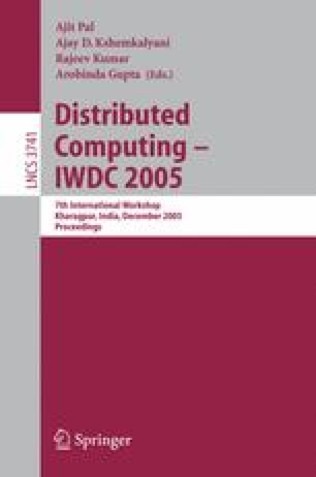
Distributed computing – IWDC 2005 ; 7th International Workshop, Kharagpur, India, December 27-30, 2005, Proceedings
This book constitutes the refereed proceedings of the 7th International Workshop on Distributed Computing, IWDC 2004, held in Kharagpur, India in December 2005. The 28 revised full papers and 33 revised short papers presented together with 5 invited keynote talks were carefully reviewed and selected from 253 submissions. The papers are organized in topical sections on theory of distributed computing, sensor networks, fault tolerance, optical networks, peer-to-peer networks, wireless networks, network security, grid and networks, middleware and data management, mobility management, and distributed artificial intelligence.

Distributed artificial intelligence ; 2nd International conference, DAI 2020, Nanjing, China, October 24–27, 2020, Proceedings
This book constitutes the refereed proceedings of the Second International Conference on Distributed Artificial Intelligence, DAI 2020, held in Nanjing, China, in October 2020. The 9 full papers presented in this book were carefully reviewed and selected from 22 submissions. DAI aims at bringing together international researchers and practitioners in related areas including general AI, multiagent systems, distributed learning, computational game theory, etc., to provide a single, high-profile, internationally renowned forum for research in the theory and practice of distributed AI.

Disruptive trends in automation technology
The industrial sector is being transformed by the convergence of information technology and operational technology. The latter is another name for automation technology and covers established systems such as supervisory control and data acquisition (SCADA), programmable logic controllers (PLC), fieldbuses, and automation and control systems. As this technology is connected to the Internet and 5G networks, some monitoring, control, and analytic functionalities are deployed to the edge or cloud, and researchers are challenged to ensure the security, dependability, real-time performance, and maintainability of the resulting systems. The big data that is accessible from these systems create opportunities for artificial intelligence applications that can further disrupt the established practices in the automation domain.

Discovery Science ; 11th International Conference, DS 2008, Budapest, Hungary, October 13-16, 2008. Proceedings
This book constitutes the refereed proceedings of the 11th International Conference on Discovery Science, DS 2008, held in Budapest, Hungary, in October 2008, co-located with the 19th International Conference on Algorithmic Learning Theory, ALT 2008.

Digitization of healthcare data using blockchain
Gives a detailed description of the integration of blockchain technology for Electronic Health Records and provides the research challenges to consider in various disciplines such as supply chain, drug discovery, and data management. he aim of the book is to investigate the concepts of blockchain technology and its association with the recent development and advancements in the medical field. Moreover, it focuses on the integration of workflow strategies like NLP, and AI which could be adopted for boosting the clinical documentation and electronic healthcare records (EHR) usage by bringing down the physician EHR data entry. Also, the book covers the usage of smart contracts for securing patient records. Digitization of Healthcare Data Using Blockchain presents the practical implementations that deal with developing a web framework for building highly usable healthcare applications, a simple blockchain-powered EHR system.

Digital twin : Architectures, networks, and applications
Offers comprehensive, self-contained knowledge on digital twin (DT), which is a very promising technology for achieving digital intelligence in the next-generation wireless communications and computing networks. DT is a key technology to connect physical systems and digital spaces in Metaverse. The objectives of this book are to provide the basic concepts of DT, to explore the promising applications of DT integrated with emerging technologies, and to give insights into the possible future directions of DT. For easy understanding, this book also presents several use cases for DT models and applications in different scenarios. The book starts with the basic concepts, models, and network architectures of DT. Then, we present the new opportunities when DT meets edge computing, Blockchain and Artificial Intelligence, and distributed machine learning (e.g., federated learning, multi-agent deep reinforcement learning).
