



الصفحة 14
الصفحة 14

Information Access through Search Engines and Digital Libraries
he Information Management Systems group at the University of Padua, led by Maristella Agosti, has been a major contributor to information retrieval (IR) and digital libraries for nearly twenty years. This group has gained an excellent reputation in the IR community and has produced some of the best-known IR researchers, whose work spans a broad range of topics.The papers in this book deal with e.g. automated text categorizations, web link analysis algorithms, retrieval in multimedia digital libraries, and multilingual information retrieval. The presentation of original research results built on the past work of the group which at the same time summarizes past .

Informatics in Control, Automation and Robotics II
Informatics in Control, Automation and Robotics II is a collection of the best papers presented at the 2nd International Conference on Informatics in Control, Automation and Robotics (ICINCO). The purpose of ICINCO was to bring together researchers, engineers and practitioners interested in the application of informatics to Control, Automation and Robotics.

Informatics in Control, Automation and Robotics I
The present book includes a set of selected papers from the first “International Conference on Informatics in Control Automation and Robotics” (ICINCO 2004), held in Setúbal, Portugal, from 25 to 28 August 2004. The conference was organized in three simultaneous tracks: “Intelligent Control Systems and Optimization”, “Robotics and Automation” and “Systems Modeling, Signal Processing and Control”. The book is based on the same structure.

Informatics education - supporting computational thinking ; 3rd International Conference on informatics in secondary schools : Evolution and perspectives, ISSEP 2008 Torun Poland, July 1-4, 2008 Proceedings
Informatics Education – Supporting Computational Thinking contains papers presented at the Third International Conference on Informatics in Secondary Schools – Evolution and Perspective, ISSEP 2008, held in July 2008 in Torun, Poland. As with the proceedings of the two previous ISSEP conferences (2005 in Klag- furt, Austria, and 2006 in Vilnius, Lithuania), the papers presented in this volume address issues of informatics education transcending national boundaries and, the- fore, transcending differences in the various national legislation and organization of the educational system. Observing these issues, one might notice a trend. The p- ceedings of the First ISSEP were termed From Computer Literacy to Informatics F- damentals [1]. There, broad room was given to general education in ICT.

Inference Control in Statistical Databases : From Theory to Practice
Inference control in statistical databases, also known as statistical disclosure limitation or statistical confidentiality, is about finding tradeoffs to the tension between the increasing societal need for accurate statistical data and the legal and ethical obligation to protect privacy of individuals and enterprises which are the source of data for producing statistics. Techniques used by intruders to make inferences compromising privacy increasingly draw on data mining, record linkage, knowledge discovery, and data analysis and thus statistical inference control becomes an integral part of computer science. This coherent state-of-the-art survey presents some of the most recent work in the field. The papers presented together with an introduction are organized in topical sections on tabular data protection, microdata protection, and software and user case studies.

Industrial applications of semantic web ; Proceedings of the 1st International IFIP/WG12.5 Working Conference on Industrial Applications of Semantic Web, August 25-27, 2005 Jyvaskyla, Finland
The IFIP series publishes state-of-the-art results in the sciences and technologies of information and communication. The scope of the series includes: foundations of computer science; software theory and practice; education; computer applications in technology; communication systems; systems modeling and optimization; information systems; computers and society; computer systems technology; security and protection in information processing systems; artificial intelligence; and human-computer interaction. Proceedings and post-proceedings of referred international conferences in computer science and interdisciplinary fields are featured. These results often precede journal publication and represent the most current research. The principal aim of the IFIP series is to encourage education and the dissemination and exchange of information about all aspects of computing.
Inductive logic programming ; 18th International Conference, ILP 2008 Prague, Czech Republic, September 10-12, 2008 Proceedings
This book constitutes the refereed proceedings of the 18th International Conference on Inductive Logic Programming, ILP 2008, held in Prague, Czech Republic, in September 2008.The 20 revised full papers presented together with the abstracts of 5 invited lectures were carefully reviewed and selected during two rounds of reviewing and improvement from 46 initial submissions. All current topics in inductive logic programming are covered, ranging from theoretical and methodological issues to advanced applications. The papers present original results in the first-order logic representation framework, explore novel logic induction frameworks, and address also new areas such as statistical relational learning, graph mining, or the semantic Web.

Inductive logic programming ; 17th International Conference, ILP 2007, Corvallis, OR, USA, June 19-21, 2007, Revised Selected Papers
The 18th International Conference on Inductive Logic Programming was held in Prague, September 10–12, 2008. ILP returned to Prague after 11 years, and it is tempting to look at how the topics of interest have evolved during that time. The ILP community clearly continues to cherish its beloved ?rst-order logic representation framework. This is legitimate, as the work presented at ILP 2008 demonstrated that there is still room for both extending established ILP approaches (such as inverse entailment) and exploring novel logic induction frameworks (such as brave induction). Besides the topics lending ILP research its unique focus.
Inductive logic programming ; 16th International Conference, ILP 2006, Santiago de Compostela, Spain, August 24-27, 2006, Revised Selected Papers
This book constitutes the thoroughly refereed post-proceedings of the 16th International Conference on Inductive Logic Programming, ILP 2006, held in Santiago de Compostela, Spain, in August 2006. The papers address all current topics in inductive logic programming, ranging from theoretical and methodological issues to advanced applications.
Inductive logic programming ; 15th International Conference, ILP 2005, Bonn, Germany, August 10-13, 2005, Proceedings
“Change is inevitable.” Embracing this quote we have tried to carefully exp- iment with the format of this conference, the 15th International Conference on Inductive Logic Programming, hopefully making it even better than it already was. But it will be up to you, the inquisitive reader of this book, to judge our success. The major changes comprised broadening the scope of the conference to include more diverse forms of non-propositional learning, to once again have tutorials on exciting new areas, and, for the ?rst time, to also have a discovery challenge as a platform for collaborative work. This year the conference was co-located with ICML 2005, the 22nd Inter- tional Conference on Machine Learning, and also in close proximity to IJCAI 2005, the 19th International Joint Conference on Arti?cial Intelligence. - location can be tricky, but we greatly bene?ted from the local support provided by Codrina Lauth, Michael May, and others. We were also able to invite all ILP and ICML participants to shared events including a poster session, an invited talk, and a tutorial about the exciting new area of “statistical relational lea- ing”. Two more invited talks were exclusively given to ILP participants and were presented as a kind of stock-taking—?ttingly so for the 15th event in a series—but also tried to provide a recipe for future endeavours.

Independent Component Analysis and Blind Signal Separation ; 6th International Conference, ICA 2006, Charleston, SC, USA, March 5-8, 2006, Proceedings
This book constitutes the refereed proceedings of the 6th International Conference on Independent Component Analysis and Blind Source Separation, ICA 2006, held in Charleston, SC, USA, in March 2006. The 120 revised papers presented were carefully reviewed and selected from 183 submissions. The papers are organized in topical sections on algorithms and architectures, applications, medical applications, speech and signal processing, theory, and visual and sensory processing.

Inconsistency tolerance
Inconsistency arises in many areas in advanced computing. Often inconsistency is unwanted, for example in the specification for a plan or in sensor fusion in robotics; however, sometimes inconsistency is useful. Whether inconsistency is unwanted or useful, there is a need to develop tolerance to inconsistency in application technologies such as databases, knowledge bases, and software systems. To address this situation, inconsistency tolerance is being built on foundational technologies for identifying and analyzing inconsistency in information, for representing and reasoning with inconsistent information, for resolving inconsistent information, and for merging inconsistent information. The idea for this book arose out of a Dagstuhl Seminar on the topic held in summer 2003. The nine chapters in this first book devoted to the subject of inconsistency tolerance were carefully invited and anonymously reviewed. The book provides an exciting introduction to this new field.

Inclusive radio communications for 5G and beyond
Based on the COST IRACON project that consists of 500 researchers from academia and industry, with 120 institutions from Europe, US and the Far East involved. The book presents state-of-the-art design and analysis methods for 5G (and beyond) radio communication networks, along with key challenges and issues related to the development of 5G networks.

Improvements in System Safety ; Proceedings of the Sixteenth Safety-critical Systems Symposium, Bristol, UK, 5-7 February 2008
Improvements in System Safety contains the full complement of papers presented at the sixteenth annual Safety-critical Systems Symposium, held at Bristol, UK, in February 2008.The Symposium is for engineers, managers and academics in the field of safety, across all industry sectors, and so the papers included in this volume offer a wide-ranging coverage of major safety issues as well as a good blend of academic research and industrial experience. They include discussions of some of the most recent developments in the field.

IMPROVE - Innovative modelling approaches for production systems to raise validatable efficiency : Intelligent methods for the factory of the future
This open access work presents selected results from the European research and innovation project IMPROVE which yielded novel data-based solutions to enhance machine reliability and efficiency in the fields of simulation and optimization, condition monitoring, alarm management, and quality prediction.
Implementing machine learning for finance : A systematic approach to predictive risk and performance analysis for investment portfolios
Introduces pattern recognition and future price forecasting that exerts effects on time series analysis models, such as the Autoregressive Integrated Moving Average (ARIMA) model, Seasonal ARIMA (SARIMA) model, and Additive model, and it covers the Least Squares model and the Long Short-Term Memory (LSTM) model. It presents hidden pattern recognition and market regime prediction applying the Gaussian Hidden Markov Model. The book covers the practical application of the K-Means model in stock clustering. It establishes the practical application of the Variance-Covariance method and Simulation method (using Monte Carlo Simulation) for value at risk estimation. It also includes market direction classification using both the Logistic classifier and the Multilayer Perceptron classifier. Finally, the book presents performance and risk analysis for investment portfolios. You will: Understand the fundamentals of the financial market and algorithmic trading, as well as supervised and unsupervised learning models that are appropriate for systematic investment portfolio management / Know the concepts of feature engineering, data visualization, and hyperparameter optimization / Design, build, and test supervised and unsupervised ML and DL models / Discover seasonality, trends, and market regimes, simulating a change in the market and investment strategy problems and predicting market direction and prices / Structure and optimize an investment portfolio with preeminent asset classes and measure the / underlying risk
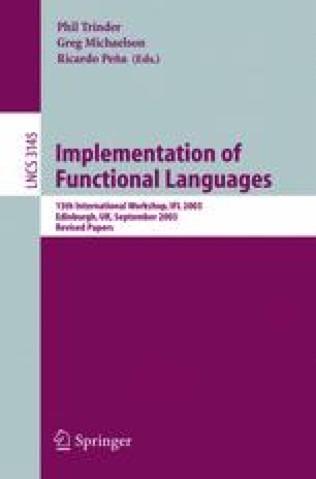
Implementation of functional languages ; 15th International Workshop, IFL 2003, Edinburgh, UK, September 8-11, 2003. Revised Papers
This book constitutes the thoroughly refereed post-proceedings of the 15th International Workshop on the Implementation of Functional Languages, IFL 2003, held in Edinburgh, UK in September 2003. The 11 revised full papers presented were carefully selected during two rounds of reviewing and revision from 32 workshop presentations. The papers are organized in topical sections on language constructs and programming, static analysis and types, parallelism, and generic programming.
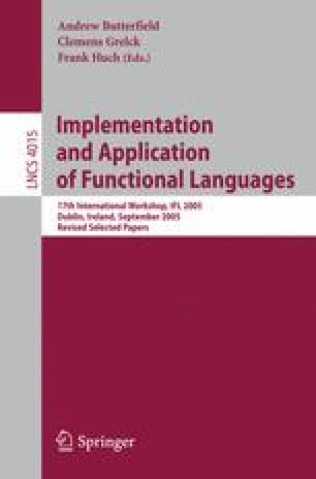
Implementation and Application of Functional Languages ; Vol. 4015 ; 17th International Workshop, IFL 2005, Dublin, Ireland, September 19-21, 2005, Revised Selected Papers
The 17th International Workshop on Implementation and Application of Functional Languages (IFL 2005) was held in Dublin, Ireland, September 19–21, 2005. It was organized by the Department of Computer Science at Trinity College, University of Dublin. IFL 2005 was the 17th event in the annual series of IFL workshops. The aim of the workshop series is to bring together researchers actively engaged in the implementation and application of functional and function-based programming languages. It provides an open forum for researchers who wish to present and discuss new ideas and concepts, work in progress, preliminary results, etc., related primarily, but not exclusively, to the implementation and application of functional languages. Topics of interest cover a wide range from theoretical aspects over language design and implementation towards applications and tool support.
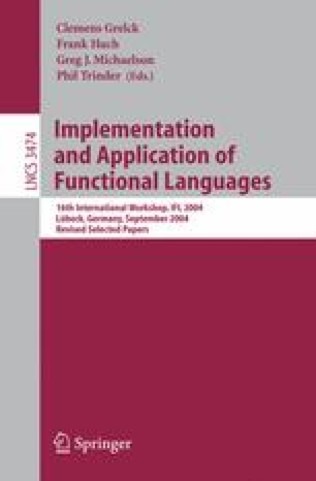
Implementation and application of functional languages ; Vol. 3474 ; 16th International Workshop, IFL 2004, Lübeck, Germany, September 8-10, 2004, Revised Selected Papers
The 16th International Workshop on Implementation and Application of Fu- tional Languages (IFL 2004) was held in Lub ¨ eck, Germany, September 8–10, 2004. It was jointly organized by the Institute of Computer Science and Applied Mathematics of the University of Kiel and the Institute of Software Technology and Programming Languages of the University of Lub ¨ eck. IFL 2004 was the sixteenth event in the annual series of IFL workshops. The aim of the workshop series is to bring together researchers actively engaged in the implementation and application of functional and function-based progr- ming languages. It provides an open forum for researchers who wish to present and discuss new ideas and concepts, work in progress, preliminary results, etc., related primarily, but not exclusively, to the implementation and application of functional languages. Topics of interest cover a wide range from theoretical - pects over language design and implementation towards applications and tool support.

Implementation and Application of Functional Languages ; 19th International Workshop, IFL 2007, Freiburg, Germany, September 27-29, 2007. Revised Selected Papers
This book constitutes the thoroughly refereed post-proceedings of the 19th International Workshop on Implementation and Applications of Functional Languages, IFL 2007, held in Freiburg, Germany in September 2007.The 15 revised full papers presented went through two rounds of reviewing and improvement and were selected from 33 submissions. The papers address all current theoretical and methodological issues on functional and function-based languages such as type checking, contract checking, compilation, parallelism, development and debugging, data structures, parsing as well as various performance related concepts.
