



الصفحة 13
الصفحة 13

Machine Learning for Multimodal Interaction ; 4th International Workshop, MLMI 2007, Brno, Czech Republic, June 28-30, 2007, Revised Selected Papers
This book contains a selection of revised papers from the 4th Workshop on Machine Learning for Multimodal Interaction (MLMI 2007), which took place in Brno, Czech Republic, during June 28 30, 2007. As in the previous editions of the MLMI series, the 26 chapters of this book cover a large area of topics, from multimodal processing and human computer interaction to video, audio, speech and language processing. The application of machine learning techniques to problems arising in these felds and the design and analysis of software
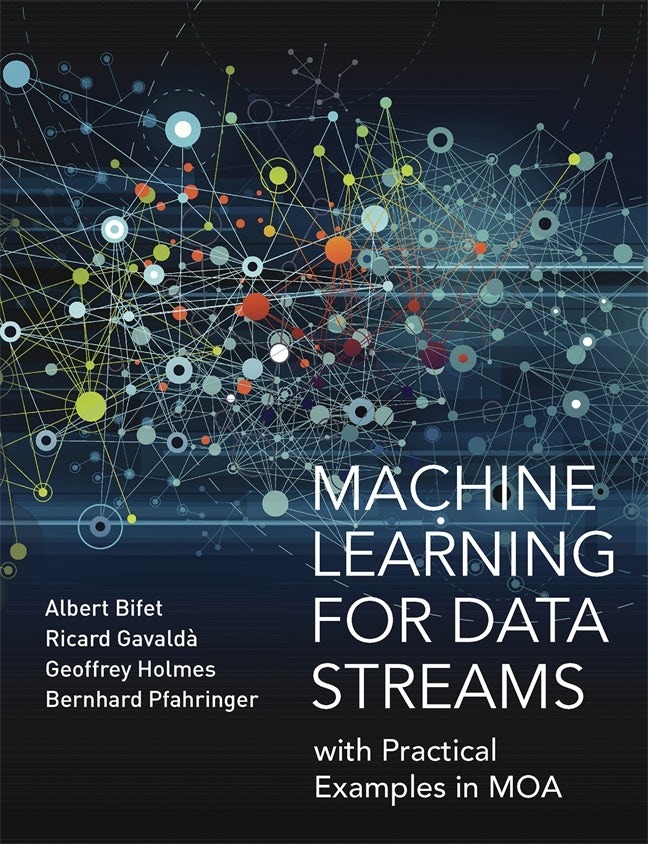
Machine learning for data streams : With practical examples in MOA
The book first offers a brief introduction to the topic, covering big data mining, basic methodologies for mining data streams, and a simple example of MOA. More detailed discussions follow, with chapters on sketching techniques, change, classification, ensemble methods, regression, clustering, and frequent pattern mining. Most of these chapters include exercises, an MOA-based lab session, or both. Finally, the book discusses the MOA software, covering the MOA graphical user interface, the command line, use of its API, and the development of new methods within MOA.
Machine learning for cyber-physical systems: selected papers from the international conference ML4CPS 2023
Contains selected papers from the international conference ML4CPS – Machine Learning for Cyber-Physical Systems, which was held in Hamburg (Germany), from 29 to 31 March 2023. Cyber-physical systems are adaptive and learning: they analyze their environment and, based on observations, learn patterns, associations and predictive models. Typical applications are condition monitoring, predictive maintenance, image processing and diagnostics. Machine learning is the key technology for these developments.

Machine Learning for Cyber Physical Systems : Selected papers from the International Conference ML4CPS 2018
Presents new approaches to Machine Learning for Cyber Physical Systems, experiences and visions. Cyber Physical Systems are characterized by their ability to adapt and to learn: They analyze their environment and, based on observations, they learn patterns, correlations and predictive models. Typical applications are condition monitoring, predictive maintenance, image processing and diagnosis. Machine Learning is the key technology for these developments.
Machine Learning and Robot Perception
Presents some of the most recent research results in the area of machine learning and robot perception. The chapters represent new ways of solving real-world problems. This book will appeal to researchers, senior undergraduate/postgraduate students, application engineers and scientists.
Machine Learning and Probabilistic Graphical Models for Decision Support Systems
Presents recent advancements in research, a review of new methods and techniques, and applications in decision support systems (DSS) with Machine Learning and Probabilistic Graphical Models, which are very effective techniques in gaining knowledge from Big Data and in interpreting decisions. It explores Bayesian network learning, Control Chart, Reinforcement Learning for multicriteria DSS, Anomaly Detection in Smart Manufacturing with Federated Learning, DSS in healthcare, DSS for supply chain management, etc. Researchers and practitioners alike will benefit from this book to enhance the understanding of machine learning, Probabilistic Graphical Models, and their uses in DSS in the context of decision making with uncertainty. The real-world case studies in various fields with guidance and recommendations for the practical applications of these studies are introduced in each chapter.
Machine Learning and Big Data Analytics Paradigms : Analysis, Applications and Challenges
Intended to present the state of the art in research on machine learning and big data analytics. The accepted chapters covered many themes including artificial intelligence and data mining applications, machine learning and applications, deep learning technology for big data analytics, and modeling, simulation, and security with big data. It is a valuable resource for researchers in the area of big data analytics and its applications.
Machine Learning : The Basics
Approaches ML as the computational implementation of the scientific principle. This principle consists of continuously adapting a model of a given data-generating phenomenon by minimizing some form of loss incurred by its predictions. Trains readers to break down various ML applications and methods in terms of data, model, and loss, thus helping them to choose from the vast range of ready-made ML methods.
Logics of Specification Languages
Dedicated chapters address : the use of ASM (Abstract State Machines) in the classroom; the Event-B modelling method; a methodological guide to CafeOBJ logic; CASL, the Common Algebraic Specification Language; the Duration Calculus; the logic of the RAISE specification language (RSL); the specification language TLA+; the typed logic of partial functions and the Vienna Development Method (VDM); and Z logic and its applications. Each chapter is self-contained, with references, and symbol and concept indexes. Finally, in a unique feature, the book closes with short commentaries on the specification languages written by researchers closely associated with their original development.

Logic, language, information and computation ; 15th International Workshop, WoLLIC 2008 Edinburgh, UK, July 1-4, 2008 Proceedings
The papers cover all pertinent subjects in computer science with particular interest in cross-disciplinary topics. Typical areas of interest are: foundations of computing and programming; novel computation models and paradigms; broad notions of proof and belief; formal methods in software and hardware development; logical approach to natural language and reasoning; logics of programs, actions and resources; foundational aspects of information organization, search, flow, sharing, and protection.

Logic, language, information and computation ; 14th International Workshop, WoLLIC 2007, Rio de Janeiro, Brazil, July 2-5, 2007, Proceedings
The Workshop on Logic, Language, Information and Computation (WoLLIC) is an annual international forum on inter-disciplinary research involving formal logic, computing and programming theory, and natural language and reasoning. The WoLLIC meetings alternate between Brazil (and Latin America) and other countries, with the aim of fostering interest in applied logic among Latin Am- ican scientists and students, and facilitating their interaction with the international - plied logic community.
Logic Programming with Prolog
Logic Programming is the name given to a distinctive style of programming, very different from that of conventional programming languages such as C++ and Java. By far the most widely used Logic Programming language is Prolog. Prolog is a good choice for developing complex applications, especially in the field of Artificial Intelligence. This book does not assume that the reader is an experienced programmer or has a background in Mathematics, Logic or Artificial Intelligence. It starts from scratch and aims to arrive at the point where quite powerful programs can be written in the language. It is intended both as a textbook for an introductory course and as a self-study book. On completion the reader will know enough to use Prolog in their own research or practical projects. Each chapter has self-assessment exercises so that the reader may check their own progress. A glossary of the technical terms used completes the book.

Leveraging applications of formal methods, verification and validation : Engineering Principles ; 9th International Symposium on Leveraging Applications of Formal Methods, ISoLA 2020, Rhodes, Greece, October 20–30, 2020, Proceedings, Part II
Constitutes the refereed proceedings of the 9th International Symposium on Leveraging Applications of Formal Methods, ISoLA 2020, which was planned to take place during October 20–30, 2020, on Rhodes, Greece. The event itself was postponed to 2021 due to the COVID-19 pandemic. The papers presented were carefully reviewed and selected for inclusion in the proceedings. Each volume focusses on an individual topic with topical section headings within the volume: Part II, Engineering Principles : Automating Software Re-Engineering ; Rigorous Engineering of Collective Adaptive Systems.
Learning from data streams : Processing techniques in sensor networks
The book provides the reader with a comprehensive overview of stream data processing, including famous prototype implementations like the Nile system and the TinyOS operating system. The set of chapters covers the state-of-art in data stream mining approaches using clustering, predictive learning, and tensor analysis techniques, and applying them to applications in security, the natural sciences, and education.

Learning Design : A Handbook on Modelling and Delivering Networked Education and Training
Put together contributions from members of the "Valkenburg Group", consisting of 33 experts deeply involved in e-learning and more specifically learning design. The result is a rich and lasting source of information for both e-learning course and tool developers, providing information about the specification itself, how to implement it in practice, what tools to use, and what pitfalls to avoid. The book not only reports first experiences, but also goes beyond the current state of the art by looking at future prospects and emerging applications.

Learning Classifier Systems ; International Workshops, IWLCS 2003-2005, Revised Selected Papers
The work embodied in this volume was presented across three consecutive e- tions of the International Workshop on Learning Classi?er Systems that took place in Chicago (2003), Seattle (2004), and Washington (2005). The Genetic and Evolutionary Computation Conference, the main ACM SIGEvo conference, hosted these three editions.

Learning and Adaption in Multi-Agent Systems ; 1st International Workshop, LAMAS 2005, Utrecht, The Netherlands, July 25, 2005, Revised Selected Papers
Contains selected and revised papers of the International Workshop on Lea- ing and Adaptation in Multi-Agent Systems (LAMAS 2005), held at the AAMAS 2005 Conference in Utrecht, The Netherlands, July 26. An important aspect in multi-agent systems (MASs) is that the environment evolves over time, not only due to external environmental changes but also due to agent int- actions. For this reason it is important that an agent can learn, based on experience, and adapt its knowledge to make rational decisions and act in this changing environment autonomously. Machine learning techniques for single-agent frameworks are well established. Agents operate in uncertain environments and must be able to learn and act - tonomously. This task is, however, more complex when the agent interacts with other agents that have potentially different capabilities and goals. The single-agent case is structurally different from the multi-agent case due to the added dimension of dynamic interactions between the adaptive agents. Multi-agent learning, i.e., the ability of the agents to learn how to cooperate and compete, becomes crucial in many domains. Autonomous agents and multi-agent systems (AAMAS) is an emerging multi-disciplinary area encompassing computer science, software engineering, biology, as well as cognitive and social sciences. A t- oretical framework, in which rationality of learning and interacting agents can be - derstood, is still under development in MASs, although there have been promising ?

Law and the Semantic Web : Legal Ontologies, Methodologies, Legal Information Retrieval, and Applications
As part of this objective, ICT (information and communication technologies) services should become available for every citizen, and for all schools, homes and businesses. The book you have in front of you is about Semantic Web technology and law. Law is something omnipresent; all citizens — at some points in their lives — have to deal with it. In addition, law involves a large group of professionals, and is a mul- billion business world wide. Information technology is important because it that can improve citizens’ interaction with law, as well as improve legal professionals’ work environment. Legal professionals dedicate a significant amount of their time to finding, reading, analyzing and synthesizing information in order to take decisions, and prepare advice and trials, among other tasks. As part of the “Semantic-Based Knowledge and Content Systems” Strategic Objective, the European Commission is funding projects to construct technology to make the Semantic Web vision come true. 1 The articles in this book are related to two current foci of the Strategic Objective : • Knowledge acquisition and modelling, capturing knowledge from raw information and multimedia content in webs and other distributed repositories to turn poorly structured information into machi- processable knowledge.
Knowledge Processing with Interval and Soft Computing
In particular, these chapters cover computing techniques for interval linear systems of equations, interval matrix singular-value decomposition, interval function approximation, and decision making with statistical and graph-based data processing. To enable these applications, the book presents a standards-based object-oriented interval computing environment in C++.

Knowledge Engineering : Practice and Patterns ; 16th International Conference, EKAW 2008, Acitrezza, Italy, September 29 - October 2, 2008. Proceedings
Constitutes the refereed proceedings of the 16th International Conference on Knowledge Engineering and Knowledge Management, EKAW 2008, held in Acitrezza, Sicily, Italy, in September/October 2008.The 17 revised full papers and 15 revised short papers presented together with 3 invited talks were carefully reviewed and selected from 102 submissions. The papers are organized in topical sections on knowledge patterns and knowledge representation, matching ontologies and data integration, natural language, knowledge acquisition and annotations, search, query and interaction, as well as ontologies.
