



الصفحة 12
الصفحة 12

Intelligent Data Mining : Techniques and Applications
Intelligent Data Mining - Techniques and Applications is an organized edited collection of contributed chapters covering basic knowledge for intelligent systems and data mining, applications in economic and management, industrial engineering and other related industrial applications. The main objective of this book is to gather a number of peer-reviewed high quality contributions in the relevant topic areas.

Intelligent data engineering and automated Learning - IDEAL 2008 ; 9th International Conference Daejeon, South Korea, November 2-5, 2008 Proceedings
This book constitutes the refereed proceedings of the 9th International Conference on Intelligent Data Engineering and Automated Learning, IDEAL 2008, held in Daejeon, Korea, in November 2008.The 56 revised full papers presented together with 10 invited papers were carefully reviewed and selected from numerous submissions for inclusion in the book. The papers are organized in topical sections on learning and information processing, data mining and information management, bioinformatics and neuroinformatics, agents and distributed systems, as well as financial engineering and modeling.

Intelligent data engineering and automated Learning - IDEAL 2007 ; 8th International Conference, Birmingham, UK, December 16-19, 2007, Proceedings
This book constitutes the refereed proceedings of the 8th International Conference on Intelligent Data Engineering and Automated Learning, IDEAL 2007. The papers are organized in topical sections on learning and information processing, data mining and information management, bioinformatics and neuroinformatics, agents and distributed systems, financial engineering and modeling, agent-based approach to service sciences, as well as neural-evolutionary fusion algorithms and their applications.

Intelligent Computing in Engineering and Architecture ; 13th EG-ICE Workshop 2006, Ascona, Switzerland, June 25-30, 2006, Revised Selected Papers
Providing computer support for tasks in civil engineering and architecture is hard. Projects can be complex, long and costly. Firms that contribute to design, construction and maintenance are often worth less than the value of their projects. Everyone in the field is justifiably risk adverse. Contextual variables have a strong influence making generalization difficult. The product life cycle may exceed one hundred years and functional requirements may evolve during the service life. It is therefore no wonder that practitioners in this area have been so reluctant to adopt advanced computing systems. After decades of research and industrial pilot projects, advanced computing s- tems are now being recognized by many leading practitioners to be strategically - portant for the future profitability of firms involved in engineering and architecture. Engineers and architects with advanced computing knowledge are hired quickly in the market place. Closer collaboration between research and practice is leading to more comprehensive validation processes for new research ideas. This is feeding devel- ment of more useful systems, thus accelerating progress. These are exciting times. th This volume contains papers that were presented at the 13 Workshop of the Eu- pean Group for Intelligent Computing in Engineering. Over five days, 70 participants from around the world listened to 59 paper presentations in a single session format.

Intelligent Computing Everywhere
Intelligent Computing Everywhere investigates the relevance and relationship artificial intelligence maintains with "modern strands of computing" i.e. pervasive computing and ambient intelligence, bioinformatics, neuroinformatics, computing and the mind, non-classical computing and novel computing models, as well as DNA computing and quantum computing.

Intelligent Computing ; International Conference on Intelligent Computing, ICIC 2006, Kunming, China, August 16-19, 2006, Proceedings, Part I
The International Conference on Intelligent Computing (ICIC) was formed to provide an annual forum with dedication to the emerging and challenging topics in artificial intelligence, machine learning, bioinformatics, and computational biology, etc. It aims to bring together researchers and practitioners from both the academia and industry to share ideas, problems and solutions related to the multifaceted aspects of intelligent computing. The ICIC 2006 to be held in Kunming, Yunnan, China, 16-19 August 2006 is the second International Conference on Intelligent Computing, which is built upon the success of ICIC 2005 held in Hefei, China, 2005. This year, the conference mainly concentrates on the theories & methodologies as well as the emerging applications of intelligent computing. It intends to unify the contemporary intelligent computing techniques within an integral framework that highlights the trends in advanced computational intelligence and bridges the theoretical research with the applications. In particular, the bio-inspired computing emerges as a key role in pursuing for novel technology in recently years. The resulting techniques vitalize the life science engineering and daily life applications. In light of this trend, the theme for this conference is the Emerging Intelligent Computing Technology and Applications. Papers related to this theme were especially solicited, including theories, methodologies, and applications in science and technology.

Intelligent Algorithms for Packing and Cutting Problem
Introduces intelligent solving algorithms for classical packing and cutting problem and their variants / Investigates novel methods, e.g. reinforcement learning algorithms, for rectangular and irregular packing problems / Presents practical engineering application cases in combination of theory and practice / investigates in detail the two-dimensional packing and cutting problems in the field of operations research and management science. It introduces the mathematical models and intelligent solving algorithms for these problems, as well as their engineering applications. Most intelligent methods reported in this book have already been applied in reality, which can provide reference for the engineers. The presented novel methods for the two-dimensional packing problem provide a new way to solve the problem for researchers interested in operations research or computer science. This book also introduces three new variants of packing problems and their solving methods, which offer a different research direction.
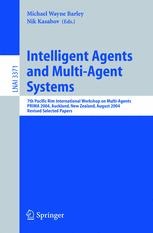
Intelligent Agents and Multi-Agent Systems ; 7th Pacific Rim International Workshop on Multi-Agents, PRIMA 2004, Auckland, New Zealand, August 8-13, 2004, Revised Selected Papers
A Combined System for Update Logic and Belief Revision.- Using Messaging Structure to Evolve Agents Roles in Electronic Markets.- Specifying DIMA Multi-agents Models Using Maude.- picoPlangent: An Intelligent Mobile Agent System for Ubiquitous Computing.- An Approach to Safe Continuous Planning.- Modeling e-Procurement as Co-adaptive Matchmaking with Mutual Relevance Feedback.- Price Determination and Profit Sharing for Bidding Groups in Agent-Mediated Auctions.- Agent Based Risk Management Methods for Speculative Actions.- Handling Emergent Resource Use Oscillations.- The Role of Agents in Intelligent Mobile Services.

Intelligent Agents and Multi-Agent Systems ; 11th Pacific Rim International Conference on Multi-Agents, PRIMA 2008, Hanoi, Vietnam, December 15-16, 2008. Proceedings
This book constitutes the proceedings of the the 11th Pacific Rim International Conference on Multi-Agents, PRIMA 2008, held in Hanoi, Vietnam, in December 2008.The 19 regular papers and 22 short papers presented together with 3 keynote speeches, were carefully reviewed and selected from 56 submissions. Many current subjects in multi-agent research and development are addressed, ranging from theoretical and methodological issues to various applications in different fields. There was a track on multi-issue negotiation and agents and HCI.

Intelligence in communication systems ; IFIP international onference on intelligence in communication systems, INTELLCOMM 2005, Montreal, Canada, October 17-19, 2005
International Federation for Information Processing The IFIP series publishes state-of-the-art results in the sciences and technologies of information and communication. The scope of the series includes: foundations of computer science; software theory and practice; education; computer applications in technology; communication systems; systems modeling and optimization; information systems; computers and society; computer systems technology; security and protection in information processing systems; artificial intelligence; and human-computer interaction. Proceedings and post-proceedings of referred international conferences in computer science and interdisciplinary fields are featured. These results often precede journal publication and represent the most current research. The principal aim of the IFIP series is to encourage education and the dissemination and exchange of information about all aspects of computing.

Intelligence and security informatics ; IEEE ISI 2008 International Workshops : PAISI, PACCF, and SOCO 2008, Taipei, Taiwan, June 17, 2008. Proceedings
This book constitutes the refereed proceedings of the three international workshops PAISI 2008, PACCF 2008, and SOCO 2008, held as satellite events of the IEEE International Conference on Intelligence and Security Informatics, ISI 2008, in Taipei, Taiwan, in June 2008.The 55 revised full papers presented were carefully reviewed and selected from the presentations at the workshops. The 21 papers of the Pacific Asia Workshop on Intelligence and Security Informatics (PAISI 2008) cover topics such as information retrieval and event detection, internet security and cybercrime, currency and data protection, cryptography, image and video analysis, privacy issues, social networks, modeling and visualization, and network intrusion detection.

Intelleger = انتليجر
The project management system is a web application designed to assist software managers in efficiently managing their projects, including websites, mobile apps, and other software initiatives. Utilizing artificial intelligence, the application streamlines project creation and management processes, offering significant benefits in terms of organization and accuracy. Managers can create projects by inputting essential details such as the name, scope, deadline, and tasks. The system generates AI-based functional and non-functional requirements tailored to the project scope using gpt2 model on Pure dataset. Managers can then review and edit these requirements as needed before finalizing the project. The application facilitates comprehensive task management by allowing managers to assign tasks to developers, edit task details, and ensure task deadlines align with project deadlines. Developers can log their start and end times automatically when they begin and complete tasks, providing accurate time tracking and performance analysis.also they can use code generation model to generate their task’s code using codebert model on concode and codesearchnet dataset Real-time notifications keep both managers and developers informed of task assignments, completions, and other critical updates.

Integrating Human Aspects in Production Management ; IFIP TC5 / WG5.7 Proceedings of the International Conference on Human Aspects in Production Management 5-9 October 2003, Karlsruhe, Germany
This book is composed of six parts, each focusing on a specific theme: Human Resource Planning; Human Aspects in the Digital Factory; Human Aspects in Production Planning & Control; Knowledge Management; Management of Distributed Work; and Service Engineering. The included papers were presented at the IFIP International Working Conference "Human Aspects in Production Management." Following this conference, the papers were extended by the authors and passed a peer review process.

Integrated Research in GRID Computing : CoreGRID Integration Workshop 2005 (Selected Papers) November 28-30, Pisa, Italy
Integrated Research in Grid Computing presents a selection of the best papers presented at the CoreGRID Integration Workshop (CGIW2005). The aim of CoreGRID is to strengthen and advance scientific and technological excellence in the area of Grid and Peer-to-Peer technologies in order to overcome the current fragmentation and duplication of effort in this area.
Integrated Graphic and Computer Modelling
Full colour throughout, the book explores programming language developments from machine code to more natural language forms, and the basic display operations and commands needed to create effective computer graphic systems. As the visual presentation of real and virtual environments becomes more and more the norm in application systems, a clear understanding of the theory that underpins these techniques is required of all students and practitioners studying and working on large computer systems.

Integrated formal methods ; 6th International Conference, IFM 2007, Oxford, UK, July 2-5, 2007, Proceedings
It addresses all aspects of formal methods integration, including of a process of analysis or design application of formal methods to analysis or design, extension of one method based upon the inclusion of ideas or concepts from others, and semantic integration or practical application.

Integrated formal methods ; 5th International conference, IFM 2005, Eindhoven, The Netherlands, November 29 - December 2, 2005. Proceedings
This book constitutes the refereed proceedings of the 5th International Conference on Integrated Formal Methods, IFM 2005, held in Eindhoven, The Netherlands, in November/December 2005. The 19 revised full papers presented together with 3 invited papers were carefully reviewed and selected from 40 submissions. The papers are organized in topical sections on components, state/event-based verification, system development, applications of B, tool support, non-software domains, semantics, as well as UML and statecharts.

Integrated formal methods ; 3rd International Conference, IFM 2002, Turku, Finland, May 15-18, 2002. Proceedings.
IFM 2002 explored the relations between formal methods and graphical notations, especially the industrial standard language for software design, the Unified Modeling Language (UML). The themes of IFM 2002 reflect what we believe is a growing trend in the Formal Methods and Software Engineering research communities. Over the last threedecades,computer scientists have developed a range of formalisms focusing on particular aspects of behavior or analysis, such as sequential program structures, concurrent program structures, data and information structures, temporal reasoning, deductive proof, and model checking. Much effort is now being devoted to integrating these methods in order to combine their advantages and ensure they scale up to industrial needs. Graphical notations are now widely used in software engineering and there is growing recognition of the importance of providing these with the for mal underpinnings and form alanalysis capabilities found in formal methods.

Integrated Circuit and System Design. Power and Timing Modeling, Optimization and Simulation ; Vol. 4148 ; 16th International Workshop, PATMOS 2006, Montpellier, France, September 13-15, 2006, Proceedings
Welcome to the proceedings of PATMOS 2006, the 16th in a series of international workshops. PATMOS 2006 was organized by LIRMM with CAS technical - sponsorship and CEDA sponsorship. Over the years, the PATMOS workshop has evolved into an important European event, where researchers from both industry and academia discuss and investigate the emerging challenges in future and contemporary applications, design methodologies, and tools required for the development of upcoming generations of integrated circuits and systems. The technical program of PATMOS 2006 contained state-of-the-art technical contributions, three invited talks, a special session on hearing-aid design, and an embedded tutorial. The technical program focused on timing, performance and power consumption, as well as architectural aspects with particular emphasis on modeling, design, characterization, analysis and optimization in the nanometer era. The Technical Program Committee, with the assistance of additional expert reviewers, selected the 64 papers presented at PATMOS. The papers were organized into 11 technical sessions and 3 poster sessions. As is always the case with the PATMOS workshops, full papers were required, and several reviews were received per manuscript.

Integrated Circuit and System Design. Power and Timing Modeling, Optimization and Simulation ; Vol. 3728 ; 15th International Workshop, PATMOS 2005, Leuven, Belgium, September 21-23, 2005, Proceedings
Welcome to the proceedings of PATMOS 2005, the 15th in a series of international workshops.PATMOS2005wasorganizedbyIMECwithtechnicalco-sponsorshipfrom the IEEE Circuits and Systems Society. Over the years, PATMOS has evolved into an important European event, where - searchers from both industry and academia discuss and investigate the emerging ch- lenges in future and contemporary applications, design methodologies, and tools - quired for the developmentof upcominggenerationsof integrated circuits and systems. The technical program of PATMOS 2005 contained state-of-the-art technical contri- tions, three invited talks, a special session on hearing-aid design, and an embedded - torial. The technical program focused on timing, performance and power consumption, as well as architectural aspects with particular emphasis on modeling, design, char- terization, analysis and optimization in the nanometer era. The Technical Program Committee, with the assistance of additional expert revi- ers, selected the 74 papers to be presented at PATMOS. The papers were divided into 11 technical sessions and 3 poster sessions. As is always the case with the PATMOS workshops, the review process was anonymous, full papers were required, and several reviews were carried out per paper. Beyond the presentations of the papers, the PATMOS technical program was - riched by a series of speeches offered by world class experts, on important emerging research issues of industrial relevance. Prof. Jan Rabaey, Berkeley, USA, gave a talk on “Traveling the Wild Frontier of Ulta Low-Power Design”, Dr. Sung Bae Park, S- sung, gave a presentation on “DVL (Deep Low Voltage): Circuits and Devices”, Prof.
