



الصفحة 12
الصفحة 12
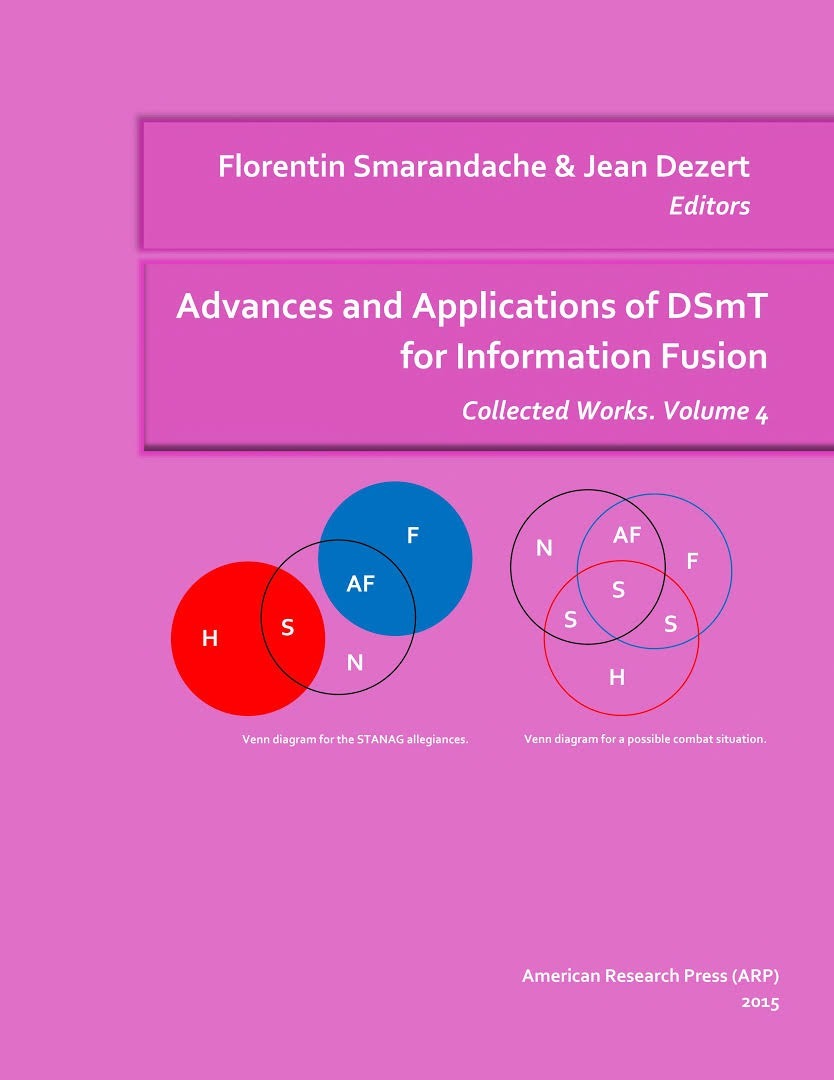
Advances and applications of DSmT for information fusion ; Vol. 4
One of the most comprehensive and flexible fusion theory based on belief functions. It can work in all fusion spaces: power set, hyper-power set, and super-power set, and has various fusion and conditioning rules that can be applied depending on each application. Some new generalized rules are introduced in this volume with codes for implementing some of them. For the qualitative fusion, the DSm Field and Linear Algebra of Refined Labels (FLARL) is proposed which can convert any numerical fusion rule to a qualitative fusion rule. When one needs to work on a refined frame of discernment, the refinement is done using Smarandache s algebraic codification. New interpretations and implementations of the fusion rules based on sampling techniques and referee functions are proposed, including the probabilistic proportional conflict redistribution rule.
Advanced Decision Sciences Based on Deep Learning and Ensemble Learning Algorithms : A Practical Approach Using Python
Describes the deep learning models and ensemble approaches applied to decision-making problems. The authors have addressed the concepts of deep learning, convolutional neural networks, recurrent neural networks, and ensemble learning in a practical sense providing complete code and implementation for several real-world examples. The authors of this book teach the concepts of machine learning for undergraduate and graduate-level classes and have worked with Fortune 500 clients to formulate data analytics strategies and operationalise these strategies.
AdvancED ActionScript Components : Mastering the Flash Component Architecture
Macromedia's architecture is like a chest filled with precious jewels, and this book is quite simply the key to open it! One of the most important tools provided with Flash is the Macromedia Component Architecture: a framework of components written in ActionScript 2, based on established design patterns, that provides a wealth of functionality you can just bolt on to your Flash applications when desired. This can save you an enormous amount of time during application development and help you improve the quality of your code. What's more, the source code is included, so if you can't find the component you need within the component architecture, you can just modify existing components to create your own!
Advanced .NET Remoting
Surpassing any white papers, specialist documents and other documentationthis book features in-depth coverage of the .NET Remoting Framework. The text is organized into three main parts, and this revised, second edition features 150 pages of entirely new material! Part one includes a guide to the 1.1 framework and its capabilities in real-world applications. Part two presents .NET remoting internals, and provides real-world code and development strategies. Finally, part three looks at futuristic remoting tools and their present implementation in Visual Studio .NET 2005. You will come to see how remoting procedures will change within the new IDE and revised framework.
Adaptive Machine Learning Algorithms with Python : Solve Data Analytics and Machine Learing Problems on Edge Devices
Learn to use adaptive algorithms to solve real-world streaming data problems. This book covers a multitude of data processing challenges, ranging from the simple to the complex. At each step, you will gain insight into real-world use cases, find solutions, explore code used to solve these problems, and create new algorithms for your own use. You will: Apply adaptive algorithms to practical applications and examples / Understand the relevant data representation features and computational models for time-varying multi-dimensional data / Derive adaptive algorithms for mean, median, covariance, eigenvectors (PCA) and generalized eigenvectors with experiments on real data / Speed up your algorithms and put them to use on real-world stationary and non-stationary data / Master the applications of adaptive algorithms on critical edge device computation applications
Abstract Computing Machines : A Lambda Calculus Perspective
The book addresses ways and means of organizing computations, highlighting the relationship between algorithms and the basic mechanisms and runtime structures necessary to execute them using machines. It completely abstracts from concrete programming languages and machine architectures, taking instead the lambda calculus as the basic programming and program execution model to design various abstract machines for its correct implementation. The emphasis is on fully normalizing machines based on full-fledged beta-reductions as essential prerequisites for symbolic computations that treat functions and variables truly as first-class objects. Their weakly normalizing counterparts are shown to be functional abstract machines that sacrifice the flavors of full beta-reductions for decidedly simpler runtime structures and improved runtime efficiency. Further downgrading of the lambda calculus leads to classical imperative machines that permit side-effecting operations on the runtime environment.
A Testers Guide to .NET Programming
A Tester's Guide to .NET Programming focuses solely on applied programming techniques for testers. You will learn how to write simple automated tests, enabling you to test tools and utilities. You will also learn about the important concepts driving modern programming today, like multitier applications and object-oriented programming. More businesses are adopting .NET technologies, and this book will equip you to assess software robustness and performance. Whether you're an experienced programmer who's unfamiliar with testing concepts, or you're an experienced tester versed in VB .NET and C#, the included real-world tips and example code will help you start your projects.
A Practical Guide to TPM 2.0 : Using the New Trusted Platform Module in the New Age of Security
A Practical Guide to TPM 2.0: Using the Trusted Platform Module in the New Age of Security is a straight-forward primer for developers. It shows security and TPM concepts, demonstrating their use in real applications that the reader can try out. Simply put, this book is designed to empower and excite the programming community to go out and do cool things with the TPM. The approach is to ramp the reader up quickly and keep their interest.A Practical Guide to TPM 2.0: Using the Trusted Platform Module in the New Age of Security explains security concepts, describes the TPM 2.0 architecture, and provides code and pseudo-code examples in parallel, from very simple concepts and code to highly complex concepts and pseudo-code.
A Platform-Centric Approach to System-on-Chip (SOC) Design
The book proposes a new methodology for realizing platform-centric design of complex systems, and presents a detailed plan for its implementation. The proposed plan allows component vendors, system integrators and product developers to collaborate effectively and efficiently to create complex products within budget and schedule constraints.
A Modular Calculus for the Average Cost of Data Structuring
This volume, with forewords by Greg Bollella and Dana Scott, presents novel programs based on the new advances in this area, including the first randomness-preserving version of Heapsort. Programs are provided, along with derivations of their average-case time, to illustrate the radically different approach to average-case timing. The automated static timing tool applies the Modular Calculus to extract the average-case running time of programs directly from their MOQA code.
A Classical Introduction to Cryptography : Applications for Communications Security
This advanced-level textbook covers conventional cryptographic primitives and cryptanalysis of these primitives; basic algebra and number theory for cryptologists; public key cryptography and cryptanalysis of these schemes; and other cryptographic protocols, e.g. secret sharing, zero-knowledge proofs and undeniable signature schemes.
.NET 2.0 Interoperability Recipes : A Problem-Solution Approach
.NET represents a new and improved way of developing software for the Windows platform. Given the chance, you'd probably rewrite all of your existing code in the newer managed code environment that .NET provides. But it is difficult or impossible to throw out all existing legacy code and start over when a new technology arrives. Instead, you need to find a way to move forward with new .NET development while reusing existing pieces of tested, working code. You need a way to interoperate with the existing code until you have a chance to finally rewrite all of it in .NET.
