



الصفحة 11
الصفحة 11

Fundamental approaches to software engineering ; 23rd International Conference, FASE 2020, Held as Part of the European Joint Conferences on Theory and Practice of Software, ETAPS 2020, Dublin, Ireland, April 25–30, 2020, Proceedings
This book constitutes the proceedings of the 23rd International Conference on Fundamental Approaches to Software Engineering, FASE 2020, which took place in Dublin, Ireland, in April 2020, and was held as Part of the European Joint Conferences on Theory and Practice of Software, ETAPS 2020. The 23 full papers, 1 tool paper and 6 testing competition papers presented in this volume were carefully reviewed and selected from 81 submissions.
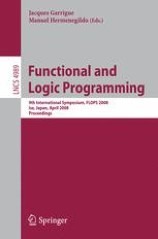
Functional and logic programming ; 9th International Symposium, FLOPS 2008, Ise, Japan, April 14-16, 2008. Proceedings
This volume contains the proceedings of the 9th International Symposium on Functional and Logic Programming (FLOPS 2008), held in Ise, Japan, April 14-16, 2008 at the Ise City Plaza. FLOPS is a forum for research on all issues concerning functional progr- ming and logic programming. In particular it aims to stimulate the cro- fertilization as well as integration of the two paradigms. The Program Committee meeting was conducted electro- cally, for a period of two weeks in December 2007. After careful and thorough discussion, the ProgramCommittee selected20 papers(33%)for presentationat theconference.

Fun and Games ; 2nd International conference, Eindhoven, The Netherlands, October 20-21, 2008. Proceedings
This book constitutes the refereed proceedings of the Second International Conference on Fun and Games, held in Eindhoven, The Netherlands, in October 2008.The 17 revised full papers, presented together with 2 invited talks were carefully reviewed and selected from a total of 36 submissions. The papers encompass the study of computer games, game development and experiences by researchers from social sciences, computing, electrical engineering, design, etc. Main focus is given to topics such as tightly-coupled embodied control of movement-sensitive mobile devices, hypercomputation and cultural computing, emerging gaming paradigms.

Frontiers in Hardware Security and Trust : Theory, design and practice
The footprint and power constraints imposed on internet-of-things end-points, smart sensors, mobile and ad hoc network devices make traditional and software based cryptographic solutions that require a general-purpose processor increasingly unfeasible. The fact that security is not the primary functionality of these devices means that only a small portion of their limited processing power and storage is available for security, driving the need for alternative security solutions. Hardware security - including hardware obfuscation, hardware security primitives, side-channel attacks and so on - is therefore becoming an increasingly active research area in both academia and industry.

From Opinion Mining to Financial Argument Mining
Financial opinion mining is a branch of traditional opinion mining and sentiment analysis which shares the basic notions of traditional approaches and adds its own domain-specific characteristics. In Sect. 1.1, we start with a common definition of general opinion mining after which we briefly overview traditional research directions.

From Digital Twins to Digital Selves and Beyond : Engineering and Social Models for a Trans-humanist World
This book aims at deepening the understanding of the relation between cyber-physical systems (CPSs) as socio-technical systems and their digital representations with intertwined artificial intelligence (AI). The authors describe why it is crucial for digital selves to be able to develop emotional behavior and why a humanity-inspired AI is necessary so that humans and humanoids can coexist.

From Animals to Animats 10 ; 10th International Conference on Simulation of Adaptive Behavior, SAB 2008, Osaka, Japan, July 7-12, 2008. Proceedings
This book constitutes the refereed proceedings of the 10th International Conference on Simulation of Adaptive Behavior, SAB 2008, held in Osaka, Japan in July 2008.The 30 revised full papers and 21 revised poster papers presented were carefully reviewed and selected from 110 submissions. The papers are organized in topical sections on the animat approach to adaptive behaviour, evolution, navigation and internal world models, perception and control, learning and adaptation, cognition, emotion and behaviour, collective and social behaviours, adaptive behaviour in language and communication, and applied adaptive behaviour.

Fourth IFIP International Conference on Theoretical Computer Science - TCS 2006 ; IFIP 19th World Computer Congress, TC-1, Foundations of Computer Science, August 23-24, 2006, Santiago, Chile
The IFIP series publishes state-of-the-art results in the sciences and technologies of information and communication. The scope of the series includes: foundations of computer science; software theory and practice; education; computer applications in technology; communication systems; systems modeling and optimization; information systems; computers and society; computer systems technology; security and protection in information processing systems; artificial intelligence; and human-computer interaction. Proceedings and post-proceedings of referred international conferences in computer science and interdisciplinary fields are featured. These results often precede journal publication and represent the most current research. The principal aim of the IFIP series is to encourage education and the dissemination and exchange of information about all aspects of computing.

Foundations of software science and computation structures ; 22nd International conference, FOSSACS 2019, Held as part of the European joint conferences on theory and practice of software, ETAPS 2019, Prague, Czech Republic, April 6–11, 2019, proceedings
This book constitutes the proceedings of the 22nd International Conference on Foundations of Software Science and Computational Structures, FOSSACS 2019, which took place in Prague, Czech Republic, in April 2019, held as part of the European Joint Conference on Theory and Practice of Software, ETAPS 2019. The 29 papers presented in this volume were carefully reviewed and selected from 85 submissions. They deal with foundational research with a clear significance for software science.

Foundations of software science and computation structures ; 21st International conference, FOSSACS 2018, Held as part of the European joint conferences on theory and practice of software, ETAPS 2018, Thessaloniki, Greece, April 14–20, 2018. proceedings
Contains the papers presented at the 21st International Conference on Foundations of Software Science and Computation Structures (FoSSaCS 2018), which was held April 16–19, 2018, in Thessaloniki, Greece. The conference is dedicated to foundational research with a clear significance for software science and brings together research on theories and methods to support the analysis, integration, synthesis,transformation, and verification of programs and software systems.

Foundations of Intelligent Systems ; Vol. 4203 ; 16th International Symposium, ISMIS 2006, Bari, Italy, September 27-29, 2006, Proceedings
This book constitutes the refereed proceedings of the 16th International Symposium on Methodologies for Intelligent Systems, ISMIS 2006. The book presents 81 revised papers together with 3 invited papers. Topical sections include active media human-computer interaction, computational intelligence, intelligent agent technology, intelligent information retrieval, intelligent information systems, knowledge representation and integration, knowledge discovery and data mining, logic for AI and logic programming, machine learning, text mining, and Web intelligence.

Foundations of Intelligent Systems ; 17th International Symposium, ISMIS 2008 Toronto, Canada, May 20-23, 2008 Proceedings
This book constitutes the refereed proceedings of the 17th International Symposium on Methodologies for Intelligent Systems, ISMIS 2008, held in Toronto, Canada, in May 2008.The 68 revised papers presented together with 3 plenary talks were carefully reviewed and selected from over 100 submissions. The papers are organized in topical sections on knowledge discovery and data mining: foundations, advances, mining changes and actional patterns; logic for artificial intelligence, autonomic and evolutionary computation, soft computing, databases and data warehouses, digital library, intelligent information retrieval.

Foundations of Intelligent Systems ; 13th International Symposium, ISMIS 2002, Lyon, France, June 27-29, 2002. Proceedings
This volume contains the papers selected for presentation at the 13th International Symposium on Methodologies for Intelligent Systems ISMIS 2002, held in Lyon, France, 27-29 June, 2002. The symposium was organized by the UniversitØ ClaudThe program committee selected the following major areas for ISMIS 2002: Intelligent Multimedia, Intelligent Information Retrieval, Intelligent Information Systems, Knowledge Representation and Integration, Learning and Knowledge Discovery, Logic for Artificial Intelligence, Methodologies (modeling, design, validation, performance evaluation), and Soft Computing.

Foundations of information and knowledge systems ; 5th International Symposium, FoIKS 2008, Pisa, Italy, February 11-15, 2008. Proceedings
This book constitutes the refereed proceedings of the 5th International Symposium on Foundations of Information and Knowledge Systems, FoIKS 2008 held in Pisa, Italy, in February 2008. The 13 revised full papers presented together with 9 revised short papers and 3 invited lectures were carefully selected during two rounds of reviewing and improvement from from 79 submissions. The papers deal with any foundational aspect of information and knowledge systems, including submissions from researchers working in fields such as discrete mathematics, logic and algebra, model theory, information theory, complexity theory, algorithmics and computation, geometry, analysis, statistics and optimisation who are interested in applying their ideas, theories and methods to research on information and knowledge systems.

Foundations of generic optimization : Vol.1 : A combinatorial approach to epistasis
This is a comprehensive overview of the basics of fuzzy control, which also brings together some recent research results in soft computing, in particular fuzzy logic using genetic algorithms and neural networks. This book offers researchers not only a solid background but also a snapshot of the current state of the art in this field.

Foundation models for natural language processing : pre-trained language models integrating media
Covers basic natural language processing models, pre-trained language models BERT, GPT, and sequence-to-sequence converters, as well as the concepts of self-attention and context-sensitive embedding. Various approaches to improving these models are then discussed, such as expanding the pre-training parameters, increasing the length of input texts, or incorporating additional knowledge. An overview of the best performing models is then provided for about twenty application areas, e.g., question answering, translation, story generation, dialogue systems, image generation from text, etc. For each application area, the strengths and weaknesses of existing models are discussed, and an overview of further developments is provided. In addition, links to freely available code are provided. The concluding chapter summarizes the economic opportunities, risk mitigation, and potential developments of AI.

Formal techniques for distributed objects, components, and systems ; 40th IFIP WG 6.1 International conference, FORTE 2020, Held as Part of the 15th International Federated Conference on distributed computing techniques, DisCoTec 2020, Valletta, Malta, June 15–19, 2020, Proceedings
This book constitutes the proceedings of the 40th IFIP WG 6.1 International Conference on Formal Techniques for Distributed Objects, Components, and Systems, FORTE 2020, held in Valletta, Malta, in June 2020, as part of the 15th International Federated Conference on Distributed Computing Techniques, DisCoTec 2020.*

Formal Concept Analysis ; 6th International Conference, ICFCA 2008, Montreal, Canada, February 25-28, 2008. Proceedings
Formal Concept Analysis (FCA) is a mathematical theory of concepts and c- ceptual hierarchyleadingto methods for conceptually analyzing data and kno- edge. The theory itselfstronglyreliesonorder and lattice theory,whichhasbeen studied by mathematicians over decades. FCA proved itself highly relevant in several applications from the beginning , and, over the last years, the range of application shaskept growing. The mainreasonfor this comesfromthe fact that our modern society has turned into an “information” society. After years and years of using computers, companies realized they had stored gigantic amounts of data.

Formal aspects in security and trust ; Vol. 173 ; IFIP TC1 WG1.7 Workshop on Formal Aspects in Security and Trust (FAST), World Computer Congress, August 22-27, 2004, Toulouse, France
The IFIP series publishes state-of-the-art results in the sciences and technologies of information and communication. The scope of the series includes: foundations of computer science; software theory and practice; education; computer applications in technology; communication systems; systems modeling and optimization; information systems; computers and society; computer systems technology; security and protection in information processing systems; artificial intelligence; and human-computer interaction. Proceedings and post-proceedings of referred international conferences in computer science and interdisciplinary fields are featured. These results often precede journal publication and represent the most current research. The principal aim of the IFIP series is to encourage education and the dissemination and exchange of information about all aspects of computing.

FitBuddy : An artificial intelligence powered personal trainer
FitBuddy App is a sports application that employs artificial intelligence in its job as a personal trainer that enables users to exercise anywhere with convenience, tremendous benefit, and high accuracy. The user can exercise with or without weights, in addition to cycling and running. The user must first provide the application with the personal data it has asked for in order to create an appropriate sports program for the user. After that, the user may explore the sports program's weeks and day's sections.
