



الصفحة 10
الصفحة 10

Covid-19 tracking application with user helping features
The era of mobile technology opens the windows to the mobile apps. The websites are vanishing and the mobile phones are emerging. In light of the development of applications on mobile and their widespread spread, especially Service (SOA) ones. It’s the time to change from conventional websites to apps, which has become the part of our daily routine. We are introducing “Covid 19 Tracker” “Covid 19 Tracker” is an interactive App used to assist the Ministry of Health to provide protection and health care for citizens and residents referred to domestic isolation or quarantine; to ensure their safety and enhance their recovery procedures.

Cooperative tool
Online collaboration is fast becoming a permanent feature of the modern workplace. Companies and organizations are attracted by the cost-effective technology allowing employees to work together anywhere, at any time using any internet-enabled device. Online collaboration gives team members the tools they need to work with others from any location, including from home and while travelling. This drastically reduces “downtime” and allows people to be productive when it best suits them therefore we propose a website that provides content (videoconference, real-time Chat, whiteboard).

Content based social platform optimization “Fashion Platform"
The purpose of this project is to design a platform that concentrates on Fashion in addition to assisting users with gathering an informative feedback, as well as linking local stores to those users. This platform will be delivered as a mobile application that is available to any user who is interested in expressing and sharing his/her prevailing taste in fashion simply by posting photos, interacting with other people’s posts and leaving comments for them. The app will also provide some features in an attempt to push the users to be more enthusiastic and to be more encouraged about trying and continuously using this app. Moreover, this platform will incorporate a Shop section, which will be the actual local stores that are connected to it, so the user can buy an item that he/she is fond of.

Content based image retrieval systems
With an advent of technology, huge collection of digital images is formed as repositories on crime prevention, medical diagnosis, military, face finding, satellites and remote sensing. The task of searching for similar images in the repository is difficult. The data is growing enormously which makes it difficult to store and manage. The traditional image retrieval technique is inefficient in retrieving these images. Content-based image retrieval is an approach from data mining community, which provides the solution of managing this huge quantity of data. In this research, a Content-Based Image Retrieval (CBIR) system has been developed using color and texture as retrieval features from the image repository. The system allows the user to search for an image based on any of the two features alone or in combination by assigning weights to the features. The histogram and color moments approach is used to extract the color feature, texture feature is extracted using statistical moments and co-occurrence matrix method and the shape feature is extracted using the morphological operations. The images and the extracted feature vectors are stored in the Pickle file. The system is robust as it provides search based on the multiple features. The performance of the system was evaluated by analyzing the retrieval results using precision and recall.

Conceptual Modeling for Traditional and Spatio-Temporal Applications : The MADS Approach
This book shows that a conceptual design approach for spatio-temporal databases is both feasible and easy to apprehend. While providing a firm basis through extensive discussion of traditional data modeling concepts, the major focus of the book is on modeling spatial and temporal information. Parent, Spaccapietra and Zimányi provide a detailed and comprehensive description of an approach that fills the gap between application conceptual requirements and system capabilities, covering both data modeling and data manipulation features.

Concepts and Semantics of Programming Languages 2 : Modular and Object-oriented Constructs with OCaml, Python, C++, Ada and Java
Explores the syntactical constructs of the most common programming languages, and sheds a mathematical light on their semantics, providing also an accurate presentation of the material aspects that interfere with coding. Presents an original semantic model, collectively taking into account all of the constructs and operations of modules and classes: visibility, import, export, delayed definitions, parameterization by types and values, extensions, etc. The model serves for the study of Ada and OCaml modules, as well as C header files. It can be deployed to model object and class features, and is thus used to describe Java, C++, OCaml and Python classes.

Concepts and Semantics of Programming Languages 1 : A Semantical Approach with OCaml and Python
Explores the syntactical constructs of the most common programming languages, and sheds a mathematical light on their semantics, while also providing an accurate presentation of the material aspects that interfere with coding. It is dedicated to functional and imperative features. Included is the formal study of the semantics of typing and execution; their acquisition is facilitated by implementation into OCaml and Python, as well as by worked examples. Data representation is considered in detail: endianness, pointers, memory management, union types and pattern-matching, etc., with examples in OCaml, C and C++. The second volume introduces a specific model for studying modular and object features and uses this model to present Ada and OCaml modules, and subsequently Java, C++, OCaml and Python classes and objects.
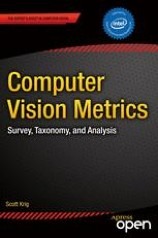
Computer Vision Metrics : Survey, Taxonomy, and Analysis
Computer Vision Metrics provides an extensive survey and analysis of over 100 current and historical feature description and machine vision methods, with a detailed taxonomy for local, regional and global features. This book provides necessary background to develop intuition about why interest point detectors and feature descriptors actually work, how they are designed, with observations about tuning the methods for achieving robustness and invariance targets for specific applications. The survey is broader than it is deep, with over 540 references provided to dig deeper. The taxonomy includes search methods, spectra components, descriptor representation, shape, distance functions, accuracy, efficiency, robustness and invariance attributes, and more.

Computer Vision in Human-Computer Interaction ; Vol.3979 ; ECCV 2006 Workshop on HCI, Graz, Austria, May 13, 2006, Proceedings
This volume presents the proceedings of the HCI 2006 Workshop, held in conjunction with ECCV 2006 (European Conference on Computer Vision) in Graz, Austria. The goal of this workshop was to bring together researchers from the field of computer vision whose work is related to human–computer interaction.

Computer vision in human-computer interaction ; Vol. 3766
Human-Computer Interaction (HCI) lies at the crossroads of many scienti?c areas including arti?cial intelligence, computer vision, face recognition, motion tracking, etc. In order for HCI systems to interact seamlessly with people, they need to understand their environment through vision and auditory input. Mo- over, HCI systems should learn how to adaptively respond depending on the situation. The goal of this workshop was to bring together researchers from the ?eld of computer vision whose work is related to human-computer interaction. The selected articles for this workshop address a wide range of theoretical and - plication issues in human-computer interaction ranging from human-robot - teraction, gesture recognition, and body tracking, to facial features analysis and human-computer interaction systems.

Computer vision approaches to medical image analysis ; 2nd International ECCV Workshop, CVAMIA 2006, Graz, Austria, May 12, 2006, Revised Papers
This was the second time that a satellite workshop,solely devoted to medical image analysis issues, was held in conjunction with the European Conference on Computer Vision (ECCV). We received 38 full-length paper submissions to the second Computer Vision Approaches to Medical Image Analysis (CVAMIA) Workshop, out of which 10 were accepted for oral and 11 for poster presentation after a rigorous peer-review process. In addition, the workshop included three invited talks.

Computer vision : Algorithms and applications
Explores the variety of techniques used to analyze and interpret images. It also describes challenging real-world applications where vision is being successfully used, both in specialized applications such as image search and autonomous navigation, as well as for fun, consumer-level tasks that students can apply to their own personal photos and videos. Suitable for an upper-level undergraduate or graduate-level course in computer science or engineering, this textbook focuses on basic techniques that work under real-world conditions and encourages students to push their creative boundaries. Its design and exposition also make it eminently suitable as a unique reference to the fundamental techniques and current research literature in computer vision.
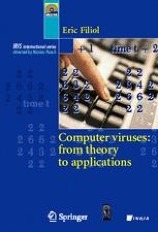
Computer Viruses : from theory to applications
The purpose of this book is to propose a teaching approach to under- 1 stand what computer viruses really are and how they work. To do this, three aspects are covered ranging from theoretical fundamentals, to pr- tical applications and technical features; fully detailed, commented source 1 We will systematically use the plural form “viruses” instead of the litteral one “virii”. The latter is now an obsolete, though gramatically recommended, form. VIII Preface codes of viruses as well as inherent applications are proposed. So far, the applications-oriented aspects have hardly ever been addressed through the scarce existing literature devoted to computer viruses.

Computer organization and design, enhanced : The hardware / software interface ; 5th ed.
Contains new examples and material highlighting the emergence of mobile computing and the cloud. It explores this generational change with updated content featuring tablet computers, cloud infrastructure, and the ARM (mobile computing devices) and x86 (cloud computing) architectures. The book uses a MIPS processor core to present the fundamentals of hardware technologies, assembly language, computer arithmetic, pipelining, memory hierarchies and I/O.Because an understanding of modern hardware is essential to achieving good performance and energy efficiency, this edition adds a new concrete example, Going Faster, used throughout the text to demonstrate extremely effective optimization techniques. There is also a new discussion of the Eight Great Ideas of computer architecture.

Computer organization and design : The hardware / software interface ; 6th ed.
Designed to be used in modern computing environments such as cloud computing, mobile devices, and other embedded systems. With the post-PC era now upon us, Computer Organization and Design moves forward to explore this generational change with examples, exercises, and material highlighting the emergence of mobile computing and the Cloud. Updated content featuring tablet computers, Cloud infrastructure, and the x86 (cloud computing) and ARM (mobile computing devices) architectures is included

Computer Music Modeling and Retrieval. Sense of Sounds ; 4th International Symposium, CMMR 2007, Copenhagen, Denmark, August 27-31, 2007. Revised Papers
This book constitutes the thoroughly refereed post-conference proceedings of the 4th International Computer Music Modeling and Retrieval Symposium, CMMR 2007, held in Copenhagen, Denmark, in August 2007 jointly with the International Computer Music Conference 2007, ICMC 2007.

Computer Analysis of Images and Patterns ; 12th International Conference, CAIP 2007, Vienna, Austria, August 27-29, 2007, Proceedings
This volume covers motion detection and tracking, medical imaging, biometrics, color, curves and surfaces beyond two dimensions, reading characters, words and lines, image segmentation, shape, image registration and matching, signal decomposition and invariants, and features and classification.
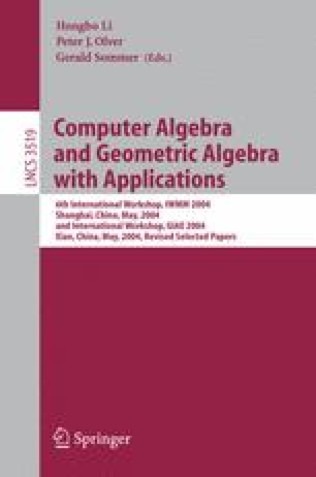
Computer algebra and geometric algebra with applications ; 6th International Workshop, IWMM 2004, Shanghai, China, May 19-21, 2004 and International Workshop, GIAE 2004, Xian, China, May 24-28, 2004.Revised Selected Papers
MathematicsMechanization consistsoftheory,softwareandapplicationofc- puterized mathematical activities such as computing, reasoning and discovering. ItsuniquefeaturecanbesuccinctlydescribedasAAA(Algebraization,Algori- mization, Application). The name “Mathematics Mechanization” has its origin in the work of Hao Wang (1960s), one of the pioneers in using computers to do research in mathematics, particularly in automated theorem proving. Since the 1970s, this research direction has been actively pursued and extensively dev- oped by Prof. Wen-tsun Wu and his followers. It di?ers from the closely related disciplines like Computer Mathematics, Symbolic Computation and Automated Reasoning in that its goal is to make algorithmic studies and applications of mathematics the major trend of mathematics development in the information age.

Computational science and its applications– ICCSA 2007 ; International Conference, Kuala Lumpur, Malaysia, August 26-29, 2007. Proceedings, Part II
This volume feature outstanding papers that present a wealth of original research results in the field of computational science, from foundational issues in computer science and mathematics to advanced applications in almost all sciences that use computational techniques.

Computational science and its applications – ICCSA 2007 ; International Conference, Kuala Lumpur, Malaysia, August 26-29, 2007. Proceedings, Part III
This volume feature outstanding papers that present a wealth of original research results in the field of computational science, from foundational issues in computer science and mathematics to advanced applications in almost all sciences that use computational techniques.
