


Refine Results
Sort By
From
To

Presents some spectacular new results in the area of decoding algorithms for error-correcting codes. Specifically, it shows how the notion of “list-decoding” can be applied to recover from far more errors, for a wide variety of err- correcting codes, than achievable before. A brief bit of background : error-correcting codes are combinatorial str- tures that show how to represent (or “encode”) information so that it is - silient to a moderate number of errors. Speci?cally, an error-correcting code takes a short binary string, called the message, and shows how to transform it into a longer binary string, called the codeword, so that if a small number of bits of the codewordare ?ipped, the resulting string does not look like any other codeword. The maximum number of errorsthat the code is guaranteed to detect, denoted d, is a central parameter in its design. A basic property of such a code is that if the number of errors that occur is known to be smaller than d/2, the message is determined uniquely. This poses a computational problem, called the decoding problem : compute the message from a corrupted codeword, when the number of errors is less than d/2.
The basic ideas underlying knowledge visualization and information vi- alization are outlined. In a short preview of the contributions of this volume, the idea behind each approach and its contribution to the goals of the book are outlined. 2 The Basic Concepts of the Book Three basic concepts are the focus of this book: "data", "information", and "kno- edge". There have been numerous attempts to define the terms "data", "information", and "knowledge", among them, the OTEC Homepage "Data, Information, Kno- edge, and Wisdom" (Bellinger, Castro, & Mills, see http://www.syste- thinking.org/dikw/dikw.htm): Data are raw. They are symbols or isolated and non-interpreted facts. Data rep- sent a fact or statement of event without any relation to other data. Data simply exists and has no significance beyond its existence (in and of itself). It can exist in any form, usable or not. It does not have meaning of itself.
Addresses the fundamentals of kernel methods for machine learning by considering relevant math problems and building Python programs. The book’s main features are as follows: Includes 100 exercises, which have been carefully selected and refined. As their solutions are provided in the main text, readers can solve all of the exercises by reading the book. / The mathematical premises of kernels are proven and the correct conclusions are provided, helping readers to understand the nature of kernels. / Source programs and running examples are presented to help readers acquire a deeper understanding of the mathematics used. / Once readers have a basic understanding of the functional analysis topics covered in Chapter 2, the applications are discussed in the subsequent chapters. Here, no prior knowledge of mathematics is assumed. / Considers both the kernel for reproducing kernel Hilbert space (RKHS) and the kernel for the Gaussian process; a clear distinction is made between the two.

Presents the most interesting talks given at ISSE 2006 - the forum for the interdisciplinary discussion of how to adequately secure electronic business processes. The topics include: Smart Token and e-ID-Card Developments and their Application - Secure Computing and how it will change the way we trust computers - Risk Management and how to quantify security threats - Awareness raising, Data Protection and how we secure corporate information. Adequate information security is one of the basic requirements of all electronic business processes. It is crucial for effective solutions that the possibilities offered by security technology can be integrated with the commercial requirements of the applications. The reader may expect state-of-the-art: best papers of the Conference ISSE 2006.

This book is written for members of the scholarly research community, and for persons involved in research evaluation and research policy. More specifically, it is directed towards the following four main groups of readers: – All scientists and scholars who have been or will be subjected to a quantitative assessment of research performance using citation analysis. – Research policy makers and managers who wish to become conversant with the basic features of citation analysis, and about its potentialities and limitations. – Members of peer review committees and other evaluators, who consider the use of citation analysis as a tool in their assessments. – Practitioners and students in the field of quantitative science and technology studies, informetrics, and library and information science. Citation analysis involves the construction and application of a series of indicators of the ‘impact’, ‘influence’ or ‘quality’ of scholarly work, derived from citation data, i.e. data on references cited in footnotes or bibliographies of scholarly research publications. Such indicators are applied both in the study of scholarly communication and in the assessment of research performance. The term ‘scholarly’ comprises all domains of science and scholarship, including not only those fields that are normally denoted as science – the natural and life sciences, mathematical and technical sciences – but also social sciences and humanities.
This book provides a gentle, software engineering oriented introduction to category theory. Assuming only a minimum of mathematical preparation, this book explores the use of categorical constructions from the point of view of the methods and techniques that have been proposed for the engineering of complex software systems: object-oriented development, software architectures, logical and algebraic specification techniques, models of concurrency, inter alia. After two parts in which basic and more advanced categorical concepts and techniques are introduced, the book illustrates their application to the semantics of CommUnity – a language for the architectural design of interactive systems. "For computer scientists, this unique book presents Category Theory in a manner tailored to their interests and with examples to which they can relate." Ira Forman, IBM "This book applies little-known yet quite powerful formal tools from category theory to software structures: designs, architectures, patterns, and styles. Rather than focus on issues at the level of computational models and semantics, it instead applies these tools to some of the problems facing the sophisticated software architect.
In this book, a team of renowned web designers take you through the ins and outs of putting together great blogs. They waste no time harking on about the philosophy of blogs, or the community behind them. Instead, they get straight to the practical details, showing how to set up a basic blog in some of the world's most popular blogging engines Movable Type, ExpressionEngine, WordPress, and Textpattern. With your blog set up, they then show you how to build great looking, usable layouts for your blog. The last chapter even shows you how to build your very own PHP/MySQL-based blog engine!

The book explains the security architecture model and the practice of building data sharing from the blockchain infrastructure, allowing readers to understand the importance of data sharing security based on the blockchain framework, as well as the threats to security and privacy. Further, by presenting specific data sharing case studies, it offers insights into solving data security sharing problems in more practical fields. The book is intended for readers with a basic understanding of the blockchain infrastructure, consensus mechanisms, smart contracts, secure multiparty computing, homomorphic encryption and image retrieval technologies.
Discusses data mining, biomedical image processing, information retrieval with broad coverage of basic scientific applications. covers the topic of mining biomedical text, images and visual features towards information retrieval. Biomedical and health informatics is an emerging field of research at the intersection of information science, computer science, and healthcare and brings tremendous opportunities and challenges due to easily available and abundant biomedical data for further analysis. The aim of healthcare informatics is to ensure the high-quality, efficient healthcare, better treatment and quality of life by analyzing biomedical and healthcare data including patient’s data, electronic health records (EHRs) and lifestyle. Previously, it was a common requirement to have a domain expert to develop a model for biomedical or healthcare; however, recent advancements in representation learning algorithms allows us to automatically to develop the model. Biomedical image mining, a novel research area, due to the vast amount of available biomedical images, increasingly generates and stores digitally.
This book highlights basic paradigms of problem analysis and algorithm design in the context of core bioinformatics problems. Mathematically demanding themes are put across to the reader by properly chosen representations with the aid of lots of illustrations.

Presents an evaluation of nanotechnologies outputs (academic outputs and patents) and their impact from 2000-2019. The evaluation uses Elsevier’s Scopus (the largest abstract and citation database of peer-reviewed literature), SciVal (a scientific research analysis platform), Funding Institutional (a funding database), and PatentSight (a patent analysis platform). It covers four key topics regarding nanoscience research, including: 1) An overview of nano-related scholarly output, 2) Nanoscience and its contribution to basic science, 3) Nanoscience and its impact on and collaboration with industry partners, and 4) Key factors that promote the development of nanoscience.
Not everything that counts can be counted. Not everything that is counted counts. Albert Einstein This is a book about software measurement from the practitioner’s point of view and it is a book for practitioners. Software measurement needs a lot of practical guidance to build upon experiences and to avoid repeating errors. This book t- gets exactly this need, namely to share experiences in a constructive way that can be followed. It tries to summarize experiences and knowledge about software measurement so that it is applicable and repeatable. It extracts experiences and lessons learned from the narrow context of the specific industrial situation, thus facilitating transfer to other contexts. Software measurement is not at a standstill. With the speed software engine- ing is evolving, software measurement has to keep pace. While the underlying theory and basic principles remain invariant in the true sense (after all, they are not specific to software engineering), the application of measurement to specific contexts and situations is continuously extended. The book thus serves as a ref- ence on these invariant principles as well as a practical guidance on how to make software measurement a success.
This book presents a set of basic techniques for estimating the benefit of IT development projects and portfolios. It also offers methods for monitoring how much of that estimated benefit is being achieved during projects. Readers can then use these benefit estimates together with cost estimates to create a benefit/cost index to help them decide which functionalities to send into construction and in what order. This allows them to focus on constructing the functionality that offers the best value for money at an early stage.
Beginning XML with C# 2008 focuses on XML and how it is used within .NET 3.5. As you'd expect of a modern application framework, .NET 3.5 has extensive support for XML in everything from data access to configuration, from raw parsing to code documentation. This book demystifies all of this. It explains the basics of XML as well as the namespaces and objects you need to know in order to work efficiently with XML. You will see clear, practical examples that illustrate best practices in action. With this book, you'll learn everything you need to know from the basics of reading and writing XML data to using the DOM, from LINQ and SQL Server integration to SOAP and web services.
Beginning Perl Web Development: From Novice to Professional introduces you to the world of Perl Internet application development. This book tackles all areas crucial to developing your first web applications and includes a powerful combination of real-world examples coupled with advice. Topics range from serving and consuming RSS feeds, to monitoring Internet servers, to interfacing with e-mail. You'll learn how to use Perl with ancillary packages like Mason and Nagios. Though not version-specific, this book is an ideal read if you have had some grounding in Perl basics and now want to move into the world of web application development. Author Steve Suehring emphasizes the security implications of Perl, drawing on years of experience teaching readers how to think safe, avoid common pitfalls, and produce well-planned, secure code.
Beginning Web Programming in VB .NET: From Novice to Professional will teach you the fundamentals of the web environment and how Visual Studio .NET (VS .NET) makes it accessible to VB programmers. You'll build a working website that demonstrates all the elements of a VB web application. Author Daniel Cazzulino takes a step-by-step approach to each example to explore the essential technologies and how VS .NET helps to integrate them into a highly interactive, attractive web application.
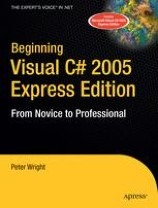
Wright took the same approach with this book that he did with the VB titles, and inside you'll find a fast–paced guide to the essentials to get you programming fast. You'll learn the C# language and the tools Visual C# 2005 Express provides. He covers everything from simple console programs to code that talks to the Internet, and even how to write your own database programs. Whatever your reasons for wanting to learn to program with C#, this book will get you where you want to be quickly, and hopefully with a smile on your face. So dive in and change the way you use computers forever.
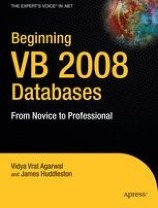
Beginning VB 2008 Databases teaches you everything you need to know about relational databases, SQL, and ADO.NET 2.0, giving you a sound start in developing console and Windows database applications. The book also includes chapters on the SQL Server XML data type and the LINQ enhancements to the next version of Visual Basic. In addition to teaching you database basics like using SQL to communicate with databases, this book provides you with detailed, code-practical techniques to access data in Visual Basic 2008 across a range of coding situations. Code-heavy and full of practical detail, this book has been fully revised and upgraded for .NET 3.5 and offers you the best contemporary practice in this core programming area, so that you'll find yourself using it in nearly all your .NET projects.
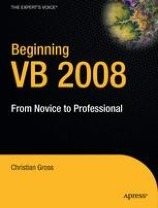
This book is for anyone who wants to write good Visual Basic 2008 code, even if you have never programmed before. Writing good code can be a challenge, there are so many options, especially in a language like Visual Basic. If you want to really get the best from a programming language you need to know which features work best in which situations and understand their strengths and weaknesses. It is this understanding that makes the difference between coding and coding well.
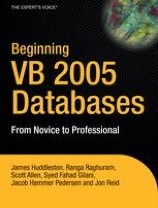
Beginning Visual Basic 2005 Databases teaches you everything you need to know about relational databases, SQL, and ADO.NET 2.0, giving you a sound start in developing console and Windows database applications. The book also includes chapters on the new SQL Server XML data type and the forthcoming LINQ enhancements to the next version of Visual Basic.

Daraa Highway - Ghabagheb - Syria
+963-15 2050 - 15 860 380 /1/2/3 - 11 662 3900