


Refine Results
Sort By
From
To

The book – the first of its kind – establishes new theory and knowledge in the area of third sector organizations (TSOs) in Asia. The main purpose of this book is to draw the attention of Asia's TSOs on the importance of good governance. It documents variety of approaches, and identifies socio-cultural, economic, and political dynamics and impacts of different models of TSO governance. The combined information from the contributions in this work will ensure the sustainability of TSOs throughout Asia.
Decision making in environmental projects is typically a complex and confusing process characterized by trade-offs between socio-political, environmental, and economic impacts. Comparative Risk Assessment (CRA) is a methodology applied to facilitate decision making when various activities compete for limited resources. CRA has become an increasingly accepted research tool and has helped to characterize environmental profiles and priorities on the regional and national level. CRA may be considered as part of the more general but as yet quite academic field of multi-criteria decision analysis (MCDA). Considerable research in the area of MCDA has made available methods for applying scientific decision theoretical approaches to multi-criteria problems, but its applications, especially in environmental areas, are still limited. The papers show that the use of comparative risk assessment can provide the scientific basis for environmentally sound and cost-efficient policies, strategies, and solutions to our environmental challenges.
This book portrays men’s experiences of home alone leave and how it affects their lives and family gender roles in different policy contexts and explores how this unique parental leave design is implemented in these contrasting policy regimes. The book brings together three major theoretical strands: social policy, in particular the literature on comparative leave policy developments; family and gender studies, in particular the analysis of gendered divisions of work and care and recent shifts in parenting and work-family balance; critical studies of men and masculinities, with a specific focus on fathers and fathering in contemporary western societies and life-courses. Drawing on empirical data from in-depth interviews with fathers across eleven countries, the book shows that the experiences and social processes associated with fathers’ home alone leave involve a diversity of trends, revealing both innovations and absence of change, including pluralization as well as the constraining influence of policy, gender, and social context.
It is fairly easy for a Finnish Jurist to understand German Company law. On the other hand, UK Company law seems very confusing. What is even more confusing is that the UK corporate govemance model is often regarded as one of the best in the World. Clearly German law cannot be as bad as it is often said to be. This books results from these kinds of thoughts and an interest in comparative law, Company law and securities markets law. I wanted to find out whether the functional method would give anything new to say about the regulation of corpo rate govemance in Germany and the UK. As I have been lecturing on Company law and corporate govemance myself, I also wanted to write a book that I could use as a textbook in my courses. For this reason, I focused on one of the key questions in corporate govemance: the regula tion of shareholder activism.
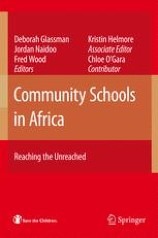
Over the past decade, community schools similar to those supported by Save the Children have been established in many developing countries, and especially in sub-Saharan Africa. As large numbers of children attend schools started and managed by their own communities and/or by nongovernmental organizations, questions have come up about the impact of such schools at large scale: "Can village-based or community schools have a national impact on access to education, spur improved long-term development strategies and education policy, or achieve or influence Education for All? This book explores these and related questions, drawing on Save the Children’s experience with community-based schooling in four countries: Ethiopia, Malawi, Mali, and Uganda.
Offers critical insights into the thriving international field of community indicators, incorporating the experiences of government leaders, philanthropic professionals, community planners and a wide range of academic disciplines. It illuminates the important role of community indicators in diverse settings and the rationale for the development and implementation of these innovative projects. details many of the practical “how to” aspects of the field as well as lessons learned from implementing indicators in practice. The case studies included here also demonstrate how, using a variety of data applications, leaders of today are monitoring and measuring progress and communities are empowered to make sustainable improvements in their wellbeing.
This book is second in a series covering best practices in community quality-of-life (QOL) indicators. The first volume in this series is a compilation of cases of best work in community indicators research. This second volume continues to build on the goal of the series and includes eleven cases (chapters). The cases in both volumes describe communities that have launched their own community indicators programs.
This open access volume is about how to research the influence of our changing media environment. Today, there is not one single medium that is the driving force of change. With the spreading of various technical communication media such as mobile phone and internet platforms, we are confronted with a media manifold of deep mediatization. But how can we investigate its transformative capability? This book answers this question by taking a non-media-centric perspective, researching the various figurations of collectivities and organizations humans are involved in. The first part of the book outlines a fundamental understanding of the changing media environment of deep mediatization and its transformative capacity. The second part focuses on collectivities and movements: communities in the city, critical social movements, maker, online gaming groups and networked groups of young people. The third part moves institutions and organizations into the foreground, discussing the transformation of journalism, religion, politics, and education, whilst the fourth and final part is dedicated to methodologies and perspectives.
In other words, this book is a call for a paradigm shift in the study of oral communication. It is a must read for people interested in language use, as well as for specialists in language studies. "The authors have identified crucial theoretical and methodological assumptions that have hampered scholarship on language use. Their critical assessment is grounded in nuanced theoretical analysis and rigorous empirical studies. As a result, they reveal the complexity, elegance, and moral aspects of day to day dialogical communication."
Science communication, as a multidisciplinary field, has developed remarkably in recent years. It is now a distinct and exceedingly dynamic science that melds theoretical approaches with practical experience. Formerly well-established theoretical models now seem out of step with the social reality of the sciences, and the previously clear-cut delineations and interacting domains between cultural fields have blurred. Communicating Science in Social Contexts examines that shift, which itself depicts a profound recomposition of knowledge fields, activities and dissemination practices, and the value accorded to science and technology.
Addresses the engagement between science and society from multiple viewpoints. At a time when trust in experts is being questioned, misinformation is rife and scientific and technological development show growing social impact, the volume examines the challenges in involving the public in scientific debates and decisions. It takes into account societal needs and concerns in research, and analyses the interface between the roles of institutions and individuals. From environmental challenges to science communication, participatory technological design to animal experimentation, and transdisciplinarity to norms and values in science, the volume brings together research on areas in which scientists and citizens interact, across diverse, often understudied, socio-cultural contexts in Europe.
This book presents histories of the WCCES and its member societies. It shows ways in which the field has changed over the decades, and the forces which have shaped it in different parts of the world. The book demonstrates that while comparative education can be seen as a single global field, it has different characteristics in different countries and cultures. In this sense, the book presents a comparison of comparisons.

This book begins with a traditional review of the basic internal and external morphology, major nerve and fiber tracts, behavioral correlates, and clinical syndromes associated with spinal cord, brain stem, and cerebellum designed to reacquaint students and practicing clinicians with the functional anatomy of the subtentorial central nervous system. However, as the text was specifically geared to meet the needs of those practitioners whose primary interest is in what might be termed "higher order cognitive-behavioral function," the main focus of the text is on the brain itself. Borrowing heavily from a Lurian tradition, the central chapters reflect an attempt to offer more detailed, integrated, and, at times, theoretical models of cortical systems and their internal organization. Additional chapters highlight vascular anatomy and associated pathology, as well as neurochemical systems and their potential clinical relevance.
This book focuses upon climate processes, variability and change and applies the general principles related to these issues, particularly in Switzerland. Although a small country, Switzerland is characterized by complex topography where climatic processes are often enhanced due to the presence of the Alps. In addition, there is a remarkable density of observational data in both the natural and social sciences that enable a comprehensive assessment of climate processes, their long-term trends and their impacts. This book is intended for students from the undergraduate level onwards and researchers interested in climate issues specific to the alpine region.
climate change focussing on technical solutions for the most important and climate relevant economic sectors is presented. It is intended for key decision makers, and administrators within industry, agricultural and energy sectors, as well as masters students and post graduates. The first of three sections covers the scientific basis of climate change and the instruments to prevent or reduce negative climate effects. It includes a survey covering current practices at different levels.It discusses evaluation methods for climate impacts from industrial processes. Climate relevant processes and measures to reduce their impact such as sequestration are defined in the final section, with the main focus being on renewable resources. Details are given on climate impacts of waste prevention, recycling and waste management as well as are proposals for every day solutions.
This the workshop proceedings present an overview of the implications of climate change for the eastern Mediterranean and the impact of climate change response on regional economic activity, particularly in the hydrocarbon industry.
When the ?rst edition of this book was published in 2004, the following year 2005 has happened to have been the warmest year since 1880, when the ?rst reliable worldwide instrumental records came into existance. Claiming no li- age between the publication of our book and the temperature record, yet this record demonstrates the trend of increase in the global surface temperatures during thepast20years,reinforcedbyevidenceofriseofatmosphere’sand oceans’ temperatures, and increased melting of ice and snow in the arctic and antarctic regions as well as on mountain tops. All these observations are par- leled by the increase in the quantity of heat trapping gases in the atmosphere, causing most probably, the global greenhouse effect. In order to try and predict, what might be the impact of this effect on the on the natural and human environments of the Near East, (Figs. 1–1d) the authors adopted the saying that the past is the key for the future. The practical conclusion of this principle says that the acquiring knowledge of the impact of past climate changes on the nature and human societies, may allow conclusions with regard to future possible impact of climate changes. By correlating proxy data of all types, paleo-sea and lake levels, paleo-hydrology, pollen pro?les, environmental isotopes as well as archaeological and historical documents, the authors tried to collect as much as possible of this knowledge.
In many parts of the world, climatic variations are recognized as one of the major factors contributing to land degradation impacting on agricultural systems performance and management. To accurately assess sustainable land management practices, the climate resources and the risk of climate-related or induced natural disasters in a region must be known. Only when climate resources are paired with management or development practices can the land degradation potential be assessed and appropriate mitigation technologies be developed. This book is based on an International Workshop held in Arusha, Tanzania and should be of interest to all organizations and agencies interested in sustainable land management to arrest land degradation.
Classical Methods of Statistics is a blend of theory and practical statistical methods written for graduate students and researchers interested in applications to plasma physics and its experimental aspects. It can also fruitfully be used by students majoring in probability theory and statistics. In the first part, the mathematical framework and some of the history of the subject are described. Many exercises help readers to understand the underlying concepts. In the second part, two case studies are presented exemplifying discriminant analysis and multivariate profile analysis. The introductions of these case studies outline contextual magnetic plasma fusion research. In the third part, an overview of statistical software is given and, in particular, SAS and S-PLUS are discussed. In the last chapter, several datasets with guided exercises, predominantly from the ASDEX Upgrade tokamak, are included and their physical background is concisely described. The book concludes with a list of essential keyword translations.

This book is based on real inner product spaces X of arbitrary (finite or infinite) dimension greater than or equal to 2. With natural properties of (general) translations and general distances of X, euclidean and hyperbolic geometries are characterized. For these spaces X also the sphere geometries of Möbius and Lie are studied (besides euclidean and hyperbolic geometry), as well as geometries where Lorentz transformations play the key role. The geometrical notions of this book are based on general spaces X as described. This implies that also mathematicians who have not so far been especially interested in geometry may study and understand great ideas of classical geometries in modern and general contexts.

Daraa Highway - Ghabagheb - Syria
+963-15 2050 - 15 860 380 /1/2/3 - 11 662 3900