


Refine Results
Sort By
From
To

Natural phenomena can be visually described with fractal-geometry methods, where iterative procedures rather than equations are used to model objects. With the development of better modelling algorithms, the efficiency of rendering, the realism of computer-generated scenes and the interactivity of visual stimuli are reaching astonishing levels. Iterated Function Systems for Real-Time Image Synthesis gives an explanation of iterated function systems and how to use them in generation of complex objects.
The purpose of this book is to present current status of this technology by looking at its application in different domains, such as electronic markets, e-tourism, ambience intelligence, and complex system analysis.It starts by discussing software engineering issues for the development of multi-agent systems, how much it costs to build a multi-agent system, and which methods and tools are currently available. Next chapters present some of the most relevant aspects that are considered for the development of multi-agent systems.
This book covers automata in depth, providing good intuitions along the way, and culminating with applications that are used every day in the field. In this respect, it is a departure from the conventional textbooks on complexity and computability, although these 'tradtional' aspects remain well represented.
Embedded systems are ubiquitous. They appear in cell phones, microwave ovens, refrigerators, consumer electronics, cars, and jets. Some of these embedded s- tems are safety- or security-critical such as in medical equipment, nuclear plants, and X-by-wire control systems in naval, ground and aerospace transportation - hicles. With the continuing shift from hardware to software, embedded systems are increasingly dominated by embedded software. Embedded software is complex. Its engineering inherently involves a mul- disciplinary interplay with the physics of the embedding system or environment. Embedded software also comes in ever larger quantity and diversity. The next generation of premium automobiles will carry around one gigabyte of binary code. The proposed US DDX submarine is e?ectively a ?oating embedded so- ware system, comprising 30 billion lines of code written in over 100 programming languages. Embedded software is expensive. Cost estimates are quoted at around US$15– 30 per line (from commencement to shipping). In the defense realm, costs can range up to $100, while for highly critical applications, such as the Space Shuttle, the cost per line approximates $1,000. In view of the exponential increase in complexity, the projected costs of future embedded software are staggering.
Modern cryptology employs mathematically rigorous concepts and methods from complexity theory. Conversely, current research in complexity theory often is motivated by questions and problems arising in cryptology. This book takes account of this trend, and therefore its subject is what may be dubbed "cryptocomplexity,'' some sort of symbiosis of these two areas. This textbook is suitable for undergraduate and graduate students of computer science, mathematics, and engineering, and can be used for courses on complexity theory and cryptology, preferably by stressing their interrelation. Starting from scratch, it is an accessible introduction to cryptocomplexity and works its way to the frontiers of current research. It provides the necessary mathematical background, has numerous figures, exercises, and examples, and presents some central, up-to-date research topics and challenges. Due to its comprehensive bibliography and subject index, it is also a valuable source for researchers, teachers, and practitioners working in these fields.
Complexity theory is the theory of determining the necessary resources for the solution of algorithmic problems and, therefore, the limits of what is possible with the available resources. An understanding of these limits prevents the search for non-existing efficient algorithms. This textbook considers randomization as a key concept and emphasizes the interplay between theory and practice: New branches of complexity theory continue to arise in response to new algorithmic concepts, and its results - such as the theory of NP-completeness - have influenced the development of all areas of computer science. The topics selected have implications for concrete applications, and the significance of complexity theory for today's computer science is stressed throughout.
This state-of-the-art survey contains the papers that were invited by the organizers after conclusion of an International Dagstuhl-Seminar on Complexity of Constraints, held in Dagstuhl Castle, Germany, in October 2006.
The book discusses major topics in complex analysis with applications to number theory.It 's including the theory of several finitely and infinitely complex variables, hyperbolic geometry, two- and three-manifolds, and number theory. In addition to solved examples and problems, the book covers most topics of current interest, such as Cauchy theorems, Picard’s theorems, Riemann–Zeta function, Dirichlet theorem, Gamma function, and harmonic functions.
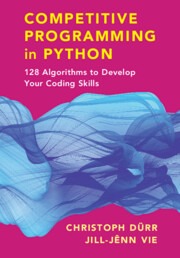
Learn all the algorithmic techniques and programming skills you need from two experienced coaches, problem setters, and jurors for coding competitions. The authors highlight the versatility of each algorithm by considering a variety of problems and show how to implement algorithms in simple and efficient code. What to expect: * Master 128 algorithms in Python. * Discover the right way to tackle a problem and quickly implement a solution of low complexity.
Covers the central ideas and concepts of chaos and fractals as well as many related topics including: the Mandelbrot set, Julia sets, cellular automata, L-systems, percolation and strange attractors.
This book provides a gentle, software engineering oriented introduction to category theory. Assuming only a minimum of mathematical preparation, this book explores the use of categorical constructions from the point of view of the methods and techniques that have been proposed for the engineering of complex software systems: object-oriented development, software architectures, logical and algebraic specification techniques, models of concurrency, inter alia. After two parts in which basic and more advanced categorical concepts and techniques are introduced, the book illustrates their application to the semantics of CommUnity – a language for the architectural design of interactive systems. "For computer scientists, this unique book presents Category Theory in a manner tailored to their interests and with examples to which they can relate." Ira Forman, IBM "This book applies little-known yet quite powerful formal tools from category theory to software structures: designs, architectures, patterns, and styles. Rather than focus on issues at the level of computational models and semantics, it instead applies these tools to some of the problems facing the sophisticated software architect.
This book highlights basic paradigms of problem analysis and algorithm design in the context of core bioinformatics problems. Mathematically demanding themes are put across to the reader by properly chosen representations with the aid of lots of illustrations.

Covers analytical techniques for handling the huge amount of data generated by the Internet of Things, from architectures and platforms to security and privacy issues, applications, and challenges as well as future directions. The fields of Big Data and the Internet of Things (IoT) have seen tremendous advances, developments, and growth in recent years. The IoT is the inter-networking of connected smart devices, buildings, vehicles and other items which are embedded with electronics, software, sensors and actuators, and network connectivity that enable these objects to collect and exchange data. The IoT produces a lot of data. Big data describes very large and complex data sets that traditional data processing application software is inadequate to deal with, and the use of analytical methods to extract value from data. This edited book covers analytical techniques for handling the huge amount of data generated by the Internet of Things, from architectures and platforms to security and privacy issues, applications, and challenges as well as future directions.

Combines experimental and theoretical research on big data recommender systems to help computer scientists develop new concepts and methodologies for complex applications. It includes original scientific contributions in the form of theoretical foundations, comparative analysis, surveys, case studies, techniques and tools. First designed to generate personalized recommendations to users in the 90s, recommender systems apply knowledge discovery techniques to users’ data to suggest information, products, and services that best match their preferences. In recent decades, we have seen an exponential increase in the volumes of data, which has introduced many new challenges. recommender systems. Volume 2 covers a broad range of application paradigms for recommender systems over 22 chapters

Combines experimental and theoretical research on big data recommender systems to help computer scientists develop new concepts and methodologies for complex applications. It includes original scientific contributions in the form of theoretical foundations, comparative analysis, surveys, case studies, techniques and tools.

The book is devoted to the analysis of big data in order to extract from these data hidden patterns necessary for making decisions about the rational behavior of complex systems with the different nature that generate this data. To solve these problems, a group of new methods and tools is used, based on the self-organization of computational processes, the use of crisp and fuzzy cluster analysis methods, hybrid neural-fuzzy networks, and others. The book solves various practical problems. In particular, for the tasks of 3D image recognition and automatic speech recognition large-scale neural networks with applications for Deep Learning systems were used.
Beginning POJOs introduces you to open source lightweight web development using Plain Old Java Objects (POJOs) and the tools and frameworks that enable this. Tier by tier, this book guides you through the construction of complex but lightweight enterprise Java-based web applications. Such applications are centered around several major open source lightweight frameworks, including Spring, Hibernate, Tapestry, and JBoss (including the new lightweight JBoss Seam). This book is ideal if you're new to open source and lightweight Java. You'll learn how to build a complete enterprise Java-based web application from scratch, and how to integrate the different open source frameworks to achieve this goal.
Autonomy Oriented Computing explores the important theoretical and practical issues in AOC, by analyzing methodologies and presenting experimental case studies. The book serves as a comprehensive reference source for researchers, scientists, engineers, and professionals in all fields concerned with this promising new development in computer science. It can also be used as a main or supplementary text in graduate and undergraduate programs across a broad range of computer-related disciplines, including Robotics and Automation, Amorphous Computing, Image Processing and Computer Vision, Programming Paradigms, Computational Biology, and many others. The first part of the book, Fundamentals, describes the basic concepts and characteristics of an AOC system, and then it enumerates the critical design and engineering issues faced in AOC system development. The second part of the book, AOC in Depth, provides a detailed analysis of methodologies and case studies to evaluate the use of AOC in problem solving and complex system modeling. The final chapter reviews the essential features of the AOC paradigm and outlines a number of possibilities for future research and development.
This book brings together leading academic researchers and industrial practitioners to address the issues in this emerging realm and presents the reader with a comprehensive introduction to the subject of speech recognition in devices and networks.
As individual needs have arisen in the fields of physics, electrical engineering and computational science, each has created its own theories of information to serve as conceptual instruments for advancing developments. This book provides a coherent consolidation of information theories from these different fields.It provides a versatile tool for quantifying complexity and information capacity in any physical system.

Daraa Highway - Ghabagheb - Syria
+963-15 2050 - 15 860 380 /1/2/3 - 11 662 3900