


Refine Results
Sort By
From
To


Biometric User Authentication for IT Security: From Fundamentals to Handwriting conveys general principals of passive (physiological trait like fingerprint, iris, face) and active (learned and trained behavior like voice, handwriting and gait) biometric recognition techniques to the reader. This professional book, unlike other publications in this area which concentrate on passive schemes, reflects a more comprehensive analysis of one particular active biometric technique: handwriting. Aspects which are thoroughly discussed include sensor characteristic dependency, attack scenarios, and the generation of cryptographic keys from handwriting.
The book reports the proceedings of the 15th Italian workshop on neural networks issued by the Italian Society on Neural Networks SIREN. The longevity recipe of this conference stands in three main points that normally renders the reading of these proceedings so interesting as appealing. 1. The topics of the neural networks is considered an attraction pole for a set of researches centered on the inherent paradigm of the neural networks, rather than on a specific tool exclusively. Thus, the subsymbolic management of the data information content constitutes the key feature of papers in various fields such as Pattern Recognition, Stochastic Optimization, Learning, Granular Computing, and so on, with a special bias toward bioinformatics operational applications. An excerpt of all these matters may be found in the book. 2. Though managed at domestic level, the conference attracts contributions from foreign researchers as well, so that in the book the reader may capture the flavor of the state of the art in the international community. 3. The conference is a meeting of friends as well. Thus the papers generally reflect a relaxed atmosphere where researchers meet to generously exchange their thought and explain their actual results in view of a common cultural growing of the community.
Solving modern biological problems requires advanced computational methods. Bioinformatics evolved from the active interaction of two fast-developing disciplines, biology and information technology. The central issue of this emerging field is the transformation of often distributed and unstructured biological data into meaningful information. This book describes the application of well-established concepts and techniques from areas like data mining, machine learning, database technologies, and visualization techniques to problems like protein data analysis, genome analysis and sequence databases. Chen has collected contributions from leading researchers in each area. The chapters can be read independently, as each offers a complete overview of its specific area, or, combined, this monograph is a comprehensive treatment that will appeal to students, researchers, and R&D professionals in industry who need a state-of-the-art introduction into this challenging and exciting young field.
In this textbook present mathematical models in bioinformatics and they describe the biological problems that inspire the computer science tools used to handle the enormous data sets involved. The first part of the book covers the mathematical and computational methods, while the practical applications are presented in the second part. The mathematical presentation is descriptive and avoids unnecessary formalism, and yet remains clear and precise. Emphasis is laid on motivation through biological problems and cross applications. Each of the four chapters in the first part is accompanied by exercises and problems to support an understanding of the techniques presented. Each of the six chapters of the second part is devoted to some specific application domain: sequence alignment, molecular phylogenetics and coalescence theory, genomics, proteomics, RNA, and DNA microarrays. Each chapter concludes with a problems and projects section, to deepen the reader's understanding and to allow for the design of derived methods. Many of the projects involve publicly available software and/or Web-based bioinformatics depositories. Finally, the book closes with a thorough bibliography, reaching from classic research results to very recent findings, providing many pointers for future research.Overall, this volume is ideally suited for a senior undergraduate or graduate course on bioinformatics, with a strong focus on its mathematical and computer science background.
Sheds new light on a selection of big data scenarios from an interdisciplinary perspective. It features legal, sociological and economic approaches to fundamental big data topics such as privacy, data quality and the ECJ’s Safe Harbor decision on the one hand, and practical applications such as smart cars, wearables and web tracking on the other. Addressing the interests of researchers and practitioners alike, it provides a comprehensive overview of and introduction to the emerging challenges regarding big data.All contributions are based on papers submitted in connection with ABIDA (Assessing Big Data), an interdisciplinary research project exploring the societal aspects of big data and funded by the German Federal Ministry of Education and Research.
Manipulating and processing masses of digital data is never a purely technical activity. It requires an interpretative and exploratory outlook - already well known in the social sciences and the humanities - to convey intelligible results from data analysis algorithms and create new knowledge. Big Data is based on an inquiry of several years within Proxem, a software publisher specializing in big data processing. The book examines how data scientists explore, interpret and visualize our digital traces to make sense of them, and to produce new knowledge. Grounded in epistemology and science and technology studies, Big Data offers a reflection on data in general, and on how they help us to better understand reality and decide on our daily actions.
Not everything that counts can be counted. Not everything that is counted counts. Albert Einstein This is a book about software measurement from the practitioner’s point of view and it is a book for practitioners. Software measurement needs a lot of practical guidance to build upon experiences and to avoid repeating errors. This book t- gets exactly this need, namely to share experiences in a constructive way that can be followed. It tries to summarize experiences and knowledge about software measurement so that it is applicable and repeatable. It extracts experiences and lessons learned from the narrow context of the specific industrial situation, thus facilitating transfer to other contexts. Software measurement is not at a standstill. With the speed software engine- ing is evolving, software measurement has to keep pace. While the underlying theory and basic principles remain invariant in the true sense (after all, they are not specific to software engineering), the application of measurement to specific contexts and situations is continuously extended. The book thus serves as a ref- ence on these invariant principles as well as a practical guidance on how to make software measurement a success.
Beginning XML with C# 2008 focuses on XML and how it is used within .NET 3.5. As you'd expect of a modern application framework, .NET 3.5 has extensive support for XML in everything from data access to configuration, from raw parsing to code documentation. This book demystifies all of this. It explains the basics of XML as well as the namespaces and objects you need to know in order to work efficiently with XML. You will see clear, practical examples that illustrate best practices in action. With this book, you'll learn everything you need to know from the basics of reading and writing XML data to using the DOM, from LINQ and SQL Server integration to SOAP and web services.
Beginning Web Development, Silverlight, and ASP.NET AJAX: From Novice to Professional aims to give you the skills you need to start building web applications with Microsoft's next–generation technology as quickly as possible. Whether you're interested in ASP.NET AJAX, Silverlight, or the technologies that support them (WPF, WCF, WF, etc.), this book is the starting point that you need. It adopts a “zero to hero” approach that concentrates on achieving practical results you can use in real projects rather than presenting a deep academic treatment that can't be immediately applied.
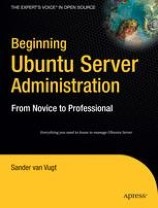
You love it as the world's most popular desktop Linux distribution, and now Ubuntu is available at a server near you. Embracing the very same features desktop users have grown to love, system administrators are rapidly adopting Ubuntu due to their ability to configure, deploy, and manage network services more effectively than ever. Beginning Ubuntu Server Administration guides you through all of the key configuration and administration tasks you'll need to know. Whether you're interested in adopting Ubuntu within a Fortune 500 environment or just want to use Ubuntu to manage your home network, this book is your go–to guide to using the distribution securely for a wide variety of network services. Topics include file, print, web, and FTP management, command–line tips and tricks, automated installation, configuration and deployment processes, and kernel management.
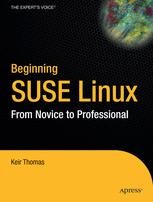
The book begins by discussing the background of Linux and open source software, then proceeds to guide you through the SUSE installation process. You'll learn how to use the basic functions, and modify the look and feel according to your tastes. This book is packed with troubleshooting tips, so even the most cautious beginner will feel right at home. Next, the book covers the daily usage tasks that are enjoyable and interesting to learn. You'll learn how to configure your system to listen to audio CDs and MP3s, burn CDs, watch movies, connect to the Internet, and reproduce common Windows tasks.
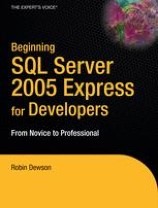
This book is a comprehensive guide that covers installing and configuring SQL Server 2005 Express, creating, backing up, and restoring databases, creating tables, then querying and manipulating them with T-SQL, coding stored procedures and triggers, and using Reporting Services to deliver information to end users.
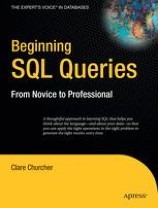
Clare Churcher's Beginning SQL Queries is your guide to mastering the lingua franca of the database industry: the SQL language. Good knowledge of SQL is crucial to anyone working with databases, because it is with SQL that you retrieve data, manipulate data, and generate business results. Knowing how to write good queries is the foundation for all work done in SQL, and it is a foundation that Clare lays well in her book.
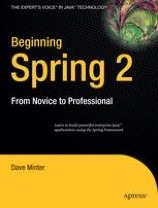
Beginning Spring 2 is the first Spring–authorized book that takes you through the first steps of using Spring, and requires no prior J2EE experience. It discusses relevant integrated technologies that you should be aware of, and illustrates how Spring makes using them easier.
Introduces you to the Scala programming language, its object-oriented and functional programming characteristics, and then guides you through Scala constructs and libraries that allow you to assemble small components into high-performance, scalable systems. You will understand why Scala is judiciously used for critical business applications by leading companies such as Twitter, LinkedIn, Foursquare, the Guardian, Morgan Stanley, Credit Suisse, UBS, and HSBC – and you will be able to use it in your own projects. You will: Get started with Scala 3 or Scala language programming in general / Understand how to utilitze OOP in Scala / Perform functional programming in Scala / Master the use of Scala collections, traits and implicits / Leverage Java and Scala interopability / Employ Scala for DSL programming / Use patterns and best practices in Scala
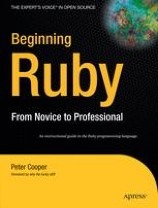
Beginning Ruby is a thoroughly contemporary guide for every type of reader who wants to learn Ruby, from novice programmers to web developers to Ruby newcomers. It starts by explaining the principles behind object-oriented programming and within a few chapters builds toward creating a genuine Ruby application.
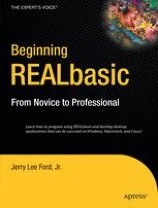
REALbasic is an easy-to-learn, powerful, cross-platform programming language, allowing you to write powerful applications that can be distributed across Windows, Mac, and Linux. REALbasic’s success is proven - there are already over 100,000 users, and this number is steadily growing. In a recent promotional effort, 35,000 Visual Basic developers downloaded a free copy of the Windows version of REALbasic, and REAL software has had many requests for decent beginning title on the subject. As far as we know, this is the only up-to-date book planned for the current version, REALbasic 2005, which matches that description. REAL software are enthusiastic about helping us sell the book.
Beginning Rails is the practical starting point for anyone wanting to learn how to build dynamic web applications using the Rails framework for Ruby. You'll learn how all of the components of Rails fit together and how you can leverage them to create sophisticated web applications with less code and more joy.
Gain a fundamental understanding of Python's syntax and features with the second edition of Beginning Python, an up–to–date introduction and practical reference. Covering a wide array of Python–related programming topics, including addressing language internals, database integration, network programming, and web services, you'll be guided by sound development principles. Ten accompanying projects will ensure you can get your hands dirty in no time. Updated to reflect the latest in Python programming paradigms and several of the most crucial features found in Python 3.0 (otherwise known as Python 3000), advanced topics, such as extending Python and packaging/distributing Python applications, are also covered
Beginning POJOs introduces you to open source lightweight web development using Plain Old Java Objects (POJOs) and the tools and frameworks that enable this. Tier by tier, this book guides you through the construction of complex but lightweight enterprise Java-based web applications. Such applications are centered around several major open source lightweight frameworks, including Spring, Hibernate, Tapestry, and JBoss (including the new lightweight JBoss Seam). This book is ideal if you're new to open source and lightweight Java. You'll learn how to build a complete enterprise Java-based web application from scratch, and how to integrate the different open source frameworks to achieve this goal.

Daraa Highway - Ghabagheb - Syria
+963-15 2050 - 15 860 380 /1/2/3 - 11 662 3900